
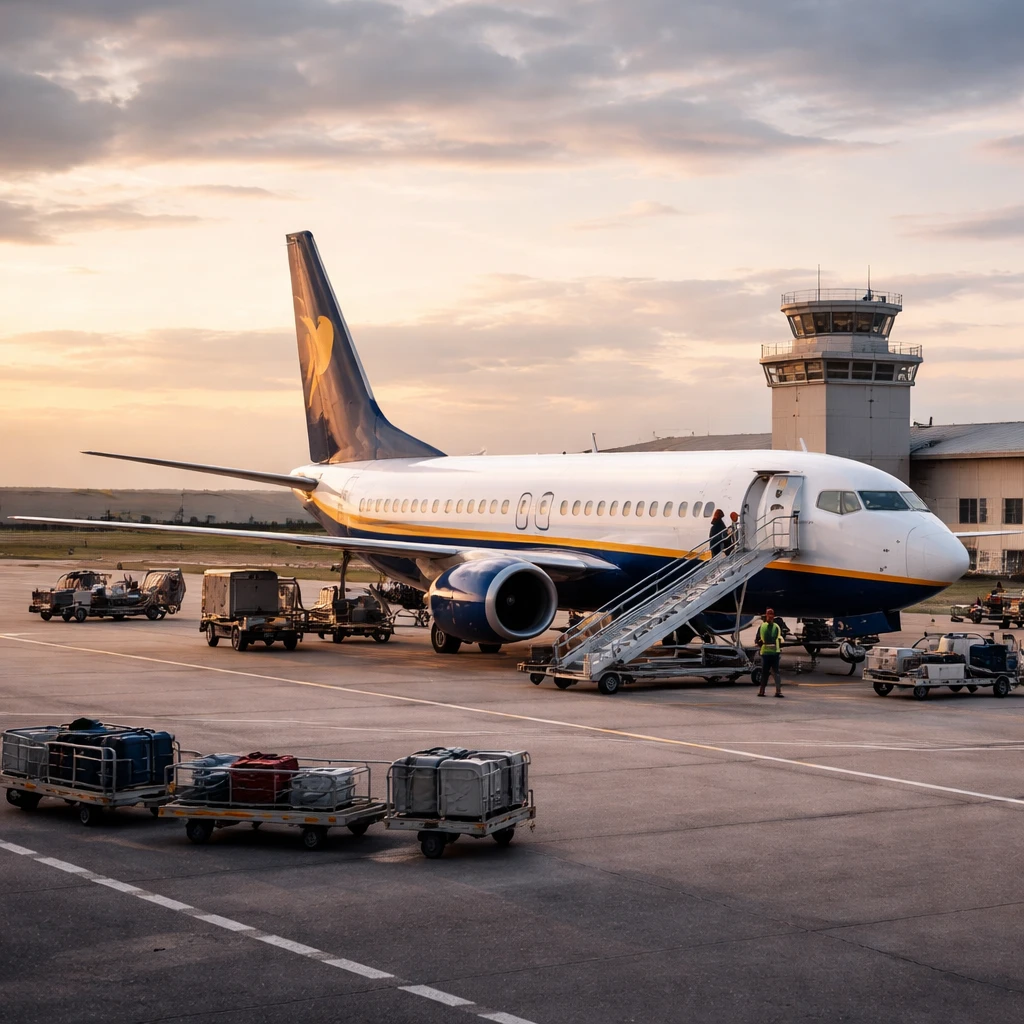
Ryanair Holdings Plc has redirected recent growth toward adding more flights on routes it already serves, a strategic adjustment that analysts at Bernstein say could nudge yields and improve unit economics without abandoning the airline's cost-focused model.
According to Bernstein, which carries an "outperform" rating and a €32 target price on Ryanair, the Irish carrier raised its average daily frequency per route from 1.0 to 1.3 over the past four years while keeping the total number of routes largely unchanged. Over that same period, group flights increased from 31 million to 38 million, and Bernstein notes that all of that additional flying was allocated to schedule density rather than adding destinations.
"Ryanair has more recently been prioritizing schedule depth, enhancing its share in its footprint and setting the company up for enhanced unit economics," the analysts said. That emphasis on frequency represents a departure from the company’s long-standing expansion model, under which it has historically added many new city pairs each year.
Despite the shift, Ryanair remains a vast operator: it serves more than 2,000 routes and operates from 95 bases across 223 airports. The carrier has tended to add between 100 and 200 new routes in a year but has trimmed a similar number, exiting some cities entirely. Bernstein points to Ryanair’s withdrawals from Dresden and Leipzig as instances where the company cited "uncompetitive airport fees and aviation taxes."
Bernstein suggests the move to denser schedules "may, at the margin, help to attract some higher-yielding traffic," but the broker stopped short of declaring Ryanair has abandoned its core cost-minimization strategy. In the analysts’ view, Ryanair continues to sit in the cost-minimizer category alongside Wizz Air, in contrast to revenue-maximizing network carriers such as British Airways and Lufthansa.
The divergence between depth and breadth in European aviation is stark. Bernstein contrasts Ryanair’s broad route map and low average frequency with carriers that concentrate flying. For example, KLM operates 93 intra-European routes at an average 6.5 flights per day, while Ryanair covers more than 2,000 routes at an average of 1.3 flights per day. The comparison highlights the extremes between schedule depth and network breadth in the region.
Within the low-cost segment, easyJet has followed a similar densification playbook, focusing capacity at slot-constrained, high-demand airports such as Gatwick, Paris, Geneva, Lisbon, and Milan to attract business travelers. Those carriers are prepared to accept higher airport charges in return for the yield benefits associated with denser schedules.
Ryanair, by contrast, remains oriented toward lower-cost secondary airports, favoring Stansted over Heathrow, Beauvais over Charles de Gaulle, and Bergamo over Milan Malpensa. Bernstein notes the carrier uses its scale to secure incentive deals at those airports. The broker also observes Ryanair’s public posture on airport economics: "Ryanair has made a point in the past of announcing when it leaves an airport due to higher fees or taxes: a direct warning to other airports," the analysts said.
Even though Ryanair flies fewer distinct city pairs than its broad footprint might imply, Bernstein finds the airline’s market position is stronger than headline route counts suggest. Ryanair’s share of intra-European seats stands at 21%, which is 6 points higher than pre-pandemic levels. Using Bernstein’s preferred metric, capacity share in non-hub cities, Ryanair’s share is 44%, up from 29% pre-pandemic and 14% in 2007.
Geographically, Italy, Spain, and the UK accounted for roughly half of Ryanair’s seats in 2025, with meaningful presence also in Poland, France, and Ireland. The analysis shows Ryanair overlaps with Wizz Air and easyJet on about 20% of Ryanair’s own city pairs but appears on 45-50% of the city pairs served by those competitors.
Bernstein’s financial projections for Ryanair include an earnings-per-share forecast of €2.09 in fiscal 2028 and €2.64 in fiscal 2029, figures that underpin the broker’s €32 target price for the stock.
Bottom line: Ryanair has shifted recent growth toward schedule density rather than network expansion. Bernstein views this as a potential driver of higher yields and improved unit economics, while the carrier continues to pursue a low-cost airport strategy and maintain its cost-minimization identity within Europe’s airline landscape.