
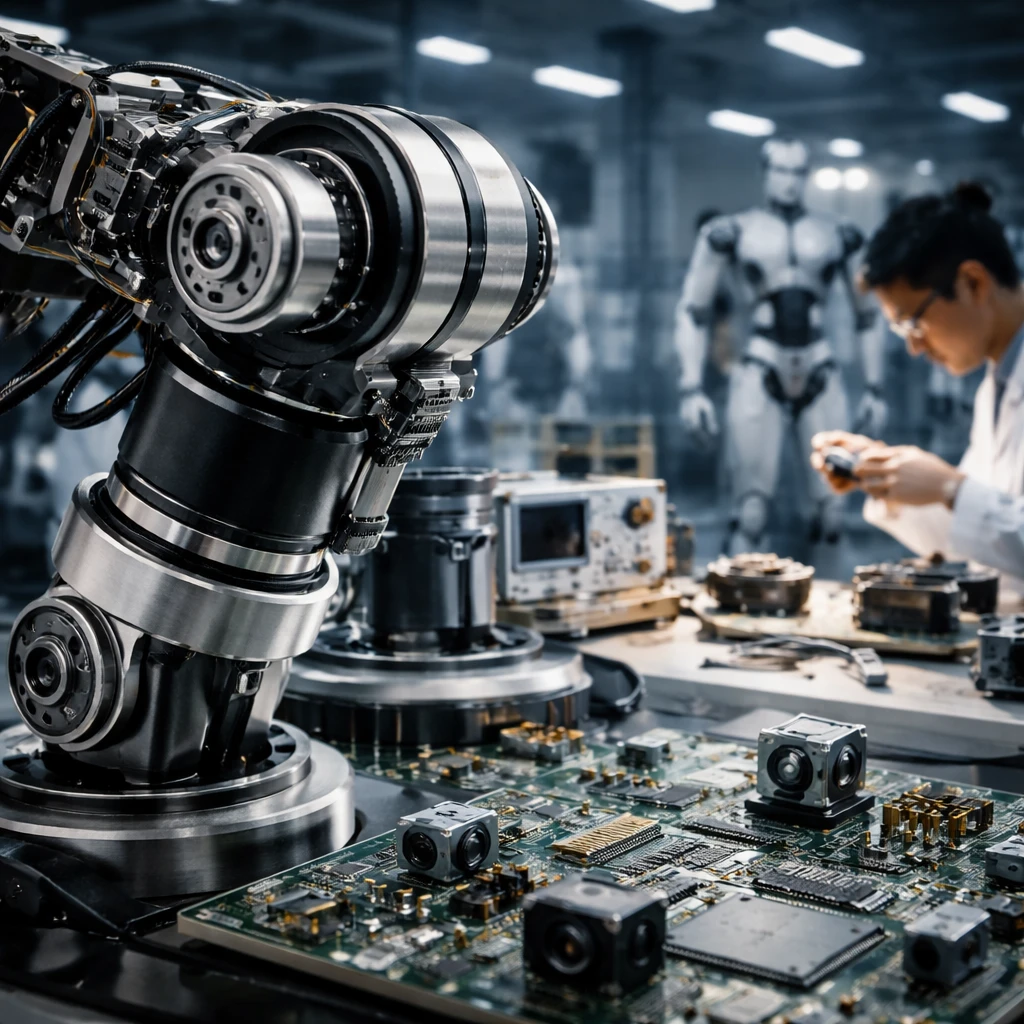
Stocks of firms that supply components for humanoid robots moved notably higher as the quarter ended, with investors rotating into specialized suppliers that provide the subassemblies found inside the competing humanoid platforms. Traders focused on the parts makers beneath the headline robot assemblers - the makers of gearboxes, motors, sensors, vision systems, edge AI processors and power electronics that ultimately sit inside the joint actuators and perception systems of humanoid machines.
Sensor and vision suppliers led some of the gains. Ouster, Cognex and Allegro Microsystems, all producers of robotic sensors, posted strong finishes on the day, closing up 15.6%, 5.9% and 4.9%, respectively. Ambarella, which produces edge AI vision processors, was among the biggest movers, surging 28%. Other companies that provide edge AI inference technology also advanced, with CEVA up 9.6% and Lattice Semiconductor up 4.2%.
Motor, gearbox and actuation names also advanced. Motor manufacturers Nidec, RBC Bearings, Regal Beloit and Ametek finished the session between 1% and 8% higher. Regal Beloit posted an 8.3% jump after Kerrisdale Capital disclosed a long position tied to the physical AI theme. Harmonic Drive Systems - a closely watched pure-play in Japan whose precision strain-wave gears are embedded in the joint actuators of competing robot OEMs - traded higher on Wednesday in Tokyo, rising 2.8%.
AI "brain" and battery suppliers moved unevenly. NVIDIA and Qualcomm, both associated with AI processing, traded in opposite directions on the day, with NVIDIA up 2.6% and Qualcomm down 2.1%. Battery maker Enersys gained 4.3%.
Power electronics strength broadened the rally. Wolfspeed jumped 9% and other power-electronics suppliers - including Navitas Semiconductor, ON Semiconductor, Monolithic Power and Texas Instruments - closed higher in a range between 1% and 7%.
The scale of these moves highlights a characteristic of the humanoid component trade: many of the suppliers sell into multiple robot original equipment manufacturers at once. That structure means that if humanoid build rates accelerate broadly, the benefit flows across the entire component tier rather than concentrating at a single assembler. A gearbox from Harmonic Drive or a motor from Nidec, for example, can be integrated into different platforms interchangeably, which both diversifies revenue risk for suppliers and magnifies potential upside if several platforms scale simultaneously.
But caution remains. Reuters reported on June 29 that "doubts are creeping in" around the broader AI trade, citing a Bank for International Settlements warning that valuations for AI and automation-linked assets may be stretched. That warning is particularly relevant for high-multiple humanoid component names whose valuation increases have been driven by expectations for a robotics adoption curve that, in many cases, sits ahead of current earnings rather than being already reflected in them.
For investors contemplating entry points, the central tension is the split between the structural demand argument for diversified component suppliers and the near-term sentiment risk tied to valuation sensitivity. On the constructive side, component suppliers are not tied to the commercial fate of any single finished-goods robot maker, which can help spread downside and concentrate upside if multiple OEMs scale. On the other side, the BIS caution and the expanded multiples on earnings expectations underline the valuation risk facing many names in this space.
Market context: The trading activity coincided with the final day of a strong quarter for broader equity markets, a period during which some major indexes experienced window-dressing. Within that environment, traders sought out specialist suppliers positioned deeper in the humanoid robotics supply chain rather than the headline robot assemblers themselves.