
Auto-repair businesses in suburban Tokyo and car dealers across the United States have been operating with sharply reduced inventories of key products such as motor oil and specialty paints for months following disruptions to Middle East shipping routes. While a preliminary agreement between the United States and Iran was reported to have been signed, industry participants and trade associations caution that the end of hostilities would not immediately replenish supplies strained by Tehran's earlier shutdown of the Strait of Hormuz.
Closure of the strait since March has restricted nearly one-fifth of global oil flows and created choke points for some petroleum-derived inputs used across the auto repair and maintenance value chain. U.S. President Donald Trump said on Monday that both countries signed a preliminary agreement to halt the war, but acknowledged details were unclear and that it could take time for shipments through the strait to return to pre-conflict levels.
For some repair-shop operators, the scarcity has already become acute. "Oil supplies were almost completely wiped out after the war started in March. Since April, nothing has been coming in," said Hiroyuki Nakamura, a director at Shin Etsu Denso, a Tokyo-based auto-repair company. Nakamura described this as the first motor oil shortage he has encountered in 35 years of repairing cars. He also reported tightness in paint thinner and diesel exhaust fluid supplies.
Nakamura and other mechanics, executives and officials who spoke for this report provided their accounts prior to news of the proposed U.S.-Iran deal. Their assessments point to several practical constraints that will delay recovery even if shipping resumes: strict regulations limiting on-site storage of petroleum products, production capacity limits at refineries and specialty chemical plants, and prior attacks on key processing facilities that reduced availability of high-grade base oils.
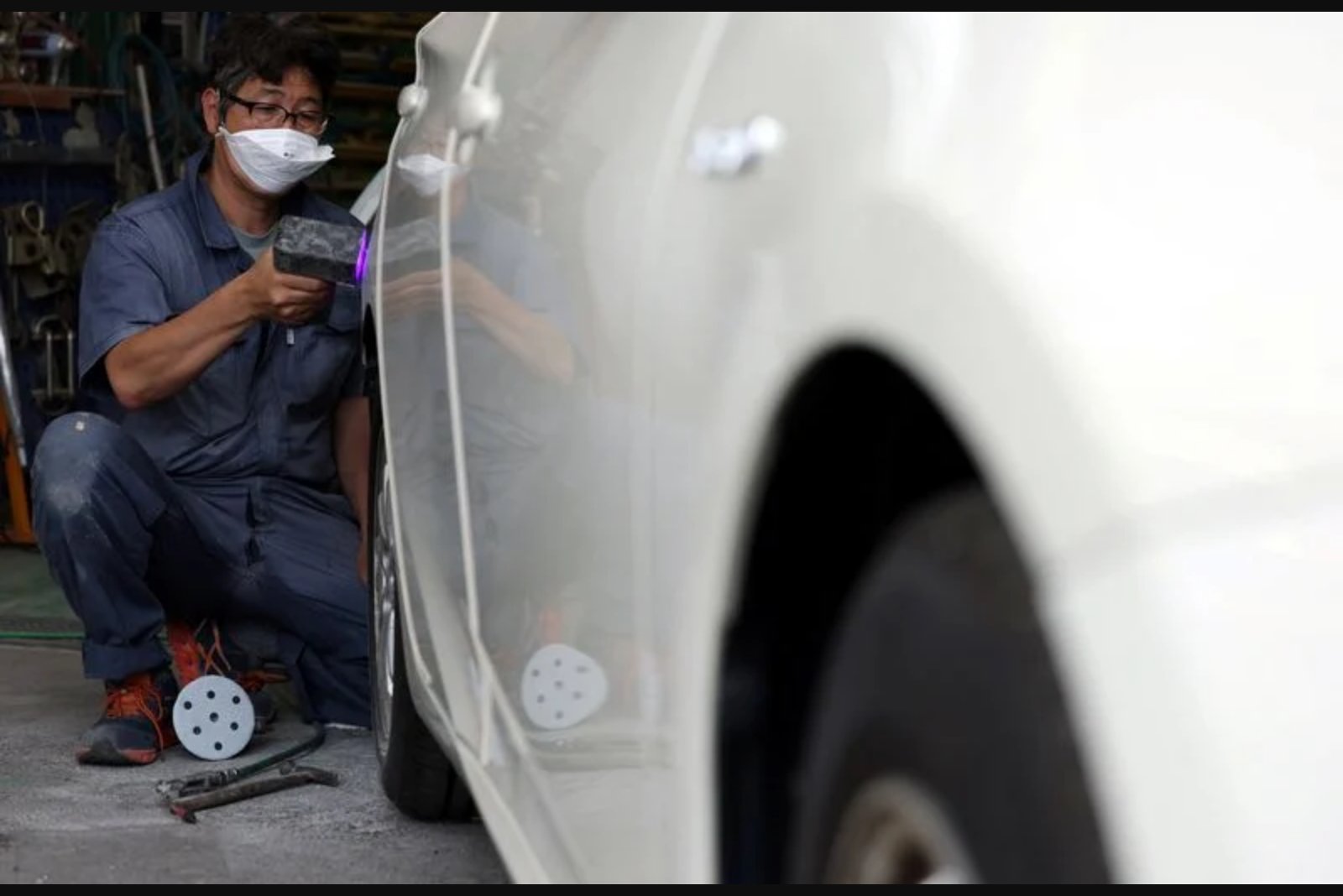
At Fuchu Car, a repair shop serving the suburbs of Tokyo, a scarcity of the popular "pearl white" finish has been particularly disruptive. Pearl white is produced by combining white base paint with a liquid gloss that yields a lustrous finish. Masato Yagai, president of Fuchu Car, said the shop recently obtained a single 300-ml bottle of the pearl finish, the first supply in about two weeks. That quantity is roughly one bottle's worth of consumption for the shop.
Faced with the prospect of running out, Yagai said he would proceed with repairs and postpone painting until supplies return, rather than turning away customers for lack of paint. "We'd complete the painting later, once supplies return," he said. Around one third of the roughly 160 cars his shop handles monthly are painted pearl white, he said.
The storage issue is a common constraint across the sector. Regulations on the storage of volatile or flammable materials make it difficult for small operators to stockpile significant amounts of petroleum-derived products such as engine oils and thinners. That leaves smaller repair shops exposed when supply chains tighten.
In the United States, Nissan Motor has implemented oil-rationing measures following supplier warnings, according to a memo sent to U.S. dealers on May 20. The company said it is working with supplier partners to identify additional sourcing. Meanwhile, a spokeswoman for the National Automobile Dealers Association said U.S. dealers were concerned about a dwindling supply of synthetic oil.
Industry groups point to upstream incidents that aggravated shortages. In March, a Shell gas-to-liquids facility in Qatar was attacked, constraining production of Group III base oil, an important input for synthetic motor oils. "As soon as the Shell facility was hit, we knew right away there was going to be a big problem," said Holly Alfano, chief executive of the Independent Lubricant Manufacturers Association. The association expects lubricant prices to remain elevated and does not foresee a return to normal pricing until at least mid-2027.
Supply problems have widened beyond engine oils. Coatings and lubricant feedstocks have been disrupted in the United States, contributing to higher lubricant costs. Paints and thinners have likewise shown signs of strain. Japan's transport ministry has begun a nationwide survey of repair shops on the availability of engine oil, paint and other chemicals, tracking volumes, delivery frequency, price movements and shortage risks, according to the Automobile Business & Culture Association of Japan.
Japan's Prime Minister Sanae Takaichi has said the government is boosting supplies of raw materials used in paints and thinners. Major paint producers, however, are likely to prioritize shipments to automakers ahead of the repair-market channels when allocation decisions are necessary, analysts say. After the conflict began, some buyers placed larger-than-usual orders with major paint makers, though the large firms have been declining such requests, UBS analyst Shunta Omura said.
Kansai Paint, one of Japan's major paint producers, operates near full capacity in normal times for both white base paint and pearl liquid, making it hard to quickly scale up production when demand spikes, said Koki Chiga of Kansai's repair paint division. Chiga added that supplies of white paint and pearl liquid had been tight for body shops earlier but had returned to normal at the time of his comments.
Another dynamic affecting smaller shops is buyer behavior driven by concerns about price increases. One industry source said some buyers sought to purchase larger quantities at current prices out of fear costs would rise. "The larger the company, the more they stockpile," the source said, noting the practice disadvantages smaller operators who cannot or do not hoard supplies.
Efforts to educate vehicle owners about maintenance intervals are also under way. The Independent Lubricant Manufacturers Association has been encouraging drivers that modern motor oils generally last longer than the 3,000- to 5,000-mile intervals commonly recommended in the past. "The quality of the motor oil is much higher now, and it lasts longer," Alfano said, suggesting some demand management can reduce near-term pressure on supplies.
For now, however, smaller repair shops appear to be absorbing most of the strain. Major paint and lubricant manufacturers are more likely to allocate constrained volumes to original equipment manufacturers and larger customers, leaving independent shops and regional dealers to cope with limited deliveries and tighter schedules. Even if a deal between the United States and Iran stabilizes shipping through the Strait of Hormuz, the combination of storage rules, production capacity limits and prior facility damage means relief for smaller operators may be delayed.
Summary
Auto-repair shops in Japan and U.S. dealers have endured months of shortages in motor oil, paint and related products after disruptions to Middle East shipping routes. Although a preliminary U.S.-Iran agreement was reported, industry experts say supply restoration for smaller repair shops will not be immediate due to storage limitations, production constraints and damage to key processing facilities.
Key points
- Small repair shops and some U.S. dealerships face persistent shortages of motor oil, specialty paints and thinners caused by disruptions to Strait of Hormuz shipments.
- Production constraints and damage to facilities producing Group III base oil have tightened supplies for high-grade synthetic lubricants, pushing lubricant prices higher through at least mid-2027, according to industry groups.
- Regulatory limits on storage and preferential allocation by major suppliers to automakers favor larger companies and leave smaller shops more exposed to supply volatility.
Risks and uncertainties
- Timing risk - Even if hostilities cease, logistical and production bottlenecks mean shipments and product availability may take significant time to normalize, affecting repair and maintenance operations.
- Allocation risk - Major paint and lubricant producers are likely to prioritize automakers and large customers, which could prolong shortages in the independent repair market and impact regional dealers.
- Price and substitution risk - Rising lubricant and coating costs, and the potential for buyer stockpiling, may force smaller businesses to delay services or seek less optimal product substitutes, with operational consequences.
Tags: auto, lubricants, paint, supply, Japan