
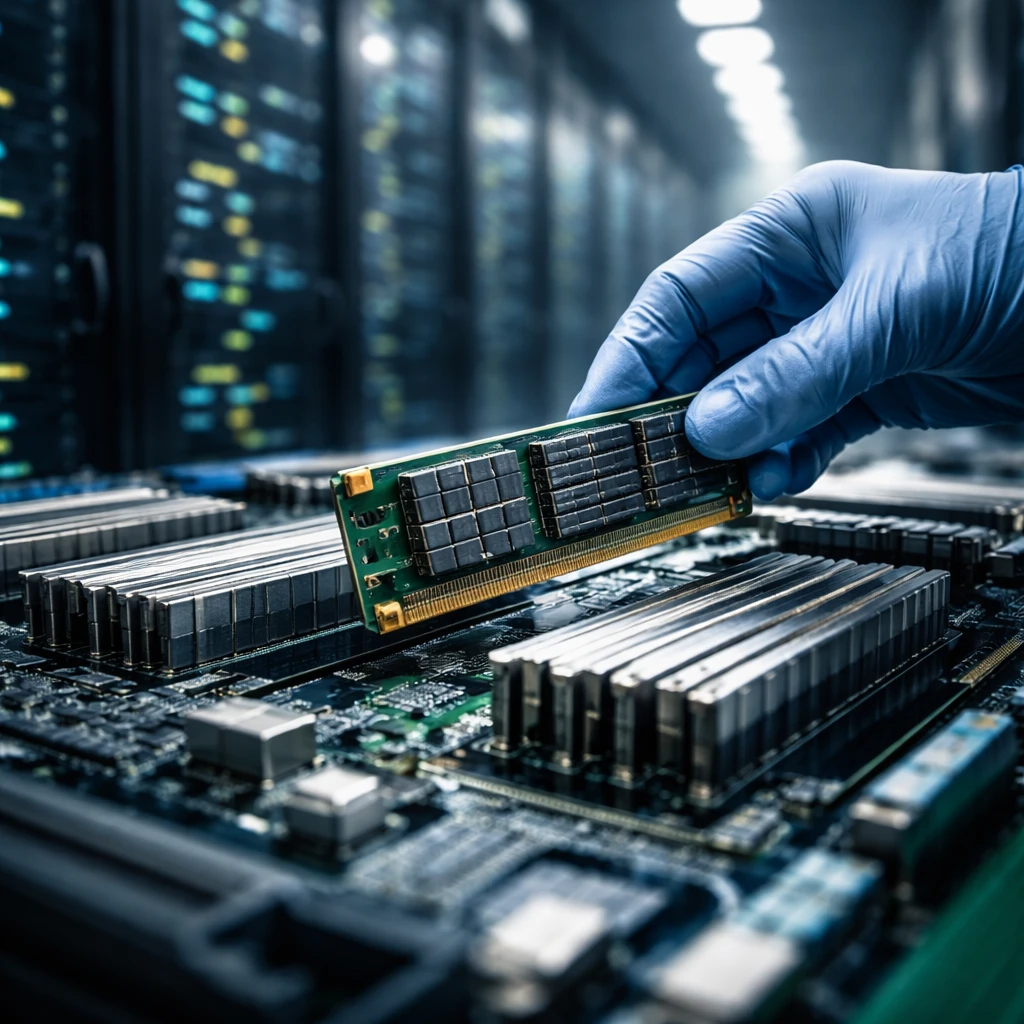
Citi's research team is flagging a sustained structural change in AI development as a major driver for memory markets, forecasting that the rise of continual learning - where models are repeatedly retrained on new tasks and retain previously learned information - will push memory consumption sharply higher across multiple product categories.
At the center of Citi's forecasts is heavy demand for HBM (high-bandwidth memory) used in training, and increased need for server DDR5 and enterprise SSDs (eSSDs) to support AI inference and storage of retained knowledge. The bank predicts the imbalance between demand and supply will persist for years.
HBM forecasts from Citi are aggressive: the firm expects bit demand to climb 62% year-over-year to 75.2 billion gigabits in 2027, then to rise a further 69% year-over-year to 127.0 billion gigabits in 2028. These projections stand despite attention to HBM de-spec and recent AI safety discussions that have attracted market scrutiny.
For DRAM, Citi models steep growth tied to simultaneous needs for server DDR5 and HBM. The bank forecasts global DRAM demand expansion of 30% year-over-year in 2027 and 35% year-over-year in 2028. On the supply side, Citi anticipates limited expansion, with supply growth of 19% in 2027 and 22% in 2028. That leaves projected supply-demand ratios of negative 8.7% in 2027 and negative 9.7% in 2028, implying undersupply.
NAND eSSDs are expected to see similarly strong demand as firms retain previously learned AI data that requires large, persistent storage footprints. Citi forecasts NAND demand growth of 29% year-over-year in 2027 and 33% in 2028, outstripping expected supply growth of 21% and 25% in those years. The firm projects NAND supply-demand ratios of negative 6.1% in 2027 and negative 5.5% in 2028, citing a shift of investment toward DRAM and HBM capacity at the expense of NAND.
Against that backdrop, Citi lists five memory suppliers it views as best positioned to capture the opportunity:
- Samsung Electronics - Citi expects Samsung to benefit from persistent memory tightness driven by continual learning and the potential rise of personal AI. The firm notes recent corporate actions including Samsung's rejection of a proposed advance payment from Korea Electric Power Corp related to power infrastructure for planned semiconductor facilities, and Samsung's launch of the Galaxy S26 FE smartphone.
- SK Hynix - Citi sees SK Hynix as well placed to gain from structural demand growth in both HBM and server DDR5 markets. The company has started construction on a $4 billion advanced memory packaging plant in Indiana. Separately, Bernstein research referenced weaker-than-expected results in Korea's July semiconductor export data for the company.
- Micron - Citi expects Micron to benefit as DRAM undersupply intensifies through 2028. Recent developments for Micron cited by the bank include an upgrade by S&P Global Ratings to 'BBB+' with a positive outlook, and Micron's plan to invest $10 billion in a new research lab in Idaho.
- Sandisk - Citi projects Sandisk will be a beneficiary of growing demand for high-density eSSDs, driven by the need to retain previously acquired AI data under continual learning regimes.
- Kioxia - Citi expects Kioxia to gain from tighter NAND supply and expanding storage requirements. Kioxia's CEO has indicated the company will not pursue closer manufacturing ties with SK Hynix due to antitrust concerns, and has stated an objective to avoid further increases in memory chip prices.
The bank's outlook implies a prolonged period of constrained supply relative to demand, with Citi projecting that the structural shift to continual learning could sustain higher memory consumption through 2031. That scenario would support elevated utilization for HBM, server DDR5, DRAM and high-density NAND, according to the firm's analysis.
Citi's forecasts are clear about the mechanics: continual learning requires both frequent model updates and ongoing access to previously learned data, increasing demand for memory capacity across training and inference workflows. The bank expects suppliers to reallocate investment toward DRAM and HBM greenfield capacity, which would further tighten NAND availability and exacerbate storage shortages absent new NAND-focused capacity additions.
The implications for hardware markets, cloud operators and enterprises using AI for inference are evident in Citi's projections. With DRAM and HBM capacity tightening, suppliers that can expand packaging and advanced memory production stand to capture premium demand, while providers of persistent storage face pressure if NAND expansion lags.
Investors and industry participants should note that Citi's analysis centers on modeled demand curves and supply-growth assumptions; the forecasts include explicit figures for bit demand, growth rates and supply-demand ratios for HBM, DRAM and NAND through 2028. The precise evolution of supply additions and customer adoption of continual-learning architectures will determine how the market balances over time.