
November's pullback in AI-related equities has widened beyond chipmakers and software firms to touch the providers of power for data centers. Over the past month, Dell Technologies has declined 28.4% and Palantir Technologies has lost 15.8%. Political developments have added to the uncertainty: 40 of 41 local ballot measures aimed at restricting data centers passed, introducing new regulatory noise for the sector.
Fuel-cell specialist Bloom Energy, often positioned by traders as a provider of rapid, off-grid power for AI facilities, has seen a notable retreat. Its share price fell 21.6% over the past month to $173.46, including a 17.2% plunge during the most recent week. That drop follows a period in which the company has reported fast revenue growth and expanding operating margins but has continued to generate negative free cash flow.
Why Bloom's product model matters
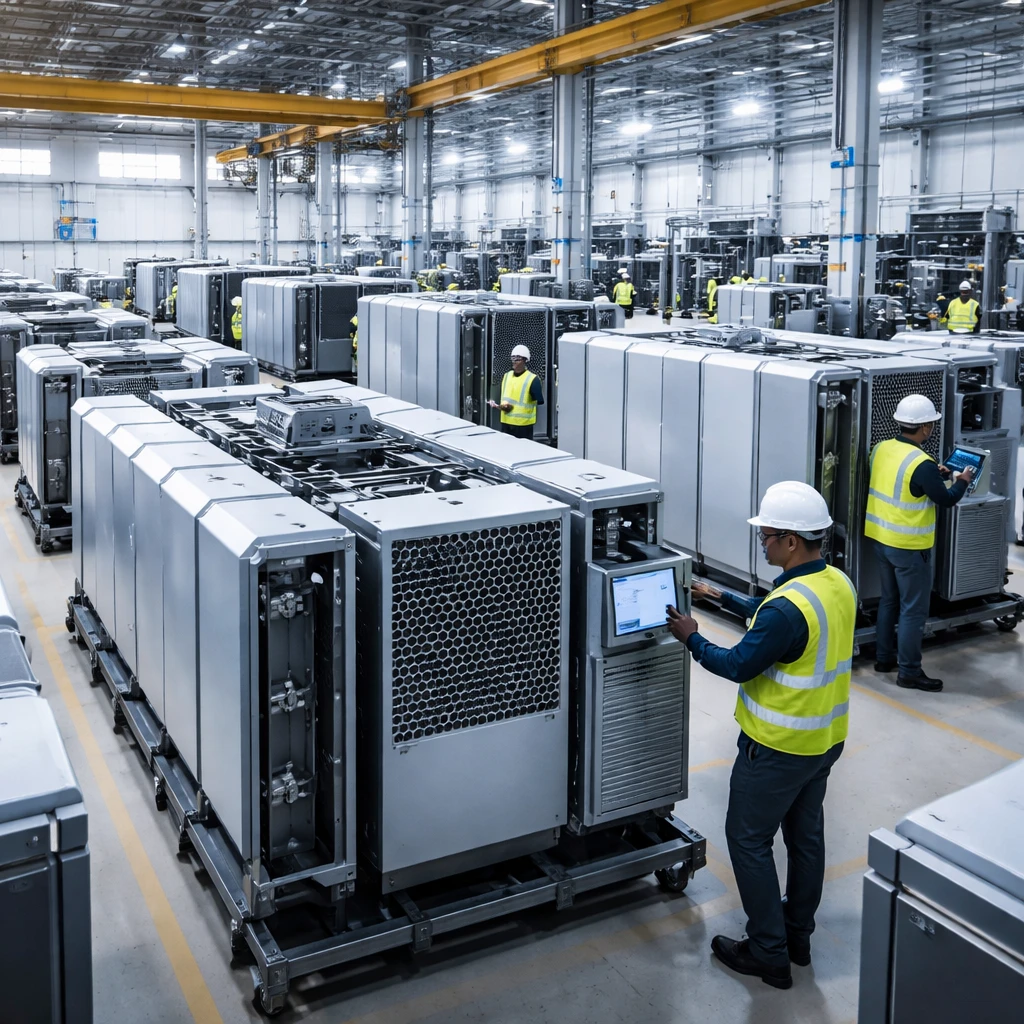
Bloom's commercial pitch centers on speed-to-power. The company sells on-site solid oxide fuel cell servers that can be deployed in under 90 days, a contrast to grid-tied projects that may take years to complete. Product sales now make up 87% of total revenue, and the production team that once delivered roughly 100 megawatts per year is operating at a much larger footprint as the business approaches 5 gigawatts of annual capacity.
Third-quarter results showcased those operational gains. Revenue rose 138% year-over-year to $1.24 billion, beating the $1.06 billion consensus by 17%. Non-GAAP earnings per share were $0.94, outperforming the $0.69 estimate by 36%. Product revenue exceeded $1 billion in a single quarter for the first time. Operating income climbed to $286 million, and operating margin widened to 23.1% from 8.9% a year earlier.
Management upgraded full-year guidance for the third time this year, forecasting revenue of $4.4 billion to $4.6 billion and raising non-GAAP EPS guidance to $3.10 to $3.40, above a prior consensus of $2.94. According to management commentary, Bloom began 2026 with guidance implying 60% revenue growth and now expects more than 120% growth at the midpoint. Contract announcements included a 702-megawatt scope tied to Google's $17 billion Wyoming data center and a 900-megawatt agreement with NTT DATA, the company's largest international contract to date.
Valuation and analyst views
Wall Street is divided between Buy and Hold opinions, with most recent price targets sitting above the current market price. Mizuho has a Buy rating with a $351 target, Morgan Stanley's target is $335, and JPMorgan's is $292. Citi maintains a Hold at $284 while Wells Fargo's target is $182. The median analyst target stands at $283.85. Over the last 90 days, 17 analysts have raised EPS estimates with no downward revisions recorded. Consensus EPS projections call for $3.57 in fiscal 2026, $6.04 in fiscal 2027, and $8.33 in fiscal 2028.
By contrast, InvestingPro's valuation framework adopts a more conservative stance. Its Fair Value model places intrinsic value at $126.71 per share, which is 27.0% below the then-current market price and substantially under the Street's median target. The shares also trade at 98.9 times trailing earnings, underscoring the high multiple investors are paying for expected growth.
Cash flow and capital intensity
Despite robust revenue gains and improving operating profitability, Bloom's cash flow profile remains a central concern. Free cash flow in the third quarter was negative $181 million. Operating cash flow moved into negative territory at negative $27 million as inventory, contract assets, and receivables built up while the business scales. Capital expenditures totaled $153 million for the quarter, bringing year-to-date capex to $231 million, a level the company described as roughly four times what it spent in all of 2025.
Management acknowledged that working capital needs will continue to climb as Bloom expands. Gross margin guidance was maintained at about 34% even after raising revenue forecasts. The contrast between improving operating margins and continuing negative free cash flow prompted an 8.7% share price decline on the day the earnings were released.
What the market must see
The investment case for Bloom hinges on whether rapidly growing demand from hyperscalers and other customers converts into positive free cash flow with predictable working-capital dynamics. The company has demonstrated the ability to secure large contracts and scale production, but the stock's valuation still assumes near-flawless execution over the coming years.
Investors weighing Bloom as an AI power play must balance the company's speed-to-power advantage against persistent cash consumption and a valuation that leaves little margin for error. Political opposition to data center expansion — exemplified by the passage of local measures restricting facilities in many jurisdictions — adds an additional layer of uncertainty for future demand timing and project approvals.
Portfolio positioning and strategy signals
Bloom was omitted from InvestingPro's Energy Elite strategy, which concentrates on energy leaders that convert demand into durable cash generation. In a similar vein, the Tech Titans strategy also excluded Bloom, instead holding cash-generating refiners and pipeline assets. The firm emphasizes data-driven screening of balance sheets to identify energy companies turning steady demand into reliable free cash flow.
For market participants evaluating high-conviction ideas in the current market environment, the decision to include Bloom in a portfolio will depend on confidence that gross margins, backlog conversion rates, and working-capital trends align with management's targets and analyst expectations. Until those elements consistently produce positive free cash flow, the market's more conservative valuation frameworks will likely cap upside for the equity.
Conclusion
Bloom Energy's recent operating performance highlights how quickly a manufacturing and project-based business can scale while improving unit economics. Yet scaling has come with a working-capital bill that has pushed free cash flow negative even as revenue and operating margins advance. The stock's sell-off in November leaves it priced between bullish analyst targets and conservative fair-value models, and the path to a clear investment case depends on converting high growth into cash flow stability while political and permitting risks for data-centers settle.
Note: Share price, performance, P/E, revenue growth forecast, and Fair Value are reported as of November 18, 2026; financial metrics and analyst data are reported as of November 13, 2026.