
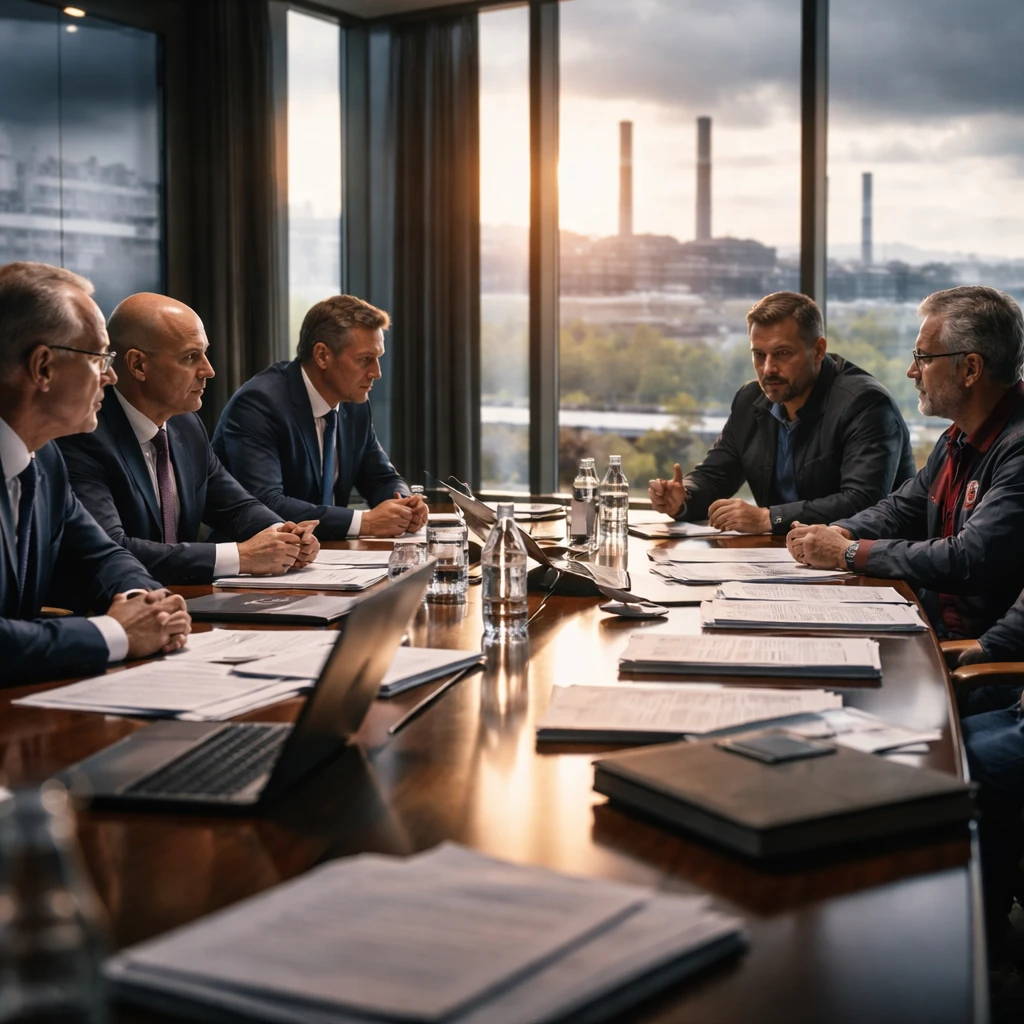
In an intense meeting at Volkswagen’s Wolfsburg headquarters, three top figures in the company negotiated a fragile compromise designed to prevent a protracted power struggle that threatened to escalate into a costly, years-long legal fight. CEO Oliver Blume, Supervisory Board Chairman Hans Dieter Poetsch and Lower Saxony state premier Olaf Lies met alongside labour representatives to hammer out a turnaround framework after management signalled it was prepared to call an emergency general meeting (EGM) to press through historic job reductions.
The package agreed by the supervisory board later that week represents the most extensive restructuring Volkswagen has pursued in its 89-year history. It gives the company a path to pursue deep cost cuts while averting an immediate clash between major stakeholders - notably the supervisory board, where unions and the Lower Saxony state hold significant sway, and the management board advocating rapid change.
What precipitated the deal
According to four people with direct knowledge of the discussions, the management board had consolidated around a hardline position a day before the Wolfsburg meeting. Management made clear it was serious about convening an EGM that could bypass the supervisory board to approve job cuts and separate certain divisions into distinct legal entities - a step that would have rebalanced influence among shareholder blocs.
Those sources said the threat to use that so-called "nuclear option" - an extraordinary move that would have overridden the supervisory board - created urgency to find a compromise. The participants reckoned that the fallout from failing to agree would be worse than the consequences of the proposed workforce reductions, with legal challenges potentially dragging on for years and inflicting heavier damage than the restructuring itself. "The damage would have been unimaginable if there hadn’t been a solution," one of the four individuals said.
How the agreement is structured
Under the deal, Volkswagen obtained supervisory board approval to pursue substantial job cuts while effectively delaying plans to set up separate legal units for its passenger car and components operations. That postponement matters because creating separate legal entities would have diminished the influence of Lower Saxony, Volkswagen’s significant regional shareholder, prompting its resistance.
The arrangement emerged only after rapid consultations, including an initial meeting of top stakeholders in Hanover the day before, and direct involvement from labour leaders during the Wolfsburg talks. The group convened Daniela Cavallo, head of Volkswagen’s works council, and Christiane Benner, deputy chair of the supervisory board and head of IG Metall, to align labour representatives with the supervisory board’s position on the turnaround package, according to the people briefed on the negotiations.
Resistance from unions and the state
The compromise came despite forceful public opposition from IG Metall, Germany’s largest union, which in the days prior vowed to fight any job reductions "with all our might." Lower Saxony, Volkswagen’s second-largest shareholder, had also opposed an earlier plan to eliminate 50,000 jobs and objected to the restructuring measures that would reduce its influence.
CEO Blume had previously lost a vote on a similar initiative in July. That context underlined the stakes: management was determined to cut costs and streamline the company as it faces margin pressure from Chinese competitors and tariffs imposed by U.S. President Donald Trump. The automaker employs more than 650,000 people globally and has publicly framed cuts as necessary to improve efficiency and preserve competitiveness.
Immediate market and corporate reaction
By Thursday morning, the supervisory board meeting was brought forward by a day and the board voted unanimously in favour of the turnaround plan, surprising investors. The shares, which the article notes trade at roughly a quarter of their value from five years ago, rose following the decision.
Spokespeople for the supervisory board, the works council and Lower Saxony declined to comment on the specifics of the negotiations.
Unresolved implementation questions
Even with the supervisory board’s backing, the vote does not end the process. The board-approved framework still requires negotiations with unions to translate workforce reductions into enforceable agreements. Those talks could produce strikes at Volkswagen plants across Germany if labour leaders reject the company’s proposals.
The company also faces ongoing external pressures that the restructuring does not eliminate: competition from Chinese producers and the challenge of U.S. tariffs remain. One of the sources involved in the talks stressed that uncertainty will persist until Volkswagen’s executive board presents detailed, concrete plans for how the cuts and other measures will be executed.
Factory futures remain unsettled
The fate of four German factories - Emden, Zwickau, Neckarsulm and Hanover - remains unclear. The article indicates potential avenues for maintaining operations at those sites after production is scaled down over the next decade could include redeployment into new sectors or outright sales, but no specific plans were finalized in the deal. Any decisions on these plants will be consequential for local economies and for the company’s capacity footprint in Europe.
Context among legacy automakers
The article notes that global legacy automakers are already undertaking restructurings: some have reconfigured capacity or sold factories, while others are postponing model investments. Volkswagen’s board emphasized the need to reduce production capacity in Europe to align with market realities and regain margin stability.
Next steps and outlook
Management must now move from headline commitments to detailed proposals. The supervisory board’s approval opens the door, but the company must still reach terms with unions and implement changes that will likely reshape its European footprint. The trustees of the deal - including senior executives, the works council and IG Metall - will play decisive roles in negotiating the next phase of the restructuring.
"The uncertainty will remain," one source said. "And it will only disappear once (Volkswagen’s) executive board quickly presents concrete plans."
In short, the Wolfsburg talks produced a deal that avoided an immediate institutional clash and granted Volkswagen the authority to pursue deep cost reductions. The long-term outcome, however, depends on complex negotiations with labour, the precise handling of factory transitions, and whether the company can translate the supervisory board’s mandate into timely and effective operational changes.