
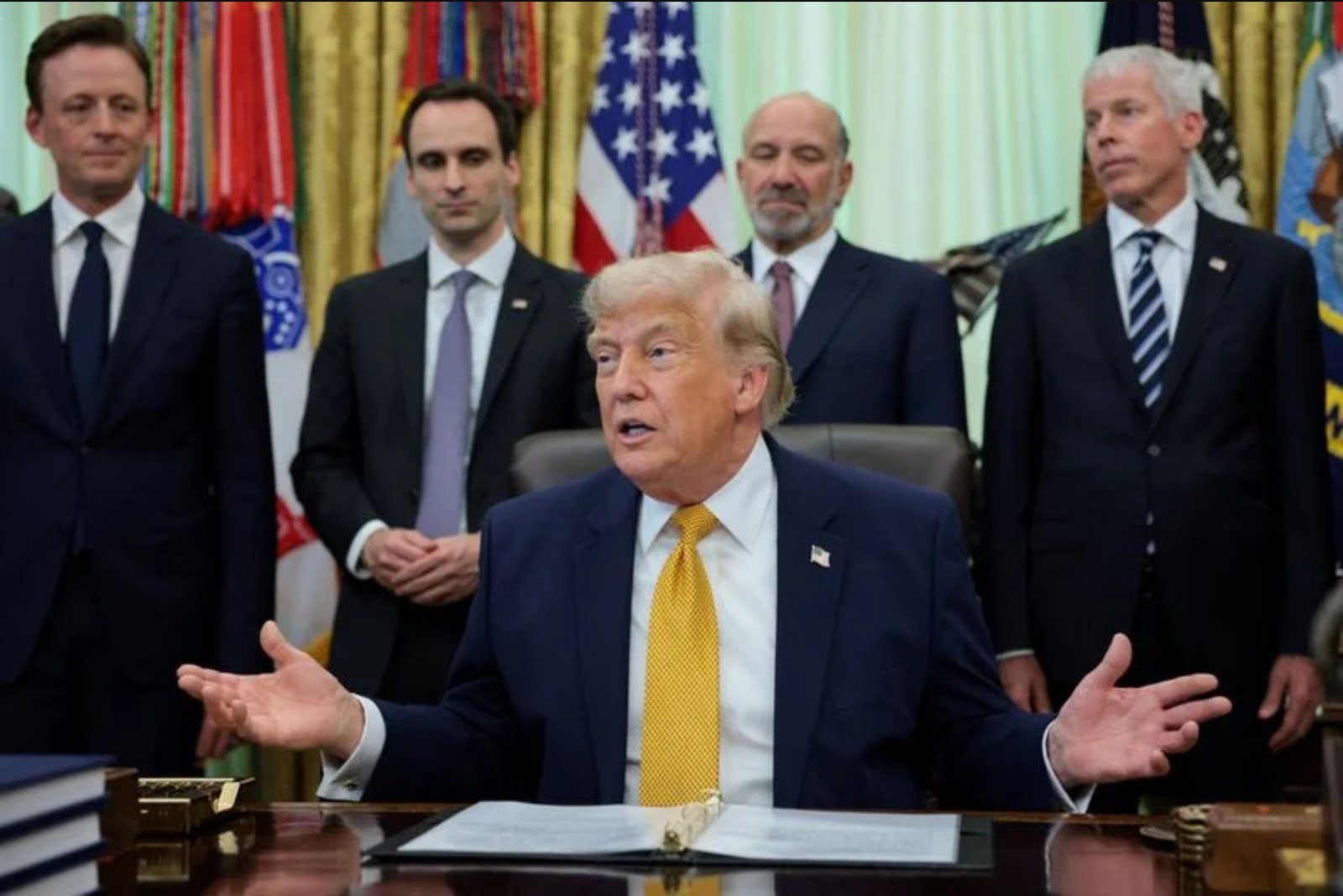
President Donald Trump signed two executive orders on June 22 that direct U.S. government efforts to develop a powerful quantum computer for scientific research and to harden federal information systems against the cybersecurity risks posed by such machines.
Michael Kratsios, director of the White House Office of Science and Technology Policy, said in a call previewing the moves that the administration believes the quantum computer goal "can happen by 2028." The orders lay out a timetable for both offensive research ambitions and defensive preparations across federal agencies.
One of the executive orders sets an objective for the federal government to migrate key government computing systems to post-quantum cryptography by 2030 or 2031. Quantum computers exploit quantum physics to process information in ways that can solve specific, complex problems much faster than today’s leading supercomputers. That capability raises the prospect that quantum machines could break current encryption schemes, creating heightened concern about cyberattacks that leverage quantum-enabled codebreaking.
The orders emphasize the administration’s focus on maintaining U.S. leadership in quantum technology amid strategic competition with China. The technology is framed as having the potential to accelerate advances in areas such as artificial intelligence, materials science and chemistry, while simultaneously creating new cybersecurity vulnerabilities that the government must address.
In a recent move related to the strategy, the Commerce Department announced last month that it would take $2 billion in equity stakes across nine quantum-computing companies, including investment in a new IBM venture. That initiative sits alongside the executive orders as part of a broader push to marshal public and private resources toward quantum research and commercialization.
Another component of the executive package directs agencies to bolster international cooperation around intellectual property protections and to implement supply chain security measures, actions Kratsios said are needed in light of "competitors and adversaries looking to undermine US economic and national security." The orders also instruct agencies to prepare plans for deploying quantum-enabled sensors and networks within the next five years, signaling an emphasis on near-term applications as well as longer-term computing goals.
The combined measures pair an ambitious research timeline with concrete defensive and cooperative elements designed to secure both technological leadership and the resilience of government systems against emerging quantum threats.
Key points
- Administration aims to build a powerful quantum computer for scientific research with a goal of achieving this by 2028.
- Executive orders set a government goal to migrate key systems to post-quantum cryptography by 2030 or 2031 and task agencies with plans to deploy quantum-enabled sensors and networks within five years.
- Orders include measures to strengthen international cooperation on intellectual property and supply chain security; the Commerce Department recently announced $2 billion in equity stakes across nine quantum firms, including a new IBM venture.
Sectors likely impacted: technology, cybersecurity, defense, materials science, government IT procurement
Risks and uncertainties
- Timeline uncertainty - the target to realize a "powerful" quantum computer by 2028 and full migration to post-quantum cryptography by 2030 or 2031 may face technical and implementation challenges.
- Cybersecurity exposure - quantum capabilities pose a risk to existing encryption protecting government and private systems, creating potential vulnerability for sectors reliant on secure data.
- Supply chain and IP threats - international competition and adversarial actions could undermine economic and national security, prompting the need for strengthened protections.