
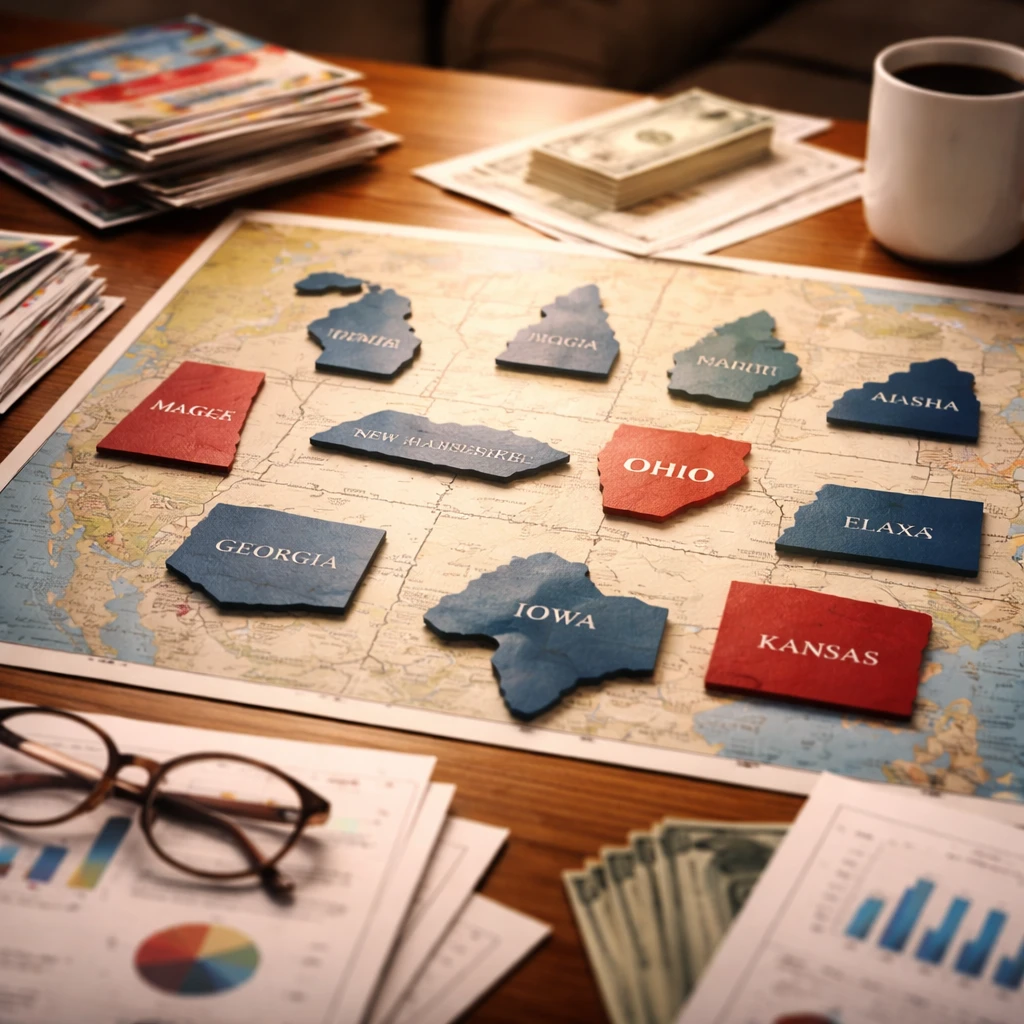
The U.S. Senate is controlled by Republicans 53-47. For Democrats to win a majority in November’s midterm elections, they must flip multiple seats - including at least two in states that President Donald Trump carried by double digits in 2024. As Election Day approaches, several contests have tightened or shifted from long-shot to competitive, giving Democrats a credible opportunity to change the balance of power in the chamber.
How Democrats can get to 51
Democrats face a two-fold challenge: protect the seats they already hold and capture Republican seats in states where Trump had large margins in 2024. The party’s offensive and defensive priorities are reflected in the slate of races now viewed as decisive.
GEORGIA
In Georgia, Democrats’ priority begins with holding incumbent US Senator Jon Ossoff. Protecting that seat is central to any path to a Democratic Senate majority. Trump won Georgia by 2 percentage points in 2024, and Ossoff’s campaign has been a major fundraising success.
Ossoff raised $98 million through June 30 and entered July with nearly $43 million on hand. His Republican opponent, US Representative Mike Collins, reported $7.4 million raised and $2.1 million on hand. Campaigns are required to file quarterly fundraising reports this week, which will disclose receipts and cash on hand for July through September and provide an updated picture of resources entering October.
Recent polls have shown Ossoff holding a double-digit lead over Collins. Outside spending so far has tilted marginally in Republicans’ favor overall in the race, with Republicans outspending Democrats $17 million to $15 million, but Ossoff’s substantial campaign treasury may overwhelm that advantage.
MICHIGAN
Michigan represents another critical front for Democrats. The party’s strategy in this state hinges on nominating and backing a progressive outsider who can both energize the base and compete statewide. In the Democratic primary, progressive Abdul El-Sayed narrowly defeated the establishment-backed moderate US Representative Haley Stevens, clinching the nomination to run for an open Senate seat.
Trump carried Michigan by 1 point in 2024. El-Sayed faces former US Representative Mike Rogers in what could be the cycle’s tightest race for a seat Democrats currently hold. Rogers recently released a 30-second advertisement that included the line that Canada is not America’s enemy and a narration urging an end to the tariff conflict: "We need to end this tariff war," followed by "Now!"
Prominent Democrats have campaigned with El-Sayed: former Vice President Kamala Harris has appeared on the trail with him, and former President Barack Obama is scheduled to hold a rally in support later this month. Polling averages show El-Sayed with leads in the range of 1 to 7 points.
Spending dynamics favor Republicans so far: they have invested $86 million in Michigan’s Senate contest, more than double the $41 million spent by Democrats.
NEW HAMPSHIRE
Another open-seat contest for Democrats is in New Hampshire, a state President Harris won by nearly 3 points in 2024. Democratic US Representative Chris Pappas is the nominee seeking to hold the seat for his party, while former US Senator John Sununu is the Republican contender. Sununu was previously defeated by Democrat Jeanne Shaheen in 2008; Shaheen is retiring from the seat.
Pappas has outpaced Sununu in fundraising, reporting $15 million raised versus $4 million for Sununu, and carries a roughly $1 million cash-on-hand advantage. Republicans have aimed to close the financial and name-recognition gaps by investing heavily: outside Republican spending in the race totals $25 million compared with $12 million from Democrats.
Recent polls have shown Pappas maintaining a steady lead of between 5 and 8 points.
MAINE
Maine is one of the most consequential offensive opportunities for Democrats. It is the only state in which a Republican incumbent is standing for reelection while having been carried by President Harris in 2024; Harris won Maine by nearly 7 points. The incumbent is Senator Susan Collins, who has taken pains to distance herself from Trump, declining to campaign in Maine with the president or with Vice President JD Vance.
Collins acknowledged during a debate that she is not the president’s preferred senator and indicated he will not be campaigning in the state. She also played a role in advancing Republican legislative priorities despite some opposition; her record, including a vote that helped confirm Brett Kavanaugh to the US Supreme Court which preceded the overturning of a federal right to abortion, is a point Democrats hope to leverage against her.
Democrats experienced turmoil in nominating a challenger. The party’s initial nominee, progressive Graham Platner, withdrew following sexual assault allegations that he has denied, prompting the state Democratic Party to conduct an expedited process to select a replacement. Former Maine Senate President Troy Jackson surfaced as Platner’s replacement, but entered the race later in the cycle without campaign funds at the outset of his campaign.
Fundraising and cash positions favor Collins. Even though Platner had outraised Collins during his campaign, Collins reported $11 million in cash, a total that Jackson was significantly behind when he began fundraising. Outside spending in the state leans toward Republicans: more than $50 million has been spent to support the incumbent, nearly double the $26 million devoted by Democrats. Despite these disparities, recent polling gives Jackson a 4-point lead.
NORTH CAROLINA
Republicans appear to have deprioritized North Carolina, shifting resources elsewhere after altering their view of the state’s competitiveness. A top Republican super PAC has redirected funds to Kansas, a state that only recently became competitive. The seat is open after Republican US Senator Thom Tillis, who had been critical of Trump, chose not to run for reelection.
Democrats recruited former North Carolina Governor Roy Cooper as their candidate, while Republicans nominated Michael Whatley, the former chair of the Republican National Committee. Cooper has demonstrated a commanding fundraising advantage, raising $35 million and entering the later stages of the campaign with $21 million on hand. Whatley reported $11 million raised with $3.5 million in cash.
Despite Republicans outspending Democrats overall in North Carolina - with $45 million in spending compared with Democrats’ $26 million - Cooper has led consistently in polls through September and into October, sometimes by double-digit margins. Trump won North Carolina by 3 points in 2024.
OHIO
Ohio is among four battleground states that Trump carried by double digits in 2024 and thus is central to Democrats’ strategic calculus: Democrats need to win at least two such double-digit Trump states to capture a Senate majority.
The Democratic nominee in Ohio is former US Senator Sherrod Brown, who lost his seat last cycle to Republican Bernie Moreno. Brown is now running to reclaim a Senate seat and faces US Senator Jon Husted, who was appointed to fill the vacancy left when Vance departed for the White House. The victor in the special election will serve the remainder of Vance’s term, which expires in January 2029.
Brown has raised $39 million and held $16 million in cash. Husted reported $14 million raised with $9 million on hand. The race has become one of the costliest Senate contests nationally, with outside spending exceeding $200 million; Republicans account for $143 million of that outside spending total. Polls have shown both candidates leading at different times in this toss-up contest.
ALASKA
Alaska is another double-digit Trump state at risk for Republicans. Trump plans to hold an event in the state, which he won by 13 points in 2024. The contest pits incumbent Republican Senator Dan Sullivan against former US Representative Mary Peltola.
Alaska’s ranked-choice voting system complicates the arithmetic, as voters rank multiple candidates in order of preference rather than selecting a single candidate. Voters will be able to rank up to four choices, including Sullivan and Peltola. The presence of another candidate named Dan Sullivan has been characterized by Republicans as a potential decoy designed to confuse voters.
Fundraising has favored Peltola on a total-raised basis, as she has outraised Sullivan by $7 million, but the incumbent reports a cash advantage of $2.7 million. Outside spending has been larger on the Republican side, with $28 million spent compared with $21 million by Democrats. Recent polls show Peltola either tied with or leading Sullivan.
IOWA
Iowa’s political environment has grown more competitive for Republicans amid public concerns over Trump’s popularity, tariff policy and the war in Iran. Trump carried Iowa by 13 points in 2024. Republican Senator Joni Ernst’s decision not to seek reelection opened the seat to an intense contest between Republican US Representative Ashley Hinson and Democratic State Representative Josh Turek, who is a two-time Paralympic gold medalist.
Hinson has urged a quick end to the Iran war, posting that Iowans should not shoulder costs at the pump or at the checkout, but she has opposed Democratic resolutions in the House calling for an end to the war. Fundraising advantages currently lie with Hinson; she reports a $4 million advantage in both fundraising totals and cash on hand over Turek. Outside spending by Republicans stands at $51 million compared with $42 million by Democrats. Polling in Iowa shows narrow leads for both candidates at different times.
TEXAS
Texas has not elected a Democrat statewide since 1994, presenting a steep challenge for the party despite hopes attached to candidates in prior cycles. James Talarico, a state representative and the Democratic nominee, runs against Attorney General Ken Paxton, the Republican nominee who emerged after runoff voters selected him over incumbent Senator John Cornyn.
Trump won Texas by nearly 14 points in 2024. Republicans have invested heavily to defend the seat, spending a reported $210 million following the contentious runoff that elevated Paxton. Democrats have spent $39 million in the race. Fundraising totals indicate Talarico has outraised Paxton by $60 million and reported nearly $20 million more in cash on hand.
Leaked audio has exposed tensions between Paxton and the president, with Paxton privately telling donors that the president’s midterm convention hurt his campaign. He said his campaign has no control over the convention because it is being run out of Washington, DC. Recent polls in Texas have ranged from a tie to Talarico leading by 6 points.
KANSAS
Kansas has moved into the competitive column for Democrats this cycle, prompting Republicans to reallocate resources from other states. Trump won Kansas by 16 points in 2024, but Democrats point to the state’s recent history of electing Governor Laura Kelly, a Democrat, twice as evidence of its openness under current conditions. Republican strategists have publicly acknowledged that the Senate contest is closer than preferred.
The Republican incumbent is US Senator Roger Marshall, who has recently criticized Immigration and Customs Enforcement activity in the state. Marshall’s Democratic opponent is Adam Hamilton, the founding pastor of a Methodist megachurch. Marshall’s campaign has outraised Hamilton by $2 million and reports $3.7 million more in cash on hand. Despite that, outside spending tilts toward Democrats in the state, with $7.6 million spent versus $4.6 million from Republicans. Recent polls show Hamilton leading by between 1 and 5 points.
Implications for control of the Senate
The collection of competitive races creates a complex electoral map. Democrats must defend the seats they already hold while advancing in states that Trump carried by wide margins in 2024. The dynamics of fundraising, outside spending and polling vary substantially from state to state. In several contests, incumbents or well-funded nominees maintain significant cash advantages; in others, late-emerging nominees and campaign disruptions have reshaped fundraising and spending patterns.
Candidates’ polling leads are not uniform and have varied over time, and outside spending has become a decisive factor in several states. Republican spending dominates in some races while Democratic outside spending leads in others. Several races remain toss-ups, with polls showing narrow or alternating leads.
What to watch in the final stretch
- Quarterly reports: The campaigns’ required filings covering July through September will provide updated fundraising totals and cash-on-hand figures that could materially alter perceptions of competitiveness in the final weeks.
- Outside spending: Large flows of Republican and Democratic outside spending have already shaped several contests, and new spending could swing close races.
- Polling volatility: Polls in many states show narrow margins or shifting leads. Continued polling updates will be critical to measuring momentum.
- Candidate dynamics: Changes in nominees, such as in Maine, or strategic decisions by national figures to campaign or stay away from a state, can affect local dynamics and voter perceptions.
The outcomes in these states will determine which party controls the Senate and, by extension, the legislative agenda and confirmation power for the next session. With multiple tight races and significant sums flowing into campaigns, the Novembers contests will be closely watched for their political as well as economic and policy implications.