
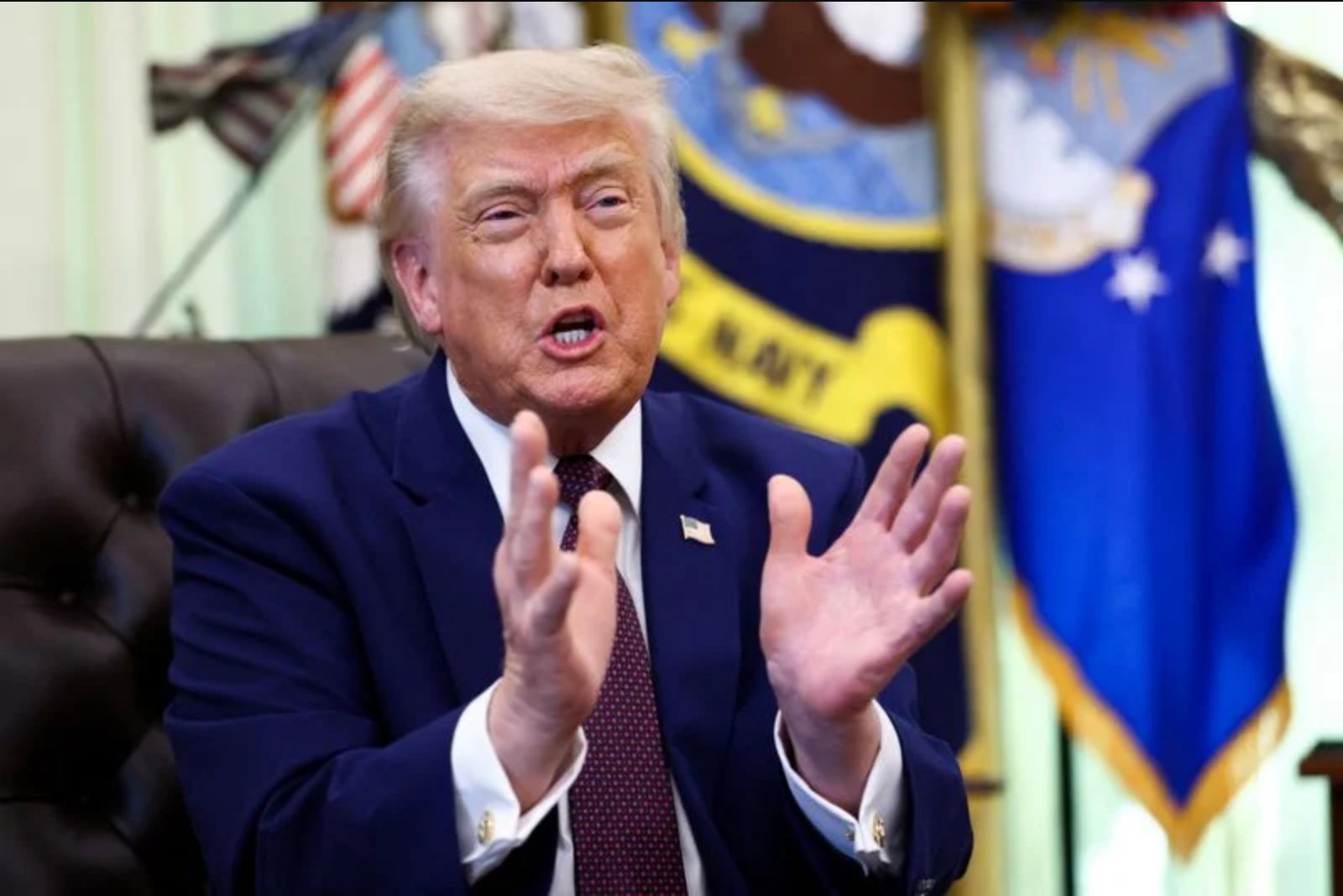
President Donald Trump on Monday repeated allegations that California's electoral process is rigged, challenging vote tallies that showed the Republican he backed in the Los Angeles mayoral race falling into third place days after polls closed. California officials say the extended time required to count ballots stems from the state's mail-in voting rules and built-in security measures.
Trump's latest critiques add to a persistent theme in which he and some allies assert, without verified evidence, that election systems disadvantage him and other Republicans. The episode follows his appearance on NBC's "Meet the Press," which aired on Sunday, where he abruptly left an interview after host Kristen Welker pressed him on his unproven claims that California election officials were cheating because, he said, after several days they "aren't even close" to finalizing results.
Focus on Los Angeles mayoral returns
The immediate trigger for Trump's comments was the primary for Los Angeles mayor. Results released six days after Election Day showed incumbent Mayor Karen Bass in the lead among a field of 14 candidates, approaching roughly 35% of counted votes as of Monday. City Council member Nithya Raman moved into second place with 27.12% of the vote, passing Spencer Pratt, the former reality television personality and Republican candidate supported by Trump, who stood at 26.69%.
Trump posted on social media that it was "Not possible for Spencer Pratt to have lost the L.A. runoffs after the big lead he had," adding "Rigged Elections!" Pratt, for his part, posted on X that the margin separating him and Raman represented "a fraction of a percentage point," and noted that "there's still hundreds of thousands of votes outstanding," citing additional time allotted by Los Angeles officials to complete counting.
Earlier, Pratt suggested that a "net swing of more than 43,000 votes since Tuesday" derived from ballots cast by homeless residents, referencing a recent count that documented more than 43,000 individuals experiencing homelessness on any given night in the city. He framed the coincidence of the two figures skeptically in a social-media post.
California officials and safeguards
State and local election authorities in California have pushed back against assertions of impropriety, highlighting a framework of safeguards intended to protect the integrity of the vote. Officials point to routine testing of voting equipment, stringent chain-of-custody controls for ballots and signature verification procedures that are part of the validation process.
Those safeguards, officials say, operate alongside a mail-in-friendly system that lengthens the time required to validate and tabulate ballots. California's open primary format places all candidates on a single ballot, with the top two finishers advancing to the November runoff regardless of party. The state also accepts ballots postmarked by Election Day for up to a week after that date, which necessitates additional time to process and count those ballots.
Wider Republican responses and context
The Speaker of the U.S. House of Representatives, Mike Johnson, also expressed doubts about the integrity of California's vote counting, noting that ballots there are "counting votes for weeks after the election." When asked for proof of rigged results, Johnson said some manipulations are "so diabolical and so far upstream it is impossible to prove."
Trump's current line of criticism builds on his repeated, unfounded claims that his 2020 presidential bid was stolen. White House insiders and others familiar with the situation have said that persisting with those 2020 allegations serves to justify new voting restrictions and to rally Trump's political base in advance of the November contests that will determine control of Congress. Multiple election experts, according to those cited, have said that by portraying the 2020 election as illegitimate, Trump is also laying groundwork to contest future losses and to cast doubt on outcomes should his preferred candidates not prevail.
Why California counts can take longer
California's extended ballot-counting timeline is largely a result of its broad mail-in voting system, which was designed to increase voter participation. In recent elections the majority of California ballots have been cast by mail. Because the state allows ballots postmarked by Election Day to arrive up to a week afterward, officials require additional time to verify signatures, confirm chain of custody and tabulate results. By contrast, states that rely mainly on in-person voting are typically able to finalize results more quickly.
Implications and outlook
The dispute over the Los Angeles mayoral primary underscores a continuing dispute over election administration that has become a recurring element in national politics. The conflicting public statements - from a sitting president and top congressional Republicans on one side, and from state and local election authorities on the other - reflect competing narratives about how elections are run and secured.
For now, the immediate outcome in Los Angeles will depend on the remaining ballots and the validation process under California law. Nationally, the exchange highlights persistent tensions ahead of pivotal November elections, while state officials point to procedural safeguards and mail-in voting rules as the principal reasons for delayed final tallies.
Note: This report restricts itself to claims and figures presented by the relevant parties and officials and does not introduce material beyond those statements.