
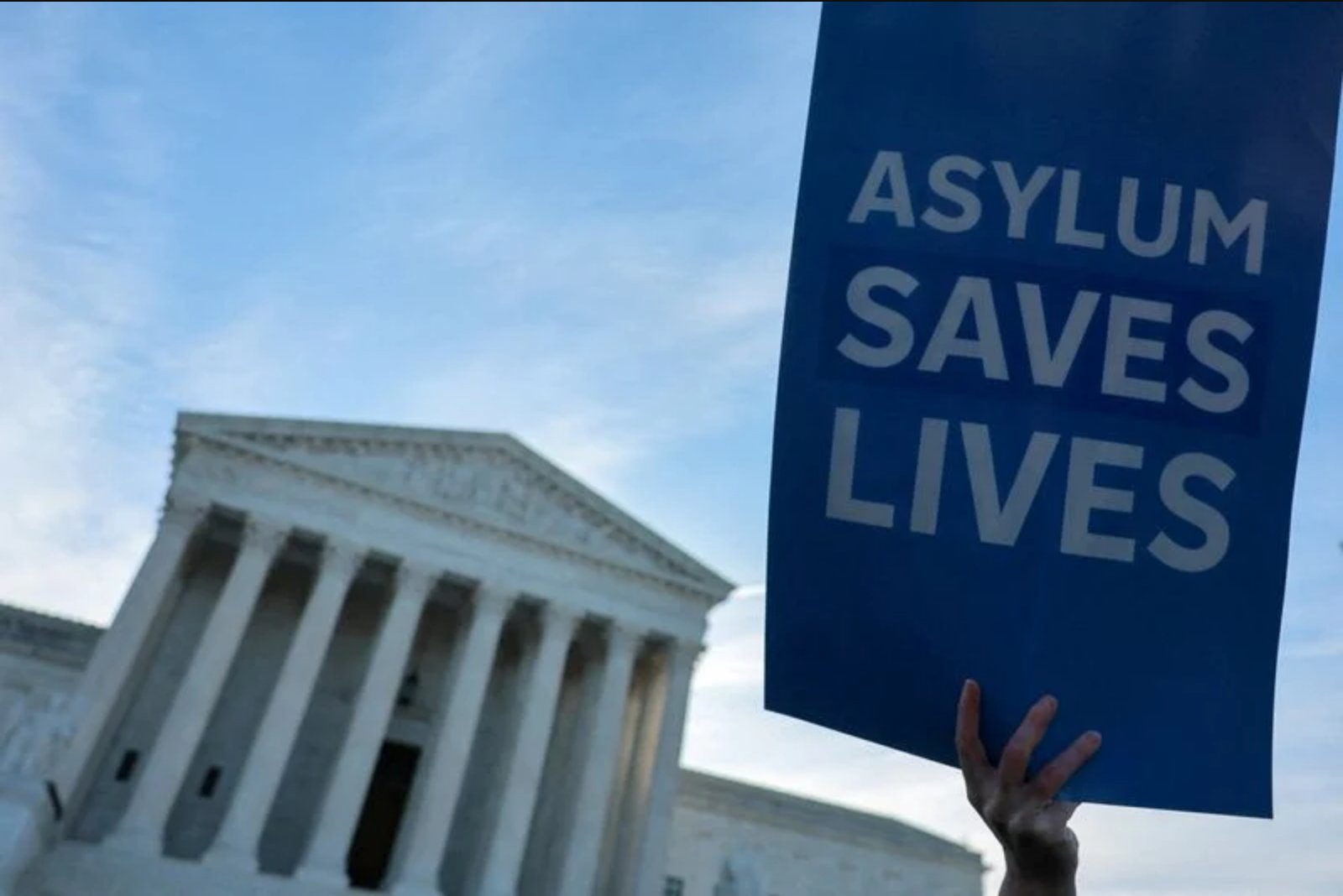
The U.S. Supreme Court on Thursday sided with the administration of President Donald Trump, finding that the federal government may bar asylum seekers from being processed at the U.S.-Mexico border when officials determine crossings are too congested to accept more claims. The court issued a 6-3 decision, with its conservative justices providing the majority, overturning a lower court determination that the practice violated federal statute.
The contested policy, commonly referred to as "metering," permitted immigration officials to stop asylum seekers on the Mexican side of the border and decline to inspect or process their requests for asylum indefinitely. That practice is distinct from a broader policy announced by the president after he returned to office last year, which seeks to deny entry to certain asylum seekers at the border; that separate measure is also subject to active legal challenges.
At the core of the litigation was the statutory phrase that allows a migrant who "arrives in the United States" to apply for asylum and requires that person to be inspected by a federal immigration official. The dispute hinged on whether an asylum seeker who is halted on Mexican soil before crossing the line has in fact "arrived in the United States." The Trump administration argued that the phrase refers to actually entering a specified place, not merely approaching it.
During March oral arguments in the case, Vivek Suri, who represented the administration for the Justice Department, told the court: "You can’t 'arrive in the United States' while you’re still standing in Mexico. That should be the end of this case." The Supreme Court majority accepted that interpretation and reversed the 9th U.S. Circuit Court of Appeals, which in 2024 had concluded that federal law requires inspection of all asylum seekers who "arrive" at official border crossings even if they have not crossed into U.S. territory, and that metering therefore contravened the law.
The roots of metering trace back to 2016, when U.S. immigration officials began turning away asylum seekers amid a large surge of migrants under the Obama administration. The policy was formalized in 2018 during President Trump’s first term, granting border officials authority to decline processing of asylum claims when the government judged it unable to accept additional applications. President Joe Biden rescinded the policy in 2021.
In litigation that predates the Trump administration's most recent actions, the advocacy group Al Otro Lado filed the challenge in 2017. The organization argued that metering prevented asylum seekers from exercising their statutory right to inspection and application for asylum.
The Trump administration has stated it would likely resume metering "as soon as changed border conditions warranted that step," but has not provided further specifics on timing or operational details. Since returning to the presidency last year, the administration has pursued a series of hardline immigration measures, several of which the Supreme Court has backed in emergency rulings. These included decisions allowing deportations to countries other than migrants' own homelands and permitting the revocation of temporary legal status for hundreds of thousands of Venezuelan immigrants.
Separately, the Supreme Court is expected to issue rulings by around the end of June on other immigration issues raised by the administration, including the legality of a directive to restrict birthright citizenship and petitions to remove temporary protections for more than 350,000 Haitian nationals and roughly 6,100 Syrians living in the United States. Those cases remain pending before the court and could further shape the legal landscape for asylum and related immigration protections.
Context and immediate effect
The decision restores the executive branch's discretion to refuse processing asylum claims at designated crossings under conditions it deems overburdened. By reversing the appeals court's 2024 ruling, the high court removes a requirement that agents must inspect anyone who has "arrived" at an official point even if they remain on foreign soil.
How quickly or extensively metering will be reimplemented rests on the administration's assessment of border conditions and on related litigation challenging other recent policies. The ruling narrows one avenue of legal relief that had been available to asylum seekers through federal courts while leaving other pending cases before the Supreme Court that could constrain or expand executive authority on immigration.
Reporting in this piece aggregates the court's decision, the statutory question before the justices, the policy history of metering, and the status of related legal challenges as presented in court filings and arguments.