
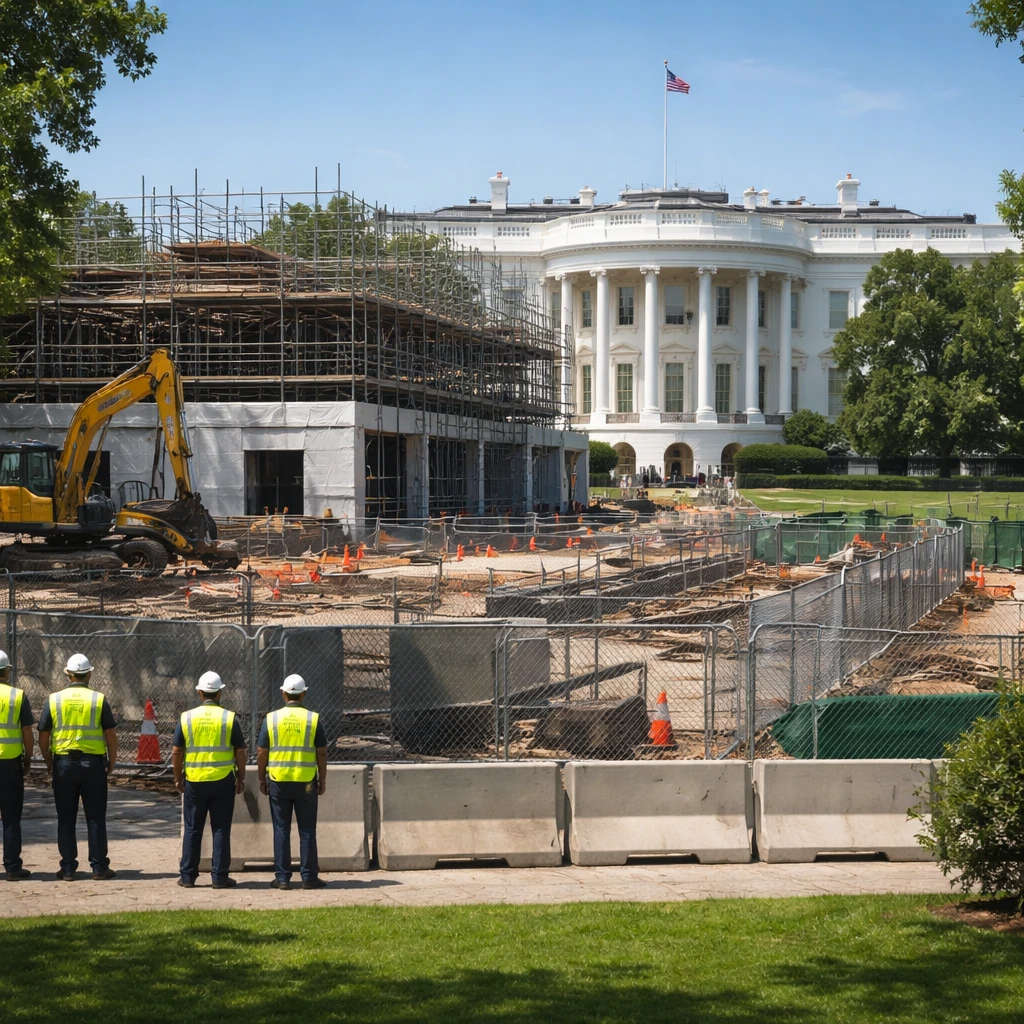
The U.S. Supreme Court on Aug. 21 issued an administrative stay that permits the Trump administration to continue building the contested White House ballroom project for now, temporarily suspending a lower court directive that would have stopped much of the development.
The stay gives the justices additional time to consider the administration's formal petition to maintain construction on the roughly $400 million East Wing project while a lawsuit brought by the nonprofit National Trust for Historic Preservation proceeds. That lawsuit seeks to block the project on the grounds that the administration did not obtain required approvals before demolishing the existing East Wing and beginning construction.
In an Aug. 14 filing to the Supreme Court, lawyers from the Justice Department framed the overall project - which pairs an above-ground ballroom with an extensive underground complex - as essential for security. The filing cited recent assassination attempts and other threats against the president in arguing that a secure space is required for the White House.
"This case involves an extraordinary and unlawful injunction that will halt the ongoing construction of the integrated military complex, including a totally secure ballroom space, at the East Wing of the White House, which is vitally required by national security," the Justice Department wrote in the Aug. 14 submission.
The National Trust sued last year after the administration tore down the East Wing and commenced building a 90,000-square-foot (8,360-square-meter) ballroom without seeking specific congressional approval. The Trump administration has described the ballroom as a component of a larger integrated facility; the president has also publicly characterized the structure in posts as a "military center." Trump has called the ballroom "the greatest of its kind ever built." He has asserted it will include bomb shelters, medical facilities, shielding from drones and missiles, and other security features, all "tied together as one big, expensive and very complex unit."
On Aug. 7, the U.S. Court of Appeals for the District of Columbia Circuit, in a 2-1 decision, affirmed U.S. District Judge Richard Leon's order directing the administration to stop above-ground construction. The appeals court noted that "Each President is a temporary tenant, not the owner, of the White House," and stated that a president cannot fundamentally reshape the residence without express congressional authorization.
Judge Leon's injunction did not amount to a permanent ban on constructing a ballroom. It enjoined above-ground work while allowing below-ground construction to continue, and it permitted activities deemed "strictly necessary" for the White House's safety and security to carry on.
In its Aug. 14 filing to the Supreme Court, the Justice Department said the East Wing project - both the underground facilities and the above-ground ballroom - was approximately 65% complete. The administration argues that the D.C. Circuit's ruling improperly disregards national security needs and left the president, White House staff and visitors insufficiently protected.
After the appeals court decision, the president described that ruling as "horrendous" and politically motivated, saying it exposed him and others to the risk of attack. "This unjust decision must be overturned by the Supreme Court in its entirety," he wrote.
The National Trust has urged the Supreme Court to reject the administration's request to continue above-ground construction while litigation continues. In court filings, the preservation group emphasized that multiple courts assessing the issue have found the administration lacks unilateral authority - constitutional, statutory or otherwise - to build a large ballroom on the footprint of the demolished East Wing without congressional approval.
"Each court to examine the question has agreed that (the Trump administration has) no unilateral legal authority - constitutional, statutory or otherwise - to build a massive ballroom on the site of the now-demolished East Wing," the group's lawyers wrote. "And each court has told (the administration) in no uncertain terms that they must stop their illegal construction unless and until they receive express approval from Congress."
The East Wing project forms part of the administration's broader plans to reshape parts of the capital's built environment. Other proposals include a 250-foot (76-meter) arch and changes to the Kennedy Center. The demolished East Wing previously housed the first lady's offices and the White House movie theater. That wing was first constructed in 1902 during the administration of Theodore Roosevelt and later expanded in 1942 during Franklin Roosevelt's presidency.
The Supreme Court's administrative stay does not decide the merits of the dispute. Instead, it temporarily preserves the status quo while the high court decides whether to permit continued construction during the pendency of the preservation group's suit. The ultimate resolution of the legal challenge will determine whether above-ground work can proceed without express congressional authorization or must be halted pending explicit approval.