
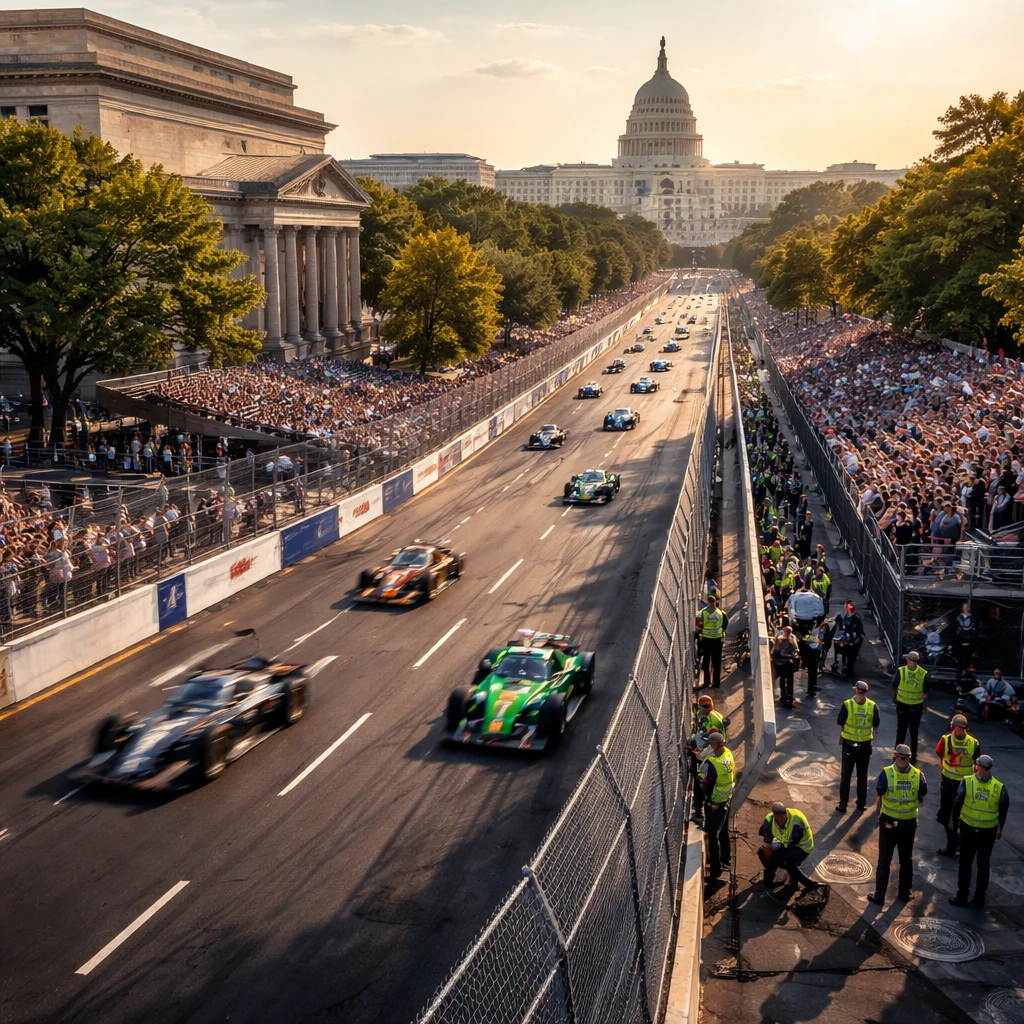
A high-profile IndyCar event will run through the heart of the nation’s capital this weekend, turning familiar avenues and civic spaces into a temporary racetrack while accentuating visible changes to federal institutions that have occurred during President Trump’s second term.
The Freedom 250 Grand Prix will send open-wheel cars down historic Pennsylvania Avenue, circle the National Archives and thread past some of Washington’s most prominent cultural institutions on Saturday and Sunday. Organizers say the circuit will reach speeds up to 185 miles per hour on the Pennsylvania Avenue straightaway, and officials have undertaken multiple street modifications to prepare the route for racing.
Preparing a city street for top-speed racing
IndyCar and local crews are taking practical measures to convert urban thoroughfares into a safe motorsport venue. Manhole covers along the route will be welded down and, in some cases, sealed with a silicone cap. Certain roadway barriers will be removed and chain-link fencing erected around the perimeter to catch debris from the racing surface, according to Bud Denker, chair of the Freedom 250 Grand Prix and president of Penske Corp.
The race will skirt the grounds of the U.S. Capitol rather than pass closer. Moving the course any nearer to the Capitol would have required congressional approval, which organizers did not obtain. Spectators along 3rd Street will nonetheless see the Capitol building in the background as cars surge past.
Federal institutions on the course and what has changed
As the Grand Prix winds through the city, it moves past institutions that have seen notable changes since Trump began his second term. Organizers and federal officials have sought to minimize disruption to the buildings themselves, even as political shifts have altered the agencies and museums that occupy them.
The National Archives, which safeguards the original Declaration of Independence, Constitution and Bill of Rights among other documents, is on the race’s path. Relations between Trump and the National Archives and Records Administration have been tense. According to the account of events leading up to his return to office, Trump refused to turn over certain classified records to the agency after his first term and removed them to his Mar-a-Lago club in Florida. That sequence prompted an FBI search of the club and an indictment charging him with 37 felonies related to the incident; those charges were later dropped. Shortly after returning to office, Trump dismissed the head of the National Archives.
Just blocks away sits the FBI headquarters, commonly referred to as the Hoover Building. The facility, completed in 1975 and named for longtime director J. Edgar Hoover, has been criticized for its appearance - Hoover himself called it "the greatest monstrosity ever constructed in the history of Washington." The building is deteriorating in places, with nets hanging from sections of its facade to prevent falling concrete from endangering pedestrians. FBI Director Kash Patel said in December 2025 that the agency would permanently close the Hoover Building and transfer operations to another federal office space, but he has not provided a timeline for that move.
The National Gallery of Art, another institution along the route, enacted internal changes quickly after Trump retook office. Within days it eliminated its diversity, equity and inclusion department and removed corresponding signage, following a Trump executive order. The gallery has examined whether nearby race-related vibrations could affect its structure or collections; it carried out a vibration study to assess potential effects from cars speeding by, but a gallery spokesman declined to provide the study’s findings.
Civic spaces and cultural flashpoints
The National Mall, designed by Pierre L’Enfant as a "grand avenue" linking government buildings with museums and monuments, has been a focal point for this year’s 250th anniversary activities. Events this summer have included a FIFA World Cup fan festival and the Freedom 250’s "Great American State Fair." But the Mall has also been the scene of political friction. Disagreements over renovation plans for the Lincoln Memorial Reflecting Pool, an anti-Trump art installation by an anonymous collective and acts of vandalism at the World War Two Memorial have all drawn attention to disputes over public space.
The Smithsonian Institution’s National Air and Space Museum, historically the most visited of the Smithsonian museums with more than 3 million visitors annually, is on the race’s circuit as well. The museum’s collection includes Apollo program artifacts and the Wright brothers’ 1903 flyer. The Trump administration has publicly accused Smithsonian leadership of trying to recast U.S. history as "irredeemably flawed," a characterization the Smithsonian and independent historians dispute. In parallel with those cultural debates, the president has been a vocal advocate for expanding U.S. space exploration, pressing for crewed moon landings by 2028 and missions to Mars by the end of his term, and advancing space-based military capabilities.
Agency footprints and building occupancy
Some federal office footprints have also shifted. The Department of Education occupies the Lyndon Baines Johnson Building now, but that arrangement is on the verge of changing. Trump campaigned on a pledge to eliminate the department, which cannot be accomplished without congressional action. Still, the administration’s Department of Government Efficiency moved to reduce the department’s workforce by roughly 70 percent. As a result, the Education Department is preparing to hand over the now largely vacant building in the coming weeks to the Energy Department.
The planned Grand Prix will therefore pass a cityscape that tells a story of administrative restructurings, personnel cuts and cultural interventions. Organizers and federal officials are balancing the logistics of a temporary sporting event with concerns about historic artifacts, building integrity and public safety. For residents and visitors watching racecars streak past, the course will also serve as a visible route through a capital whose institutions have been reshaped in recent years.
Weekend schedule note: The Freedom 250 Grand Prix is set to run on Saturday and Sunday along the described route.