
Summary
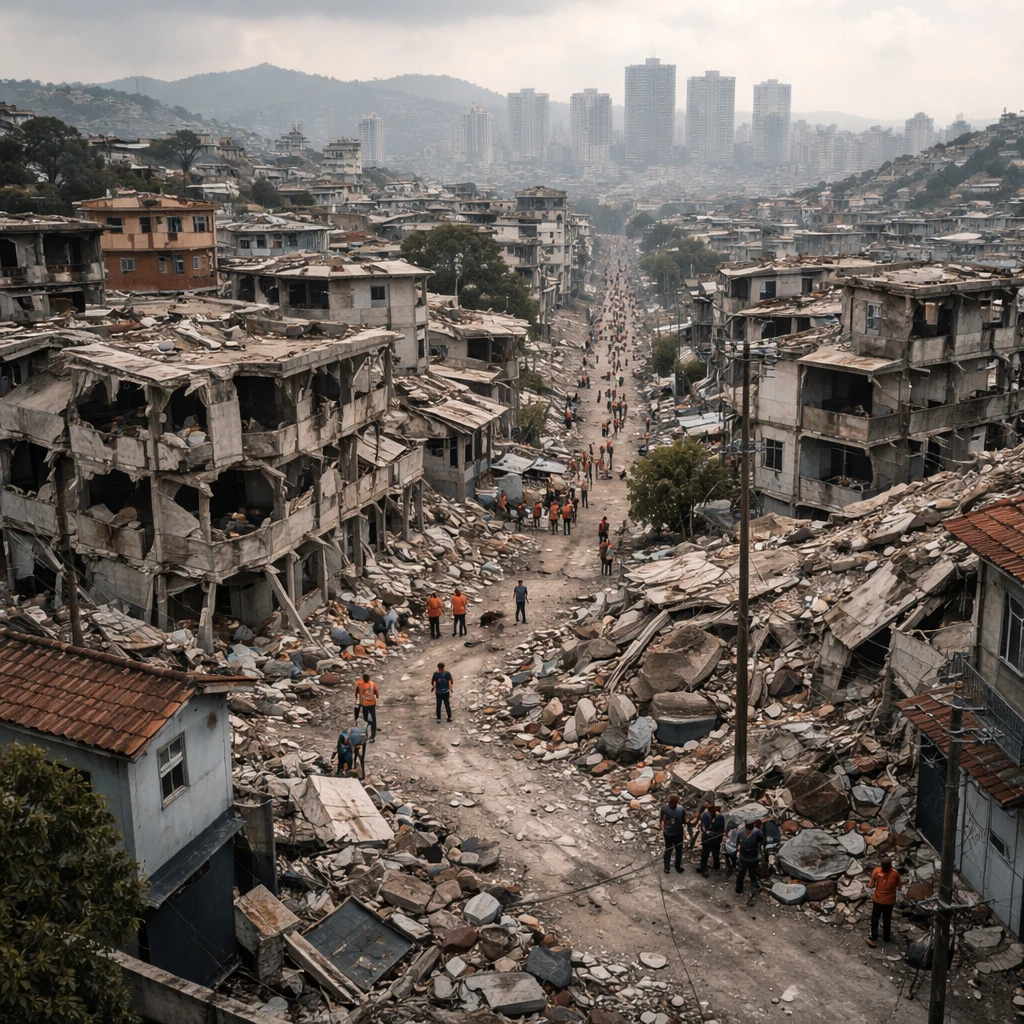
An early World Bank damage estimate places the direct physical losses from the June 24 earthquakes in Venezuela at $19.6 billion. The assessment, based on remote modeling, seismic data, satellite imagery and on-the-ground reports, attributes nearly half of the damage to residential buildings and highlights significant destruction to infrastructure and non-residential structures in northern areas of the country, including the capital. The estimate excludes costs associated with building back better and debris removal, which the bank says could raise total rebuilding needs to roughly two to two-and-a-half times the initial replacement cost.
Details of the disaster
Two powerful tremors, measured at magnitudes of 7.2 and 7.5, struck Venezuela on June 24. The government reports that about 5,000 people were killed, nearly 17,000 were injured and about 18,000 remain homeless. Damage was concentrated in the northern regions, encompassing residential neighborhoods as well as public infrastructure and commercial or institutional buildings in the capital and surrounding areas.
Methodology and scope of the World Bank rapid assessment
The bank carried out its Global Rapid Damage Estimation (GRADE) using remote-based earthquake modeling combined with local seismic readings, satellite imagery and damage reports from government sources and humanitarian groups. GRADE is intended to provide a prompt estimate within weeks; the bank noted that a more comprehensive reconstruction and recovery study - which it is conducting with the Venezuelan government, the Inter-American Development Bank and the Development Bank of Latin America (CAF) - typically takes months to complete.
What the $19.6 billion covers - and what it does not
The $19.6 billion figure represents direct physical replacement costs. It does not incorporate additional expenditures associated with building back better - such as structural improvements, changes in construction type, or debris clearance. The World Bank cautioned that incorporating those measures, along with debris removal, could raise total reconstruction costs to two to two-and-a-half times the replacement value, a range that could bring the overall bill close to $50 billion.
Distribution of damage by asset type
The assessment found that 47% of the direct damage was in residential buildings, 27% affected infrastructure and 26% impacted non-residential buildings. The bank also noted that direct economic losses were not included in the damage estimate, and it expects the country’s labor supply to be reduced by 1% this year as a result of the disaster.
Economic context and outlook
The earthquakes struck while Venezuela was already experiencing severe socioeconomic strain. The World Bank pointed to a poverty rate above 76% and the long-term outflow of people from the country - some 7.9 million have left since 2015. The bank warned that without timely and substantial additional investment, the negative effects on productive capacity and living standards will slow recovery.
In its assessment the bank said the pace and scale of reconstruction will be decisive for the country’s economic trajectory. With insufficient public and private investment, productive capacity and GDP could remain below pre-quake levels until at least 2036. The bank acknowledged that any additional borrowing to finance reconstruction would add to Venezuela’s large debt stock, but it said such borrowing could also support stronger growth that would, over time, help stabilize the fiscal position.
Comment from World Bank leadership
"The earthquake caused an estimated $19.6 billion in direct physical damage, a staggering figure for any economy and one that demands a coordinated response," said Susana Cordeiro Guerra, the World Bank vice president who oversees Latin America and the Caribbean. "Without timely additional investment, the negative impact on productive capacity and living standards will slow the path to recovery," she added.
Key points
- The World Bank’s rapid GRADE assessment estimates $19.6 billion in direct physical damage from the June 24 earthquakes.
- Damage distribution: 47% residential, 27% infrastructure, 26% non-residential buildings.
- Reconstruction costs that include building back better and debris clearance could be two to two-and-a-half times replacement costs, potentially nearing $50 billion; labor supply is expected to fall by 1% this year.
Risks and uncertainties
- Reconstruction financing - Additional borrowing would increase Venezuela’s already large debt stock, creating fiscal trade-offs for public finances and markets; however, the bank notes borrowing could also spur growth if invested effectively.
- Recovery pace - Without timely public and private investment, productive capacity and GDP may remain below pre-quake levels through at least 2036, prolonging economic and social hardship.
- Incomplete cost estimate - The rapid GRADE assessment does not include building-back-better measures or debris clearance; final reconstruction needs could be substantially higher than the direct damage figure.
The World Bank team is working with Venezuela, the Inter-American Development Bank and CAF on a more exhaustive recovery and reconstruction appraisal. That study is expected to take months to complete, while the current GRADE figure offers a near-term snapshot to inform immediate planning and resource mobilization.