
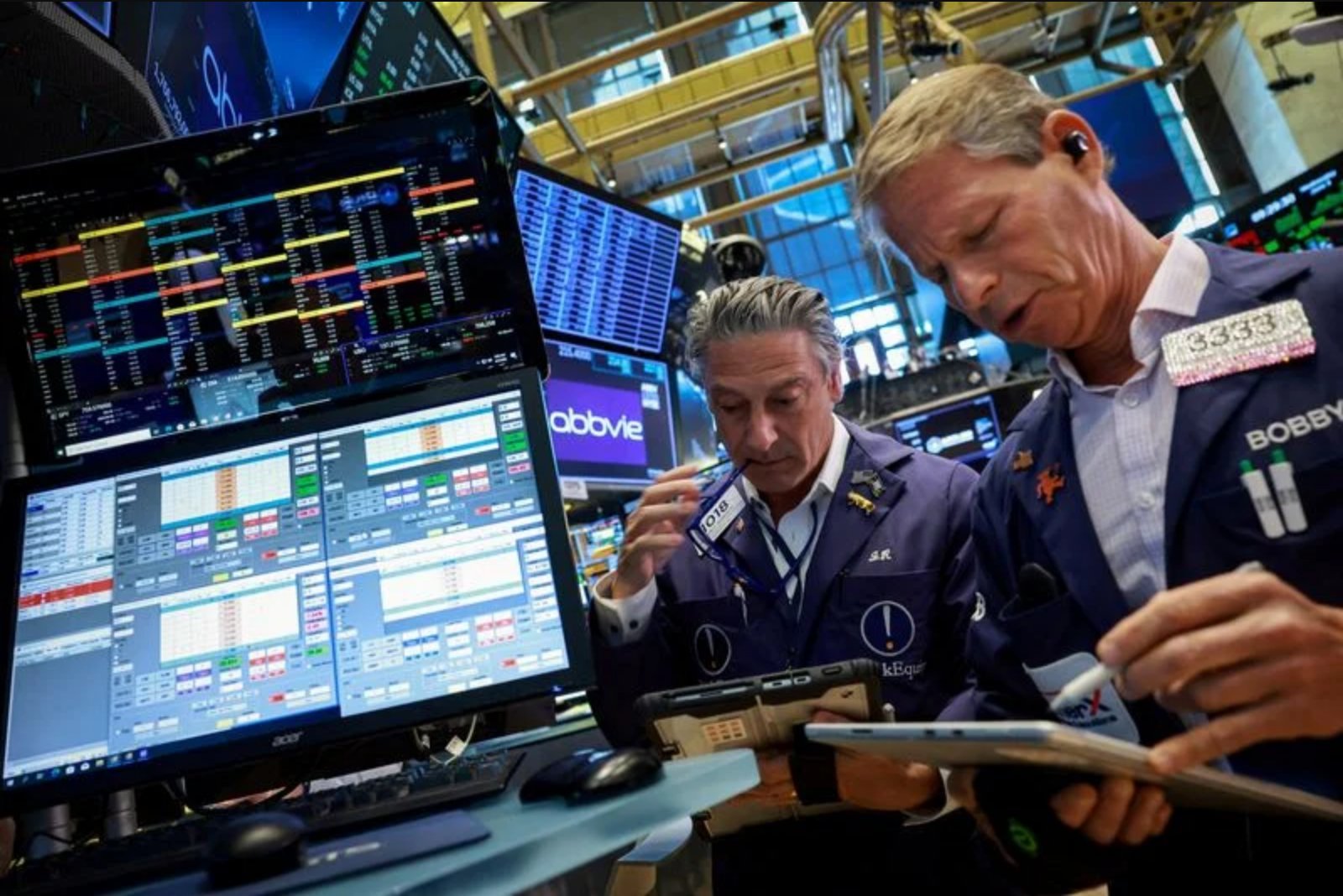
June 10 - All three major U.S. stock indexes fell by more than 1% on Wednesday afternoon, pushed lower by extended weakness in chip stocks and by fresh geopolitical uncertainty between the U.S. and Iran.
An index of semiconductors declined 2.6%, with Nvidia and Broadcom among the largest drags on the S&P 500. The S&P 500 technology index was down 1.1% as investors continued to take some profits in richly valued technology names.
President Donald Trump said the U.S. would attack Iran again "very hard" following one of the most significant exchanges of fire overnight since an April ceasefire in the Middle East war. The eruption of hostilities contributed to a rise in market volatility, with the Cboe Volatility Index adding to Tuesday's advance.
"Investors were still taking some profits in the tech space," said Tom Hainlin, an investment strategist at U.S. Bank Wealth Management in Minneapolis. He added that following recent economic releases investors appear to be "pricing in maybe a higher interest rate" and are also worried about the war. "Perhaps that conflict continues on into the mid to late summer," he said.
Market positioning reflects those concerns. The Dow Jones Industrial Average fell 721.32 points, or 1.42%, to 50,150.79. The S&P 500 lost 87.78 points, or 1.19%, to 7,298.87, while the Nasdaq Composite declined 382.36 points, or 1.49%, to 25,296.35.
Investors were also digesting fresh economic data. Friday's U.S. jobs report was stronger than expected, and U.S. consumer prices increased 4.2% in the 12 months through May - the largest 12-month gain since April 2023. The rise in inflation reflected higher gasoline and other energy prices linked to the Middle East conflict. The pace, however, ran in line with forecasts in a Reuters poll of economists.
The Federal Reserve is widely expected to leave interest rates unchanged at its June policy meeting, though market pricing includes at least one 25-basis-point rate hike by year-end.
Among individual movers, Super Micro Computer tumbled 20.9% after the company said it planned to raise $7 billion through a series of equity and equity-linked financing transactions to fund component purchases for its growing AI server demand. Separately, other highly subscribed technology shares have seen funds rotate into sectors that have lagged so far this year, including healthcare, real estate and consumer staples.
The much-hyped $1.75 trillion listing of SpaceX on Friday, targeting a record $75 billion raise, was mentioned by market participants as another factor that could exert pressure on U.S. stocks amid concerns over excessive optimism in the tech sector.
Industrial stocks led sector declines on Wednesday. Shares of trucking companies including XPO, J.B. Hunt and Old Dominion fell after Amazon announced an expansion of its less-than-truckload freight services in the U.S.
Declining issues outnumbered advancers by a 1.41-to-1 ratio on the New York Stock Exchange, where there were 168 new highs and 103 new lows. On the Nasdaq, 2,038 stocks rose and 2,729 fell, with decliners outnumbering advancers by a 1.34-to-1 ratio.
Market snapshot
- Semiconductor index: down 2.6%
- S&P 500 tech index: down 1.1%
- Cboe Volatility Index: added to Tuesday's advance
- Major averages: Dow -721.32 to 50,150.79; S&P 500 -87.78 to 7,298.87; Nasdaq -382.36 to 25,296.35
This report reflects market moves, company announcements and economic readings as they were reported on June 10 and does not include subsequent developments.