
Economy July 24, 2026 02:47 PM

U.S. Removes 35% Tariffs on Serbian Imports, Vucic Says

President announces immediate zeroing of tariff as part of a move he says will bolster investment and credit ratings

By Nina Shah
Share
Twitter Reddit Facebook LinkedIn

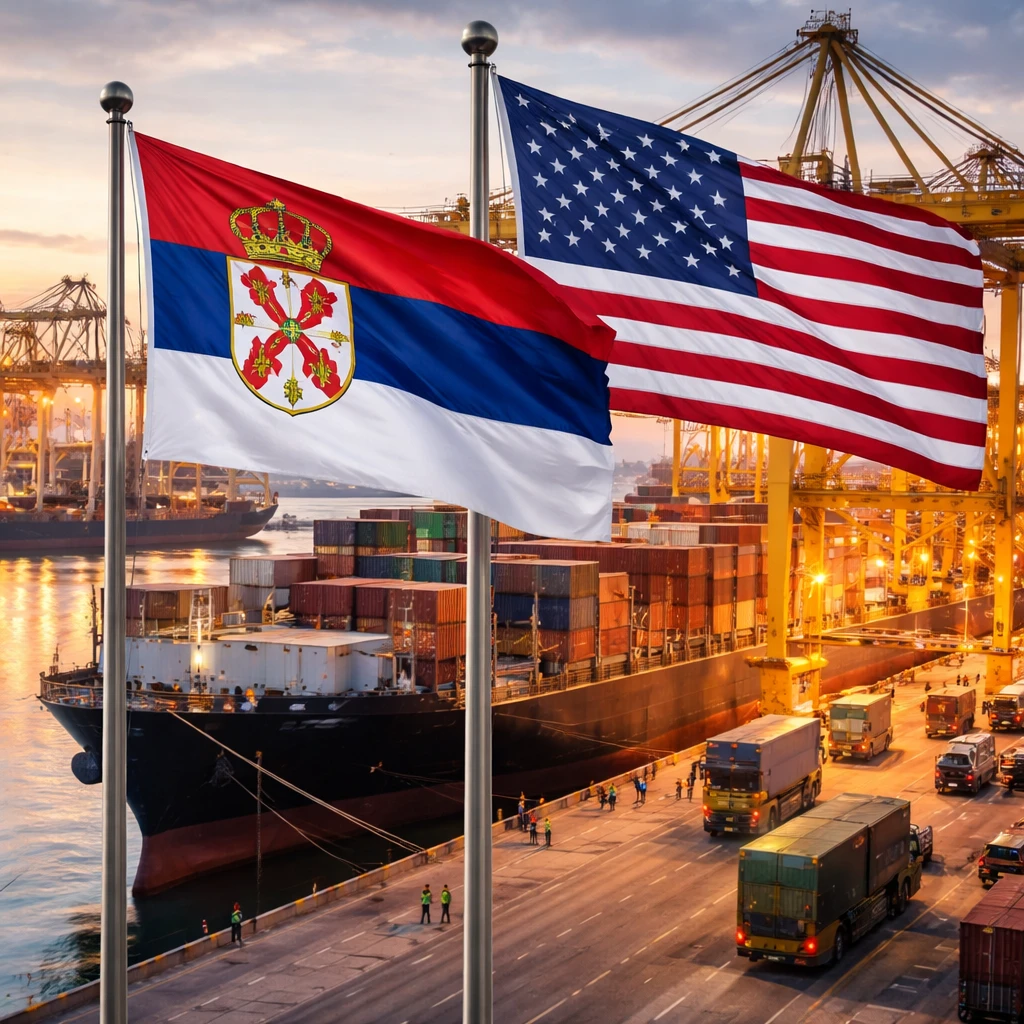
Serbian President Aleksandar Vucic said the United States will lift the 35% tariffs on Serbian goods, cutting the rate to zero effective Friday evening. The tariffs, imposed last year, hit mainly small and medium-sized firms across several sectors. Vucic also indicated the rate could later be set between 10% and 12%, and said the change should help attract investment and support Serbia's investment and credit ratings. U.S. Census Bureau data show a $730.5 million U.S. trade deficit with Serbia in 2025.

U.S. Removes 35% Tariffs on Serbian Imports, Vucic Says
Summarize with
ChatGPT Perplexity Claude Grok Gemini

Key Points

  • The United States will drop a 35% tariff on Serbian goods to zero, effective Friday evening, according to President Aleksandar Vucic.
  • Vucic said the tariff could later be set between 10% and 12%; the original duties were introduced last year and mainly affected Serbian SMEs in automotive, agriculture, machinery, metals, manufacturing, and defense.
  • U.S. Census Bureau data for 2025 show the United States ran a $730.5 million deficit with Serbia, importing $944.2 million and exporting $213.7 million; Vucic said the tariff removal should help attract investment and support Serbia's investment and credit ratings.

Serbia will see the removal of the 35% U.S. tariffs on its exports, Serbian President Aleksandar Vucic announced on Friday. Speaking live on state-run RTS TV, Vucic said the duties will be reduced to zero as of Friday evening.

Vucic added that while the rate will initially be zero, it could ultimately be adjusted to fall in a range of 10% to 12%.

The duties had been introduced last year and, according to Vucic, disproportionately affected small and medium-sized enterprises in Serbia's automotive, agriculture, machinery, metals, manufacturing, and defense sectors. Those industries were identified by the president as among the primary targets of the tariff measures.

Trade figures for 2025, cited from U.S. Census Bureau data, indicate the United States ran a $730.5 million deficit with Serbia. That gap reflects U.S. imports from Serbia of $944.2 million and U.S. exports to Serbia of $213.7 million.

Vucic framed the tariff removal as a step to stimulate further investment in Serbia and to support the country's investment and credit ratings. He presented the policy shift as beneficial for attracting capital, though he did not provide additional details on timelines or specific investment commitments tied to the announcement.

The president's remarks come against the backdrop of his earlier statement that he intends to call snap general elections in the coming months. Vucic's announcement did not link the timing of the tariff change to the election timetable, nor did it specify any mechanisms for how the proposed 10% to 12% eventual rate would be determined or implemented.


The immediate reduction to zero will remove an added cost layer for Serbian exporters to the U.S. market. At the same time, the president's comment that rates may later be set between 10% and 12% leaves an element of uncertainty about the medium-term trade regime. Detailed implementation plans and the response from affected Serbian firms or U.S. trade authorities were not included in Vucic's broadcast.

This development will be watched by firms and investors with exposure to the listed sectors, as well as by analysts monitoring Serbia's external position and credit outlook. The announcement itself contains clear policy shifts and stated objectives, while certain operational details and future adjustments remain undefined in the president's public remarks.

Risks

  • Potential reintroduction or adjustment of tariffs to a 10% to 12% range creates uncertainty for exporters and investors in the affected sectors - particularly automotive, agriculture, machinery, metals, manufacturing, and defense.
  • The assertion that tariff removal will attract more investment and support investment and credit ratings is a policy claim; the article does not provide evidence or details on how those outcomes will be realized or measured.
  • Operational details and timing for any future tariff adjustments were not provided in the announcement, leaving firms and market participants without clarity on medium-term trade costs.

More from Economy

Legal Challenge Filed Against New U.S. Tariffs at Court of International Trade Jul 24, 2026 Small U.S. Firms File Trade Court Challenge to Trump Tariffs Jul 24, 2026 Euro-zone yields retreat after touching multi-year highs as oil eases below $100 Jul 24, 2026 ECB sees current inflation overshoot as a moderate shock, aims to return to 2% within a year - Lane Jul 24, 2026 ECB chief economist says bank will steer inflation back to 2% within about a year Jul 24, 2026