
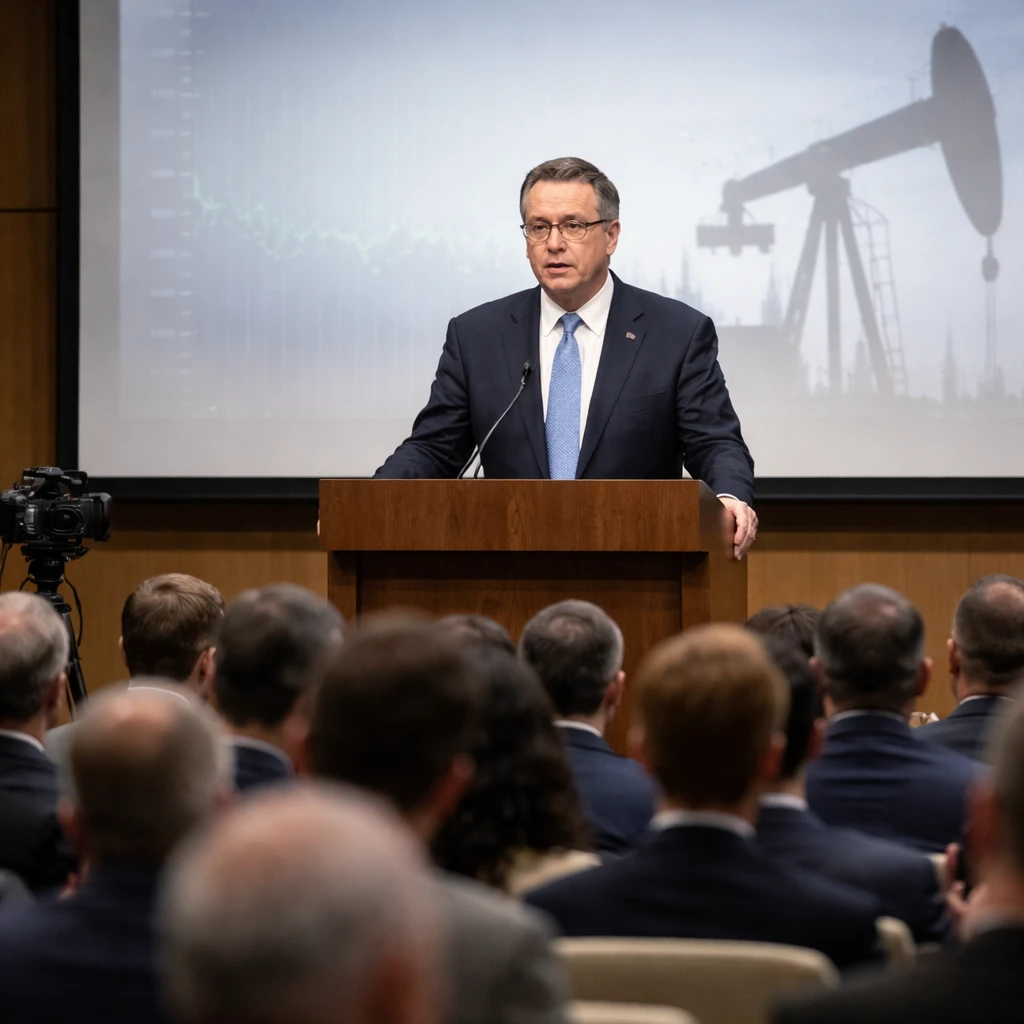
New York - Federal Reserve Bank of New York President John Williams said at a conference hosted by his institution that he does not expect energy prices to mount a sustained climb for the remainder of the year, despite renewed fighting in the Middle East.
Williams told attendees that market-implied forecasts for oil to decline over the next six to 12 months remain sensible. He argued that the underlying fundamentals point to energy prices being close to their peak and forecast that they should ease over time.
On inflation, Williams emphasized that price pressures remain "far too high," and he said monetary policy is actively focused on how movements in energy costs feed into broader inflation dynamics. He also highlighted the current role of artificial intelligence investment in driving inflation, while noting that in his base case AI should evolve into a positive supply shock that lifts productivity over the longer term.
Williams outlined that the Fed is actively debating alternative scenarios for inflation and reiterated the central bank's commitment to returning inflation to its 2% objective. He advised policymakers to focus on the underlying drivers of inflation rather than relying solely on individual measures, and he pointed to the potential for government technical adjustments to better align differences between headline personal consumption expenditures inflation and the consumer price index.
Describing the stance of policy, Williams said monetary decisions need to be data dependent. He characterized the labor market as very stable. At the same time, he acknowledged ongoing uncertainty about the longer-term neutral interest rate, and he observed that the minutes of recent Fed meetings reflected a "collective reaction function."
Context and implications
Williams' remarks signal that, in his assessment, short- to medium-term inflation dynamics are heavily influenced by energy price movements and by investment trends in technologies such as AI. His comments that markets expect oil to ease over the next six to 12 months and that fundamentals point to a peak in energy prices suggest he sees limited persistence in any oil-driven inflation spike from recent geopolitical developments.
At the same time, Williams made clear that inflation remains an overriding concern and that policy will be shaped by incoming data, the evolution of labor market conditions, and lingering ambiguities around neutral rates and measurement differences across inflation gauges.
Note: This report is based on remarks delivered at a conference and reflects the statements as presented by the speaker.