
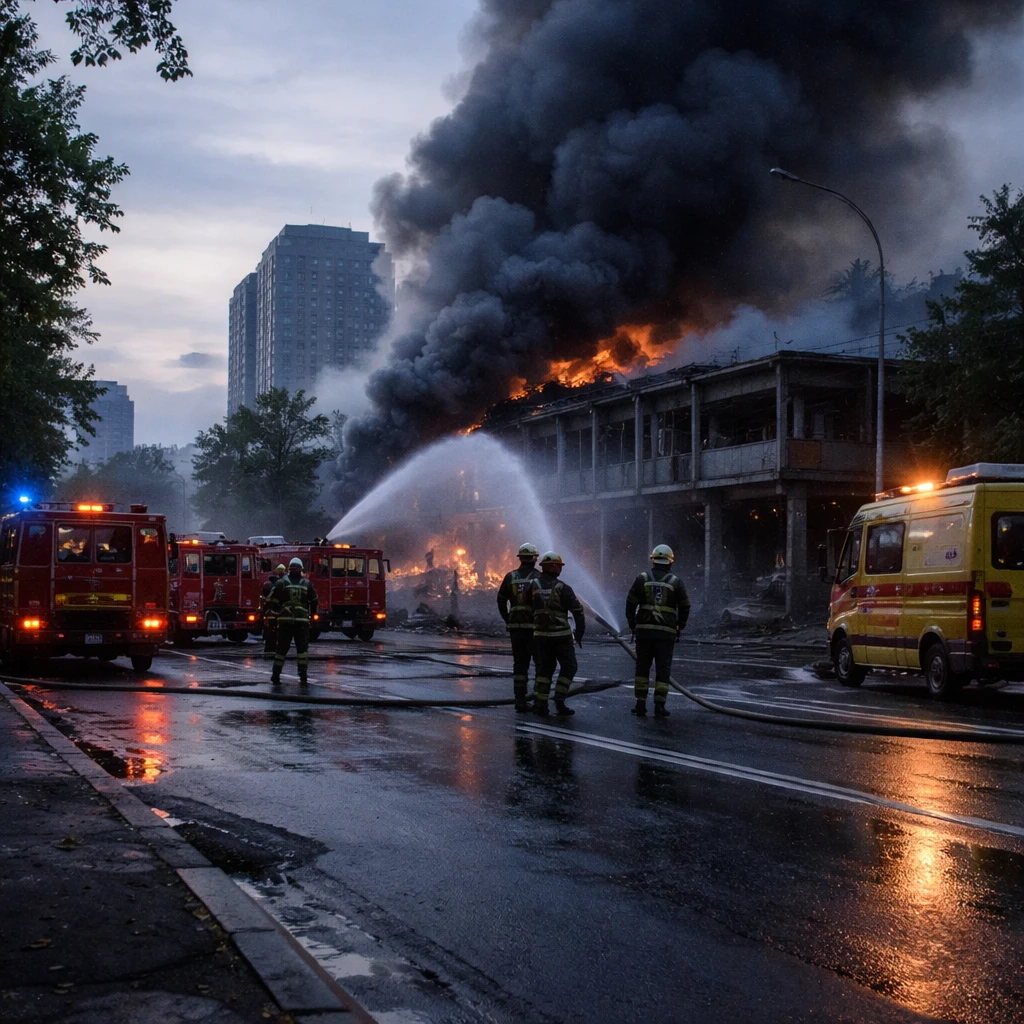
Early Sunday morning, the Ukrainian capital experienced a coordinated missile assault that triggered multiple fires across separate administrative zones. The attack resulted in at least one confirmed injury, according to official statements from Ukrainian authorities. Mayor Vitali Klitschko detailed the immediate aftermath through official communications, noting that falling debris ignited a blaze in a non-residential zone within a northern suburb. The same sector reported several vehicles engulfed in flames, while municipal data confirmed a distinct fire outbreak in an area positioned just south of the city centre.
Key Operational and Infrastructure Developments
- Multiple fire incidents were confirmed across northern and central districts, with unverified visual reports indicating commercial market stalls affected in the northern sector.
- Air-raid protocols were enforced twice after 2 a.m. local time, corresponding to 2300 GMT on Saturday. Each emergency alert remained active for approximately thirty minutes, dictating shelter protocols for local populations.
- Defense interception systems engaged incoming aerial threats. While interception units routinely deploy against incoming weapons, the physical reality of aerial combat often leaves falling fragments that compromise civilian infrastructure and pose direct safety risks.
Market and Defense Sector Implications
The sustained nature of these overnight strikes underscores the ongoing pressure on urban infrastructure and defense readiness. Recent weeks have seen a marked escalation in aerial targeting across Kyiv and additional Ukrainian municipalities. The repeated deployment of missiles and drones against concentrated urban environments and critical infrastructure forces continuous shelter mobilization and strains local response capabilities. Municipal administrations are currently conducting comprehensive damage evaluations, though official briefings have not yet outlined the full scope of property loss or the specific medical status of the injured individual.
From an operational standpoint, the consistent requirement for air-defense interception highlights the mechanical limitations of contemporary defensive networks. Falling debris and fragmentation remain persistent threats that bypass active interception layers. Defense manufacturers and industrial operators tracking military expenditure and production timelines must account for these continuous attrition patterns and the resulting strain on municipal resources. The ongoing assessment phase will ultimately determine the logistical burden placed on regional recovery operations and the sustained demand for defensive countermeasures. Witnesses monitoring the incident reported hearing distinct explosions across the metropolitan area, reinforcing the intensity of the aerial engagement. Unverified photographic documentation circulated through local networks suggested broader commercial disruption in the northern suburbs, though independent verification remains pending. Officials continue to evaluate the full operational and structural impact of the overnight assault as emergency response teams navigate the compromised zones.