
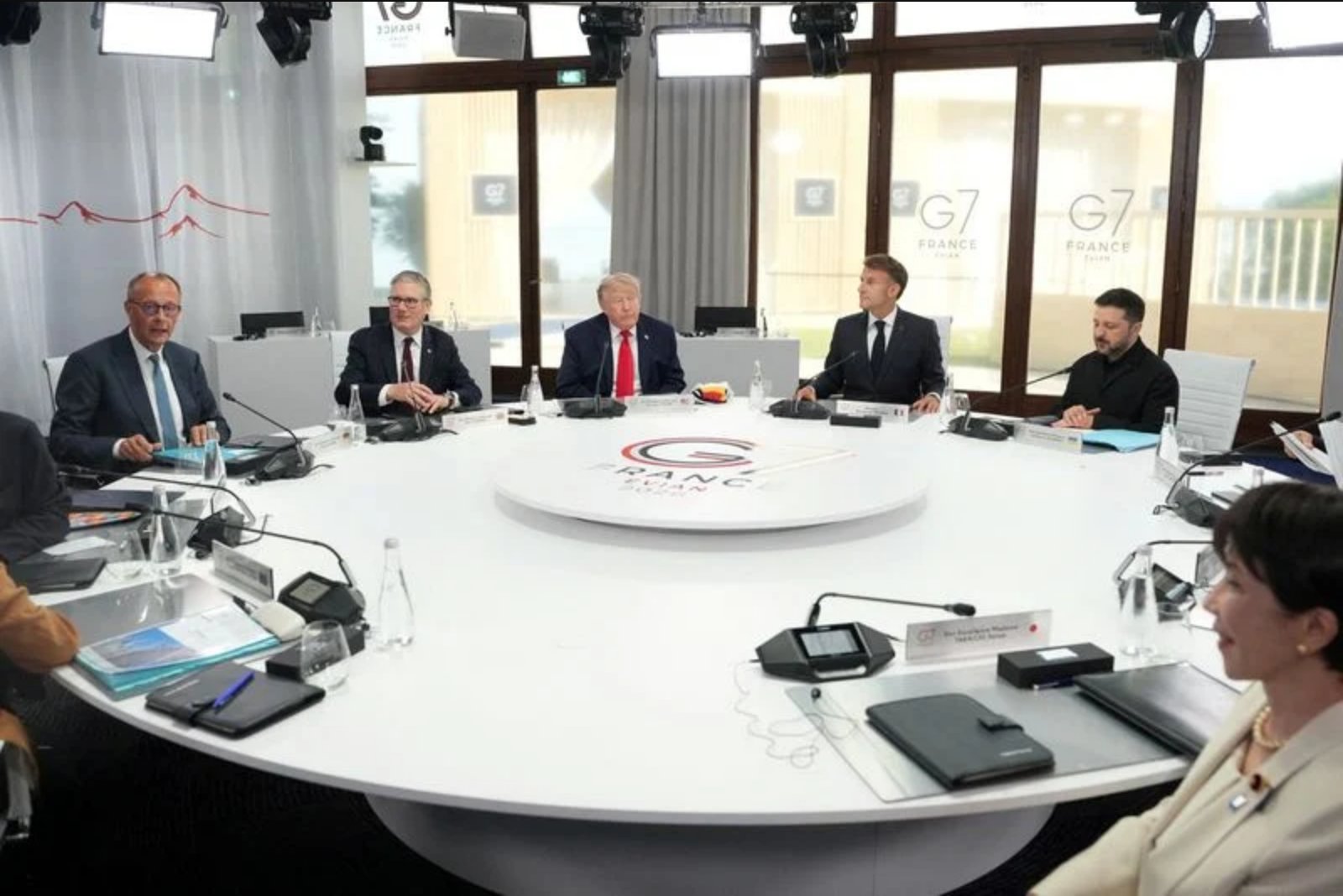
WASHINGTON, June 17 - The economic fallout from the conflict between the U.S. and Iran has already shown up in higher inflation and a roughly 30% rise in oil prices, leaving a noticeable mark on global growth prospects as leaders of the world’s largest economies meet in France.
While a temporary agreement reached over the weekend between U.S. and Iranian officials to halt fighting and reopen the Strait of Hormuz injected a dose of optimism into markets, the damage to economic activity is evident. Energy costs have climbed sharply, inflationary pressures have been renewed and analysts have flagged the possibility of a severe food supply crisis for developing countries.
European Central Bank and Bank of Japan policymakers moved to raise interest rates in the last week, underscoring central banks’ response to an elevated inflation threat. The rate moves are intended to blunt a deeper inflation shock, even as central bankers weigh the broader effect of higher energy costs on growth.
At the G7 gathering, strained relations between members and the United States have added an awkward political backdrop. Leaders had publicly criticized the U.S. president for not consulting them before the U.S. and Israel initiated hostilities with Iran in late February, and they warned early on about the likely economic fallout. But the summit has largely avoided a focus on assigning blame for the war-driven slowdown.
European leaders have expressed frustration with the conflict and its impact on households. British Prime Minister Keir Starmer said he is "fed up" with the effect on energy bills, and Italian Prime Minister Giorgia Meloni warned about economic and social consequences tied to the fighting. Rising prices have also dented approval ratings for Starmer, German Chancellor Friedrich Merz and French President Emmanuel Macron, according to participants and observers attending the meetings.
France, which holds this year’s G7 presidency, moved preemptively to reduce the risk of high-profile clashes. Paris opted against pursuing a comprehensive end-of-summit communique and instead prioritized narrower declarations covering topics such as global imbalances, critical mineral supply chains and redirecting development aid toward investment-driven programs. The approach reflects a desire to keep the summit tightly scripted and friction-free.
That cautious posture was reinforced by the interim deal between U.S. and Iranian officials reached just before the U.S. delegation departed for France. The accord has reduced the immediate prospects of a public showdown at the summit, and economists say that the truce is positive for the global economy. Nonetheless, they warn that the upside is fragile and that renewal of conflict would pose much larger risks.
Fuel and maritime analysts emphasize that restoring normal trade and energy flows will take time. Even if the strait reopens quickly, getting trade moving without disruption could require months, and some experts say it could take a year for bunker fuel supplies to return to typical levels.
International Monetary Fund chief Kristalina Georgieva, who attended the G7 meetings in France, offered a cautiously upbeat assessment in a blog post after the interim deal was concluded, softening the more dire warnings she had made two months earlier. She noted that the world economy was holding up so far, with no clear evidence yet of a global slowdown despite notable regional impacts.
The IMF will update its global forecast on July 8. Georgieva’s recent comments, which followed a gloomier outlook from the World Bank, suggested the IMF may center on the least severe of three scenarios it has considered. One scenario assumes a short-lived Iran war and projects 3.1% global growth in 2026, down from 3.4% in 2025. In the fund’s worst-case scenario, growth could slump to 2%, with inflation rising to 5.8%.
U.S. officials have argued that the worst effects of the conflict on global energy markets have already passed. They point to lower oil prices from peak levels and note that the United States, as a fuel exporter, was partly insulated from the sharpest price spikes. Sources familiar with the Trump administration’s thinking say U.S. officials also believe Europe is likely to avoid impending fuel shortages.
Still, the larger question of the G7’s relevance has resurfaced. The group, which includes the United States, Canada, Japan and major European economies, now represents a smaller share of the global economy than when it was formed. According to figures cited at the meetings, the G7 accounts for about 44.1% of global GDP, down from roughly 60.5% at its inception, a shift that reinforces how much emerging market economies have grown in importance.
Some participants argue the G7 retains utility in times of crisis. Martin Muehleisen, a former IMF strategy chief who has participated in previous summits, said the group has historically been able to deliver "real decisions that still govern half the world economy." He added that European leaders, constrained by scripted summit proceedings, would likely remain cautious but that tensions could still surface during bilateral meetings and informal meals.
Other voices at the summit emphasized the persistence of deep economic strains despite calmer markets. Eric LeCompte, executive director of Jubilee USA Network, said economic problems are widespread and tangible to consumers. "The economy is in deep turmoil and you don’t have to be in a developing country to see it. You can just go to a grocery store and feel it," he said, stressing that household-level impacts are a central concern.
Marcelo Estevao, chief economist at the Institute of International Finance, was more pointed in his assessment of U.S. policy. "U.S. policymaking has been hurting world economic activity," he said. "You have a country with the largest economy undermining what could have been a G7 agenda of collaboration," he added, arguing that the grouping needs to bolster its relevance as emerging economies assume a larger role in global output.
Against this backdrop, summit organizers have focused on contained policy outputs and technical declarations rather than broad, joint statements on blame or geopolitical strategy. The French approach aims to preserve cooperation on issues where G7 partners still require U.S. engagement, including support for Ukraine, NATO commitments and trade matters.
For now, the short-term market reaction to the weekend agreement has brightened sentiment. But economists and sector analysts caution that normalization of trade and energy supplies will not be instantaneous. The full economic consequences of the conflict, and of any potential resumption, will hinge on whether the current truce holds and on how long it takes for disrupted supply chains and fuel inventories to return to pre-crisis norms.
Summary
Rising inflation and a near 30% jump in oil prices tied to the U.S.-Iran conflict have damped global growth and prompted central bank rate hikes, but G7 leaders meeting in France have largely avoided direct confrontation with the U.S. over its role in the conflict. An interim agreement to stop fighting and reopen the Strait of Hormuz eased market fears, yet economists warn that trade and fuel supplies could take months to a year to normalize and that downside scenarios remain possible.
Key points
- Energy-led inflation and a roughly 30% increase in oil prices have curtailed global growth and pressured central banks to raise rates, including moves by the ECB and BOJ last week - sectors impacted include energy, transportation and food supply chains.
- G7 leaders have refrained from public blame for U.S. decisions that preceded the conflict, opting for a limited agenda in France focused on narrower economic declarations rather than a broad communique - relevant to diplomatic coordination, trade and security policy.
- The IMF is preparing an updated forecast that may favor a milder scenario assuming a short conflict, with one projection at 3.1% growth in 2026 versus 3.4% in 2025, while the fund's worst-case scenario sees growth at 2% and inflation at 5.8% - implications span global financial markets and sovereign policy responses.
Risks and uncertainties
- If the interim deal fails and conflict intensifies, economists warn of substantially larger economic damage - this would notably affect energy markets, shipping routes through the Strait of Hormuz and food-importing developing economies.
- Even with the truce, returning trade flows and fuel inventories to normal levels could take months or up to a year, posing continued pressure on transportation, maritime fuel supplies and global supply chains.
- The G7’s diminished share of global GDP raises questions about its ability to coordinate a unified response, particularly as emerging market economies account for a greater portion of world output - this could affect the effectiveness of coordinated fiscal and trade measures.
Tags: G7, oil, inflation, IMF, growth