
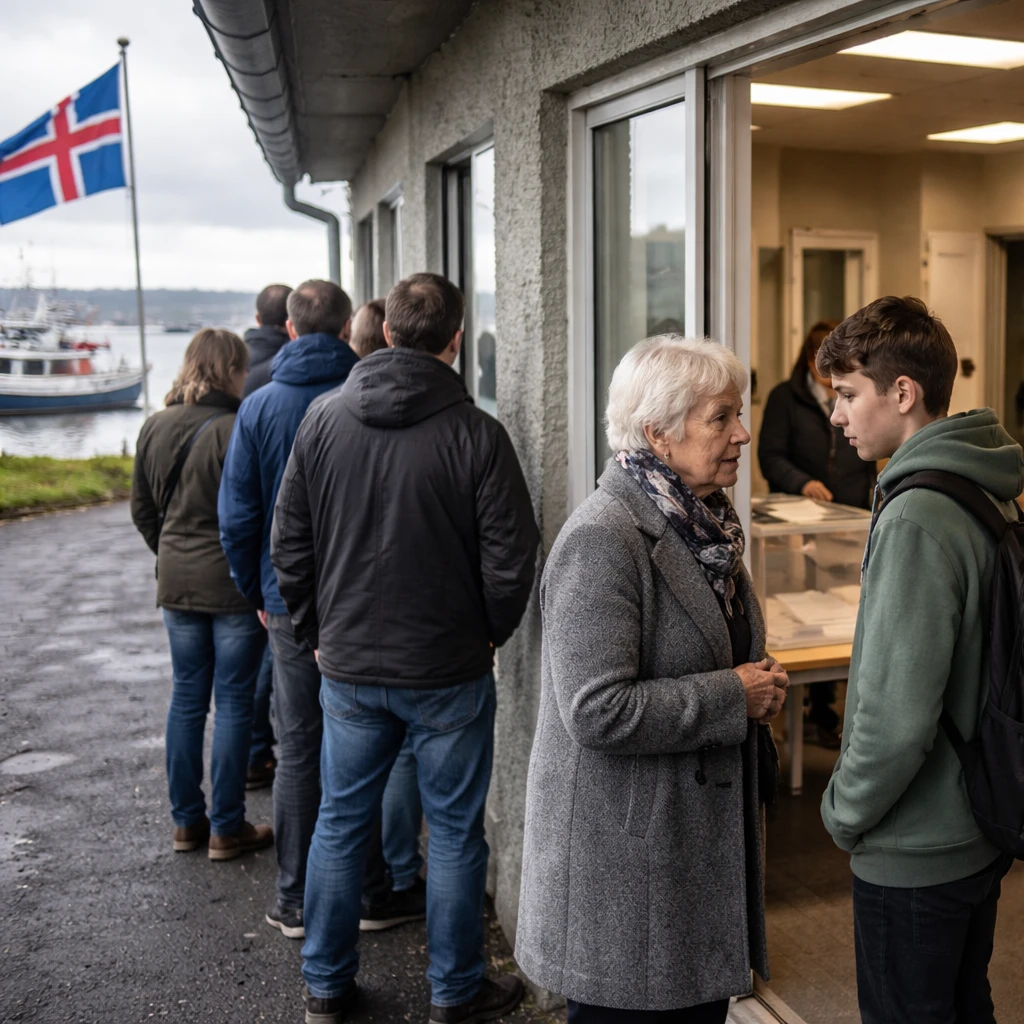
Icelanders went to the polls on Saturday to decide whether the country should reopen membership talks with the European Union, a vote that exposed a nation nearly evenly divided over questions of economics, security and control of its marine resources.
The campaign had been shaped by competing claims: supporters say renewed negotiations could help ease the burden of high borrowing costs and provide greater external security, while opponents contend that joining the EU would compromise the island's sovereignty and its authority over fishing waters. With the result too close to call, a Gallup poll released on Friday indicated a narrow majority opposed the government's proposal to restart talks, a modest reversal from previous surveys that had shown a slight lead for those backing renewed negotiations.
Backers of reopening negotiations argue EU entry could alleviate insurance against volatile global developments and potentially reduce interest-rate pressure on the domestic economy. They framed the case around the strain of high borrowing costs and an unsettled international environment, citing the war in Ukraine and threats directed at other Arctic territories as part of the broader security context informing their argument.
Opponents, for their part, warned that accession would endanger national sovereignty and diminish Iceland's autonomous control over its fishing grounds - a politically sensitive issue given the centrality of fisheries to the national economy and identity.
After casting her ballot in the capital, Prime Minister Kristrun Frostadottir described the referendum day as long anticipated and reiterated that her administration would press on with its work irrespective of the outcome. "This is a great day, we’ve been waiting for this for years to be able to have a vote," she said, underlining the domestic political weight the issue carries.
Crucially, a 'yes' vote would not immediately enroll Iceland in the EU. Rather, it would clear the way for formal discussions with Brussels - a process that, according to a foreign ministry memo, could be initiated by the end of 2026 and might last between 18 and 24 months. Any accession discussions would be followed by a second referendum, likely several years after negotiations began, at which point Icelanders would take a further decision on actual membership.
Many of the debates leading up to the vote centered less on geopolitics than on domestic economic pressures. Iceland has been contending with persistent inflation and very high interest rates that have made mortgages onerous for homeowners. Supporters of the 'yes' option highlighted the possibility that EU membership - and the potential eventual adoption of the euro - could offer some relief from those pressures. At present, Iceland's central bank rate stands at 8.00%, compared with 2.25% at the European Central Bank.
Vilhjalmur Hilmarsson, chief economist at Viska, one of the country's largest labour unions, said that accession would not be a cure for Iceland's deeper structural problems but could act as a catalyst toward healthier economic outcomes. "It would not solve Iceland’s structural faults, but it could become a catalyst to a more healthy economy," he said.
Opposition leader Gudrun Hafsteinsdottir, who led the 'no' campaign, rejected the notion that Brussels would solve Iceland's domestic economic challenges. "These are not problems that Brussels will solve for us. These are problems that Icelandic politicians must solve," she said, framing the disagreement as one of domestic policy responsibility rather than an external fix.
Voters on the ground illustrated the divide. Iwo Egill Macuga Arnasson, a 19-year-old student who cast his ballot in Reykjavik, said he intended to support reopening negotiations because he believed the question would substantially affect his future. Conversely, 70-year-old Ragnhildur Skarphedinsdottir, also voting in Reykjavik, said Iceland was managing well independently and that she would vote 'no' to preserve that autonomy. "By staying independent as we are, we look brightly to the future," she said.
The allocation of fishing rights emerged as a particularly potent sticking point. Under EU rules, quotas are informed in part by historical fishing patterns, and some officials argue that because no EU country has fished Icelandic waters for decades, Iceland could retain effective control. Skeptics remained unconvinced; Hafsteinsdottir warned that early assurances of flexibility from the EU could prove temporary. "I know that the European Union will come up with some promises of some flexibility, especially in the beginning, but we know that it will not be for good," she said.
For historical context within the framework of the vote, Iceland first applied for EU membership in 2009 during the financial crisis that struck the island's small, exposed economy. Those talks were terminated in 2013 after a eurosceptic government decided to shelve the accession process. Renewed geopolitical tensions in recent years have revived urgency around the question, prompting the current referendum.
Polling stations were scheduled to close at 2200 GMT on Saturday, with results expected in the early hours of Sunday.
Key points
- The electorate is closely divided on whether to reopen EU accession talks, with a late Gallup poll showing a narrow majority opposed.
- Economic considerations - notably high inflation and an 8.00% central bank rate compared with the ECB's 2.25% - and control over fishing waters are central to voters' decisions.
- If approved, reopening talks would be the start of a multi-year process that could begin by the end of 2026 and take 18-24 months, culminating in a later referendum on actual EU membership.
Risks and uncertainties
- Uncertainty over fishing rights and quota arrangements could affect the fisheries sector and related exports if accession talks proceed.
- The potential economic benefits of opening negotiations - including any relief on interest rates or inflation through close alignment with EU monetary policy - are contested, creating policy uncertainty for housing and financial markets.
- Timing and duration of accession talks are uncertain; the proposed timeline in a foreign ministry memo is an estimate contingent on a 'yes' vote.