
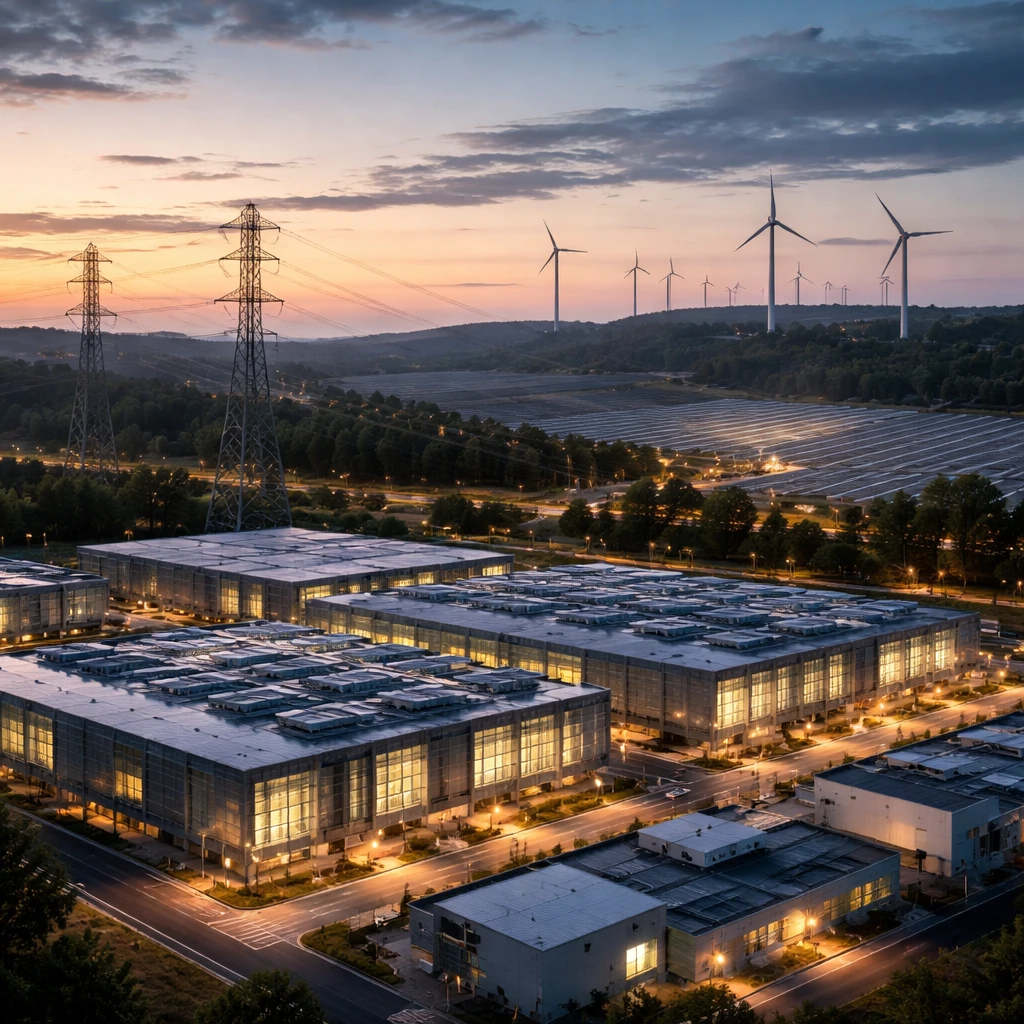
The Energy Information Administration said Tuesday in its Short-Term Energy Outlook that U.S. electricity consumption will continue an upward trajectory, setting new annual records in 2026 and 2027 after a record year in 2025.
The agency forecast total power demand at a record 4,195 billion kilowatt-hours in 2025, rising to 4,248 billion kWh in 2026 and to 4,379 billion kWh in 2027.
According to the EIA, much of the growth in electricity use is attributable to data center activity that supports artificial intelligence workloads and cryptocurrency operations. The agency also cited a broader trend of electrification as households and businesses move away from fossil fuels for heating and transportation.
One notable sectoral shift in the outlook is the projected relationship between commercial and residential consumption. The EIA expects commercial electricity demand to exceed residential demand in 2027 for the first time on record.
For 2026 specifically, the EIA projected power sales of 1,524 billion kWh for residential customers, 1,527 billion kWh for commercial users and 1,053 billion kWh for industrial users. By comparison, the agency noted all-time highs in 2025 of 1,515 billion kWh for residential consumption and 1,493 billion kWh for commercial consumption, while industrial electricity use previously peaked at 1,064 billion kWh in 2000.
The agency also provided projections for retail electricity prices and regional patterns. Residential electricity prices are forecast to increase by 5% in 2026, with further increases expected in 2027 but at a slower pace. The EIA indicated that East Coast regions are likely to see the largest price increases.
In terms of generation mix, the EIA sees coal's share falling from 17% in 2025 to 16% in 2026 and to 15% in 2027. Natural gas generation is projected to account for 39% of generation in 2026, down from 40% in 2025, before returning to a 40% share in 2027. Renewable energy's portion of generation is forecast to rise from about 24% in 2025 to 25% in 2026 and to 27% in 2027. Nuclear power is expected to maintain an 18% share across all three years.
The EIA also released sectoral natural gas sales projections for 2026. It forecast residential natural gas sales falling to 12.4 billion cubic feet per day and commercial sales declining to 9.4 bcfd, while industrial sales are expected to rise to 23.9 bcfd and natural gas consumption for power generation is projected at 36.0 bcfd.
Implications
The projections outline an evolving power sector in which demand growth is concentrated in specific high-intensity uses and where fuel shares shift modestly toward renewables even as natural gas remains a substantial portion of generation. The forecasted rise in residential electricity prices, particularly on the East Coast, may affect household energy budgets and utility revenue requirements.