
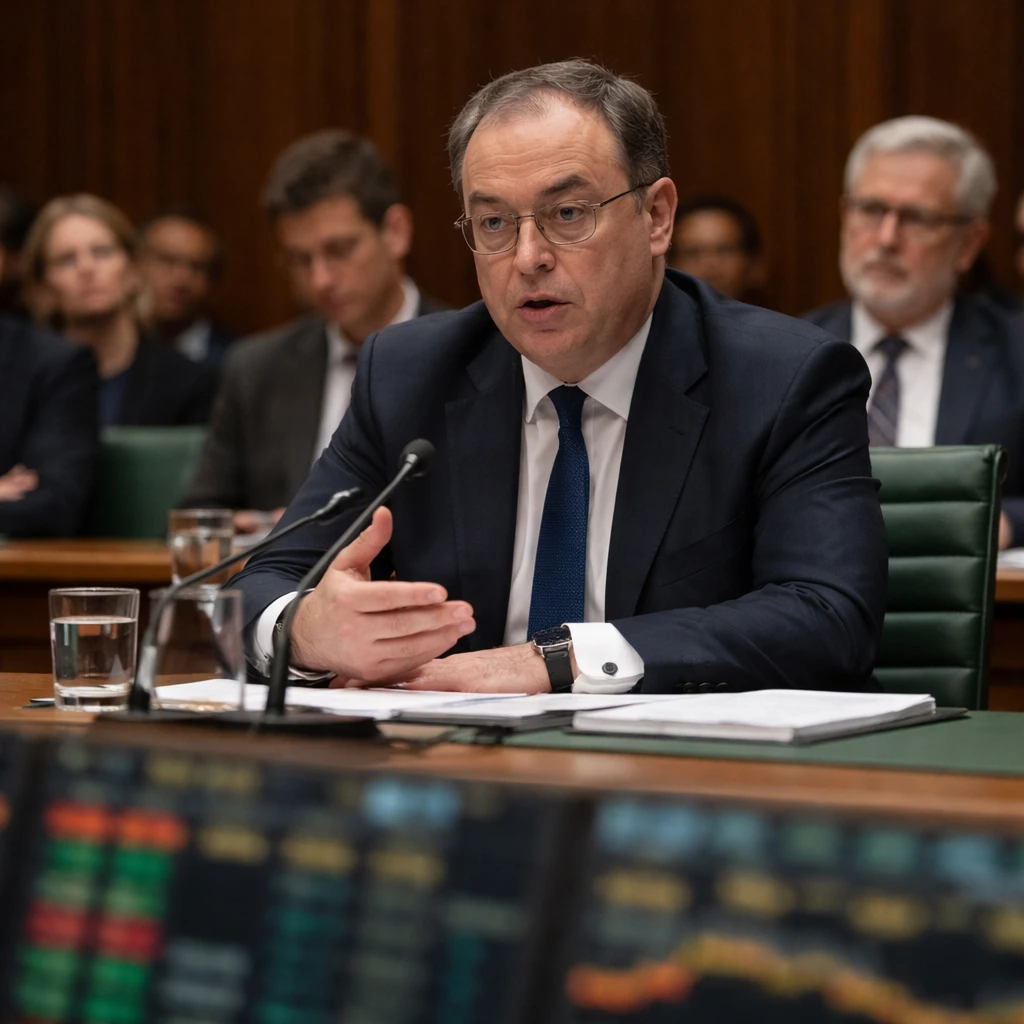
Bank of England Governor Andrew Bailey told members of parliament's Treasury Committee that market-implied interest rate expectations include a notable "risk premium" which, he said, appears linked to investor concern over potential further rises in energy prices.
Bailey said the central bank's analysis suggested that investors were pricing in tightening that went beyond what could be explained by expectations about BoE policy moves alone. "When you look at the market curve, and when you break the market curve down as far as we can do ... they've got essentially a risk premium in there," he told lawmakers.
His comments were aimed at clarifying how the Bank interprets the information embedded in market prices for future rates. According to Bailey, the additional tightening reflected in those prices cannot be fully accounted for by anticipated decisions from the Bank itself, implying that markets have built in an extra cushion linked to broader uncertainties.
Bailey also sought to correct a possible misperception about the bank's intentions on rates. He said he wanted to "dispel the idea that we've really got a secret plan, we know where we're going to go to and it's unconditional." He framed the possibility of a Bank rate increase as something that depends on developments in the economy, rather than as a predetermined outcome whose timing is merely a matter of when.
The governor's testimony to the Treasury Committee highlights two points the Bank is monitoring closely: first, the way market pricing reflects investor reactions to risks outside the direct control of monetary policy, and second, the Bank's insistence that future decisions will be guided by incoming economic evidence. In his remarks, Bailey linked the risk premium visible in the market curve to worries specifically about further energy price increases.
Contextual note: The Bank's assessment, as described by Bailey, separates the portion of market expectations that can be attributed to anticipated BoE actions from the portion that looks like a premium demanded by investors against the possibility of adverse external shocks such as higher energy costs.