
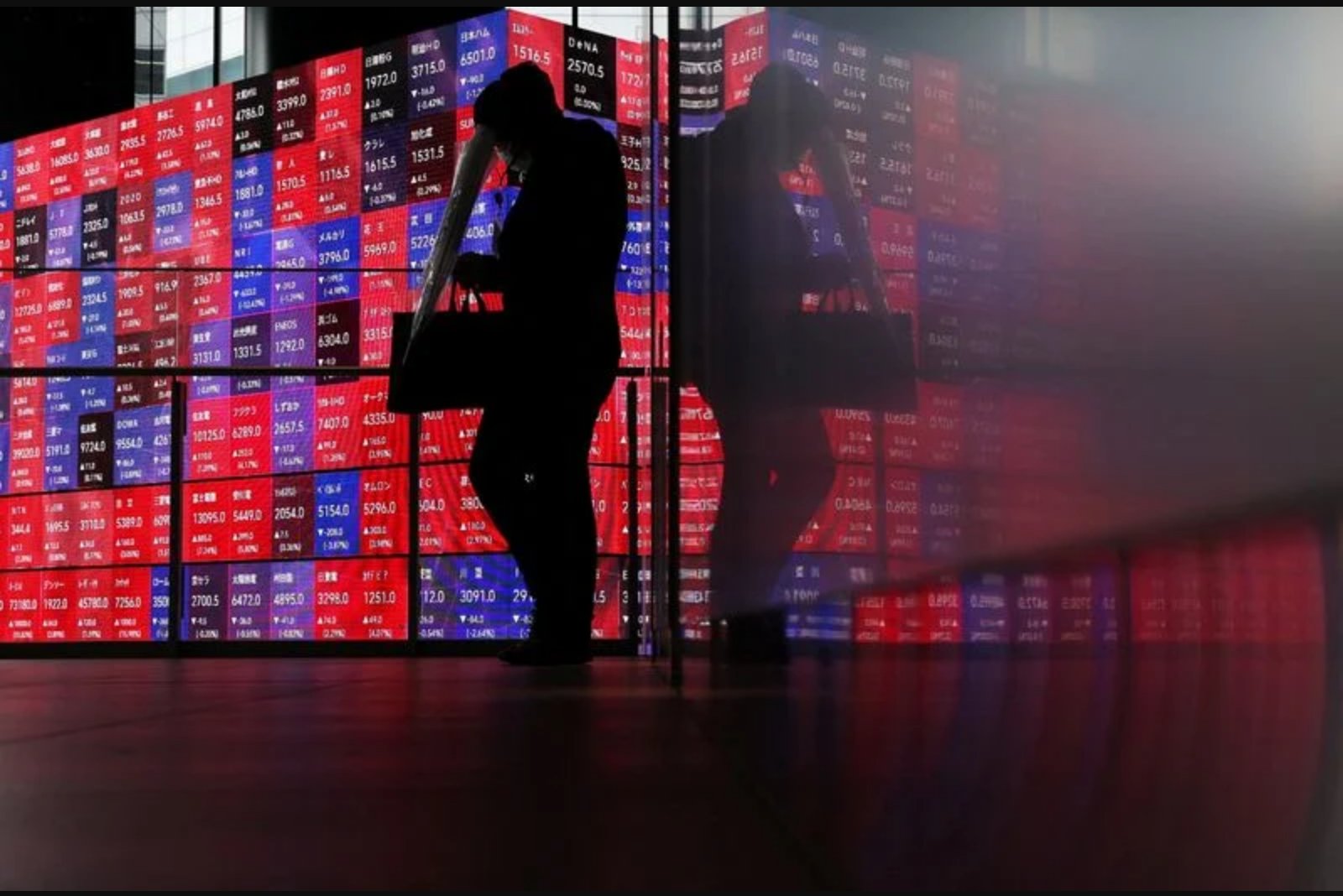
Equity markets across Asia initiated Friday's trading session with a decidedly mixed outlook, as investors absorbed the implications of a lackluster U.S. employment report that significantly weakened the case for an immediate interest rate hike by the Federal Reserve. The broadest MSCI index of Asia-Pacific equities, excluding Japan, exhibited volatility, oscillating between positive and negative territory before concluding the session with a marginal 0.1% gain. This modest uptick follows two consecutive days of downward pressure on regional markets.
Performance disparities were evident across different markets, with South Korea's Kospi index acting as a drag on the broader regional benchmark. This weakness was largely attributed to a synchronized decline in semiconductor manufacturers, which mirrored sharp losses observed in U.S. trading sessions. Meanwhile, forward indicators for the U.S. market showed S&P 500 e-mini futures and Nasdaq e-mini futures both ticking up by 0.1%, contrasting with a 1% decline in Japan's Nikkei 225 index.
The catalyst for this market recalibration was the June U.S. jobs data released on Thursday, which revealed a substantial deceleration in job growth. Furthermore, payroll figures for the preceding two months were revised downward, painting a clearer picture of a cooling labor market. Although the unemployment rate improved slightly to 4.2% from 4.3% in May, this reduction was driven by a decrease in labor force participation rather than robust job creation, pushing the participation rate to its lowest point in over five years.
Westpac analysts highlighted the significance of these figures in a research report, noting that the data directly challenged the established narrative suggesting the Fed was poised to implement a rate hike in the latter half of the year. Consequently, the tepid employment numbers have effectively doused trading expectations for an immediate tightening of monetary policy. Market participants are now increasingly pricing in the possibility that the Federal Reserve will maintain its current interest rate stance until at least October.
Data from the CME Group's FedWatch tool illustrates this shift in probability. Fed funds futures now indicate a 46.8% likelihood that the U.S. central bank will hold rates steady at its upcoming meeting scheduled for September 15 to 16. This represents a notable increase from the 35.8% probability recorded just a day prior.
Overnight in the United States, market performance was equally fragmented. The S&P 500 remained flat, while the Nasdaq Composite experienced a 0.8% decline. In contrast, the Dow Jones Industrial Average managed to reach a record closing level. It is important to note that U.S. markets will be closed on Friday in observance of the Independence Day holiday, a factor that has contributed to thinned market liquidity and heightened volatility.
In the foreign exchange market, the U.S. dollar strengthened by 0.2% against the yen, trading at 161.435 yen at the start of Asian trading. The greenback recovered some momentum after a volatile session on Thursday, where it had faced sudden strength from the Japanese currency following reports that authorities had adopted a new approach to market interventions. The exact drivers of this rally remained unclear. The U.S. dollar index, which tracks the dollar's value against a basket of six major currencies, held steady at 100.98 after a 0.5% slide on Thursday.
In the commodities sector, Brent crude futures dipped 0.4% to $71.49 as trading resumed. Gold prices saw a marginal 0.1% increase, reaching $4,125.49. In the digital asset space, bitcoin fell 0.4% to $61,306.45, while ether declined by 0.7% to $1,692.16.