
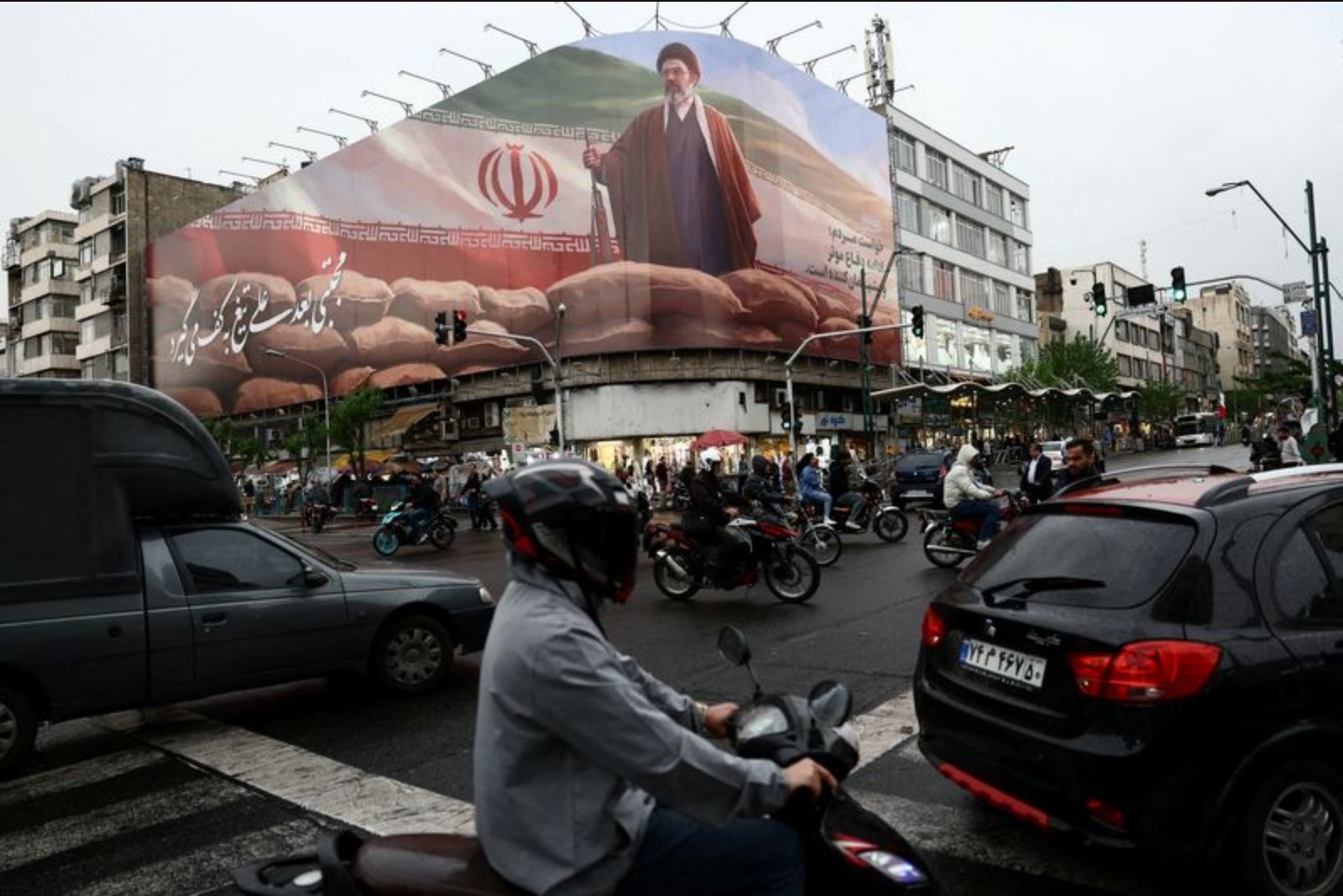
DUBAI, April 28 - Two months into a war with the U.S. and Israel, Iran no longer has a single, undisputed clerical arbiter at the summit of its state structure, marking a sharp departure from four decades of governance organized around a supreme leader. The opening-day killing of Ayatollah Ali Khamenei, and the subsequent elevation of his son Mojtaba - who was gravely wounded in the same strike - have ushered in a wartime order in which commanders of the Islamic Revolutionary Guard Corps (IRGC) play the central role.
People familiar with deliberations inside Tehran say Mojtaba Khamenei remains formally at the apex of the system, but his function has shifted toward validating decisions crafted by military and security figures rather than issuing independent directives. That concentration of authority has coalesced around a narrower, harder-line inner circle rooted in the Supreme National Security Council (SNSC), the Supreme Leader’s office and the IRGC, which now exerts decisive influence over both military strategy and major political choices, according to Iranian officials and analysts.
Decision-making in wartime
Insiders describe a wartime leadership that runs policy through institutions closely tied to the Guards. The effect, they say, is a system in which the clerical role operates more as a legitimizing mechanism than as a command organ. “Important deals probably pass through him,” Iranian analyst Arash Azizi said of Mojtaba, “but I can’t see him overruling the National Security Council. How could he go against those running the war effort?”
The practical consequence is that real power now resides in a wartime leadership centered on the SNSC and dominated by IRGC commanders. That leadership has direct control over military operations and significant sway on political decisions. Observers and participants in back-channel diplomacy report delays and disjointed responses emanating from Tehran as a result of diffused operational control. “The Iranians are painfully slow in their response,” said a senior Pakistani government official briefed on peace talks Islamabad has been mediating. “There is apparently no one decision-making command structure. At times, it takes them 2 to 3 days to respond.”
Negotiations and the cast of interlocutors
On the diplomatic front, Foreign Minister Abbas Araqchi has been the visible face at talks with the United States, and more recently parliament speaker Mohammed Baqer Qalibaf - a former IRGC commander who has served as Tehran mayor and run for president - has taken on a prominent role as a bridge between political, security and clerical elites. Despite these diplomatic figures, sources involved in the negotiations identify IRGC commander Ahmad Vahidi as the central on-the-ground interlocutor in the talks, including during moments when a ceasefire was announced.
Mojtaba Khamenei, who was severely injured in the opening strike that killed his father and other relatives and left him disfigured with serious leg wounds, has not made public appearances. Those close to his inner circle say security constraints limit his direct engagement, and he communicates through IRGC aides or via restricted audio links.
Iran submitted a fresh proposal to Washington on Monday that, according to senior Iranian sources, envisages staged talks. That proposal would set aside the nuclear issue at the start until the war ends and until disputes over Gulf shipping are resolved. Washington, however, insists that nuclear matters must be addressed from the outset.
Where the impasse lies
Analysts familiar with the negotiations say the obstacle to a deal is not merely internal infighting in Tehran but rather the gulf between what Washington is prepared to offer and what Iran’s hardline Guards are willing to accept. Alan Eyre, an Iran expert and former U.S. diplomat, described a situation in which neither side is inclined to make concessions now, each calculating that time will work to its advantage - Iran by exploiting leverage over the Strait of Hormuz and Washington through economic pressure and blockade.
“Neither side wants to negotiate,” Eyre said, adding that both believed time would weaken the other - Iran through leverage over Hormuz and Washington through economic pressure and a blockade.
For both capitals, domestic political imperatives complicate flexibility. Iran’s IRGC is cautious about appearing weak in the face of the United States, while U.S. political leadership faces midterm election pressures that limit room for concessions. “For either, flexibility would be seen as weakness,” Eyre said.
Hardline consolidation and policy outlook
Sources close to Tehran’s centers of power say the Guards have used the wartime environment to sideline pragmatic actors and to entrench a security-first worldview. Driven by revolutionary Islamism and an emphasis on deterrence, the Guards view their mission as defending the Islamic Republic at home while projecting strength abroad. This posture aligns with hardline elements within the judiciary and parts of the clerical establishment and favors centralized control and resistance to Western pressure, particularly on nuclear policy and Iran’s regional posture.
That outlook, and the Guards’ dominance in day-to-day decision-making, point to a foreign policy likely to be more assertive and a domestic environment prone to tighter repression, according to sources familiar with inner policy-making circles. Analysts say the range of permissible policy is narrowing - the choice is less about moderate versus hardline positions than about hardline versus even harder-line options. A small minority within power circles may push for further escalation, two Iranian sources said, although the Guards have so far constrained that impulse.
“We’ve gone from divine power to hard power,” said Aaron David Miller, a former U.S. negotiator, describing the shift from clerical influence to the ascendancy of the Revolutionary Guard Corps in governing Iran.
Alex Vatanka, a senior fellow at the Middle East Institute, and others note that while differences of opinion persist inside Tehran, decision-making has coalesced around security institutions, with Mojtaba acting more as a convening figure than an independent decider.
Stability and cohesion under military leadership
Despite sustained military and economic pressure from the United States and Israel, Iranian officials and analysts report no visible signs of systemic fracture or popular capitulation as the conflict approaches nine weeks. Observers see no evidence of deep splits inside the governing apparatus or significant street-level opposition that could challenge the emergent security-centered command.
This cohesion, they argue, indicates that the Guards and security services, rather than merely executing orders, are driving the war’s direction. A strategic consensus articulated by some analysts includes avoiding a return to full-scale war, preserving leverage—especially over the Strait of Hormuz—and positioning Iran to emerge from the conflict stronger politically, economically and militarily.
Implications for regional security and energy flows
Observers point out that the wartime leadership’s priorities - avoidance of full-scale escalation while maintaining leverage over key chokepoints - have direct implications for Gulf shipping and energy markets. The report of a staged negotiation proposal that seeks to resolve Gulf shipping disputes before tackling the nuclear file underscores how central control over maritime routes and the Strait of Hormuz has become to Iran’s bargaining posture. That posture matters to markets and to countries reliant on uninterrupted flows of oil and gas through the Gulf.
For now, Iran’s leadership remains consolidated around the IRGC and security institutions, with Mojtaba Khamenei providing formal assent to outcomes shaped by those bodies. Whether that structure will prove durable beyond the immediate wartime environment remains unclear to outside observers. Sources close to internal discussions caution that the current order concentrates authority in a narrower, harder-line leadership whose calculations are informed by military priorities and resistance to Western demands.
Outlook
The current configuration - a wartime leadership dominated by the Guards, constrained clerical authority, and a staged negotiating proposal emphasizing Gulf shipping - frames Tehran’s stance as it continues mediated talks with Washington. With both sides wary of appearing weak and with command concentrated in institutions prioritizing security and deterrence, diplomatic progress faces significant hurdles.
What remains evident to analysts and officials is that Iran has shifted from a governance model centered on a single clerical arbiter to one in which hard power, embodied by the IRGC and security councils, exercises primary control over the country’s wartime trajectory and its approach to negotiation.