
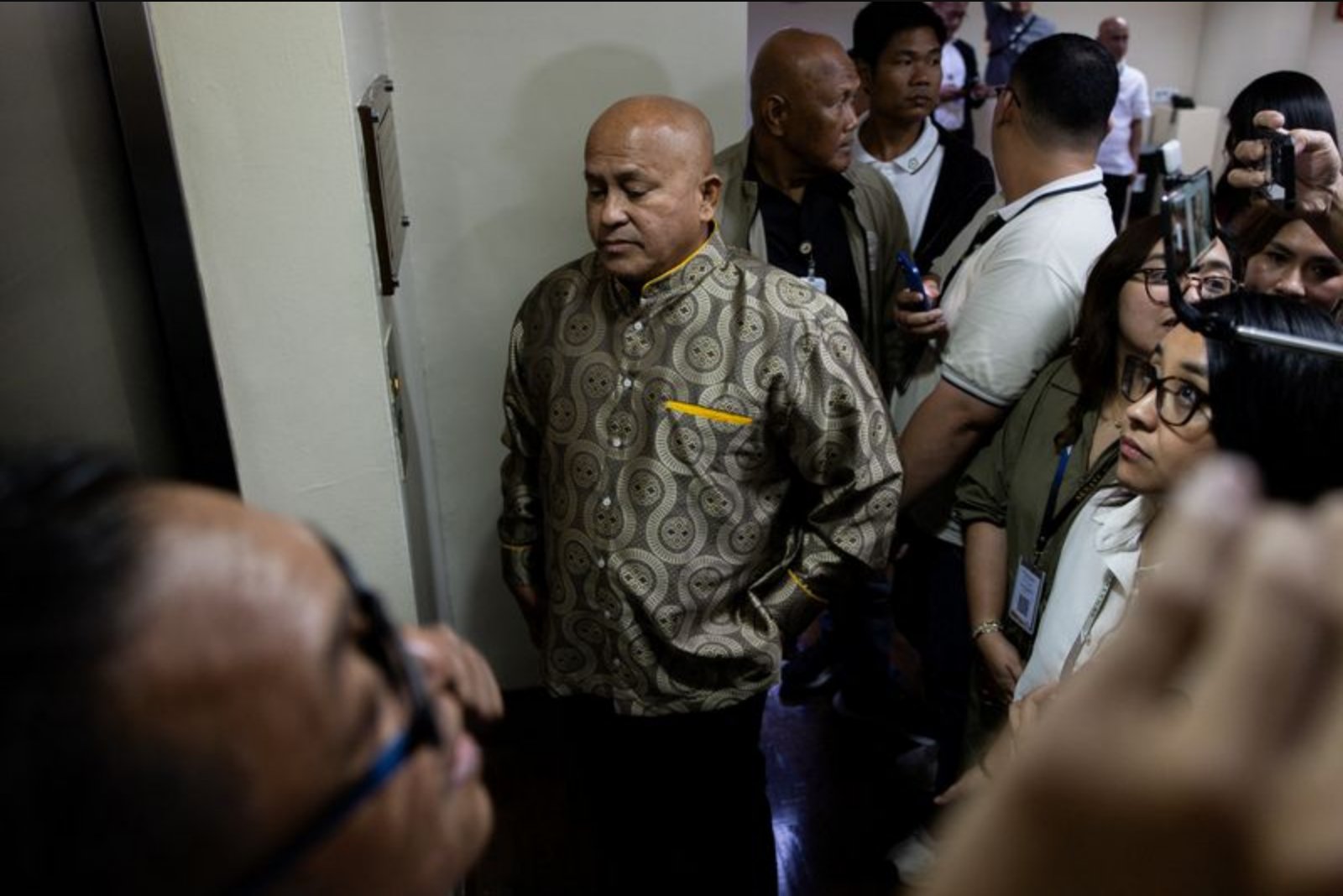
Relatives of victims killed during the Philippines' anti-drug operations gathered outside the Senate to demand the arrest of Senator Ronald dela Rosa after the International Criminal Court unsealed a warrant for his arrest on charges of crimes against humanity. The protest took on new urgency when hours later gunfire erupted inside the Senate building as security tensions rose and the senator, who had sought refuge in the chamber to evade arrest, subsequently left the premises.
For Llore Pasco, who lost two sons in anti-drug operations and who recently observed the ninth anniversary of their deaths, the day’s events were a painful echo of the disparities she sees in how the justice system treats powerful officials versus alleged drug suspects.
“That’s how it is. If you are rich and powerful, even if you are at fault, you are still protected. It’s not equal,” said Pasco, 71.
Pasco and other family members had spent hours outside the Senate urging authorities to arrest dela Rosa after Senate leaders placed him under protection on the same day the ICC unsealed its arrest warrant. Dela Rosa, a former national police chief who was a key lieutenant to then-President Rodrigo Duterte, has been identified by the ICC as an architect of the anti-drug campaign that began in 2016. The former president, now 81, faces the same charges and is awaiting trial in The Hague following his arrest last year.
Authorities reported that more than 6,000 suspects were killed in official anti-drug operations during Duterte’s presidency. Rights groups cited by the families say the true number of deaths is likely higher, and only a small fraction of killings have resulted in convictions in Philippine courts. Among the officially recorded fatalities were Pasco’s two sons, who were killed on May 12, 2017.
Late in the day, gunshots inside the Senate forced people to take cover. The incident followed a social media appeal by dela Rosa calling on supporters to mobilise, saying law enforcement officers were en route to arrest him. Senate President Alan Peter Cayetano later stated that dela Rosa had left the Senate premises on Thursday.
For many of the families gathered outside the legislative complex, the contrast between the protections afforded to a high-profile politician and the treatment meted out to alleged drug suspects was stark and personal. Pasco posed a challenge to the senator directly:
“Surrender and face the crimes you’re accused of if you really have no guilt,” she said. “There is a process, that’s what you call due process. But for us, what process did our families receive? Our children were simply killed.”
She added that addiction should be viewed as a condition requiring care: “They see our children as a scourge on society because they used drugs, when in fact addiction is something that should be treated.”
Dahlia Cuartero, who lost her son in 2019, described the same sense of exclusion from justice. She said the ICC has provided a platform victims lacked domestically and voiced a broader perception of inequality.
“Justice in this country is really only for the rich. For us poor people, we have nothing to rely on,” Cuartero said. “We are thirsty for justice.”
The day’s sequence - from public demonstrations and calls for arrest, to protection granted within the Senate, to armed disturbance inside the chamber - underscored long-standing grievances among families of those killed in the anti-drug campaign. Their appeals center on accountability for a campaign they say claimed thousands of lives and on a justice system that they perceive as failing to hold powerful officials to the same standards imposed on alleged suspects.
Context in this account is drawn from the details reported about the protests, the ICC action, and official and family statements. Where family members point to disparities in treatment and seek recourse through international mechanisms, they emphasize the need for due process to apply equally to those accused and to those who have lost loved ones in the campaign.