
Hook & thesis
Paccar (PCAR) looks buyable here. The shares are sitting just under the 52-week high after a multi-month recovery from last spring’s lows, technical momentum is positive, and the company’s cash generation gives management optionality even while cyclicality normalizes. Given the recent string of positive industry headlines and resilient parts and finance segments, I expect an earnings beat that could prompt a visible re-rating into the mid term.
The trade is simple and actionable: initiate a long at market with a defined stop-loss and two profit targets. The plan is designed for a mid-term window to let an earnings surprise and subsequent re-rating play out while keeping downside risk limited.
Business overview - why the market should care
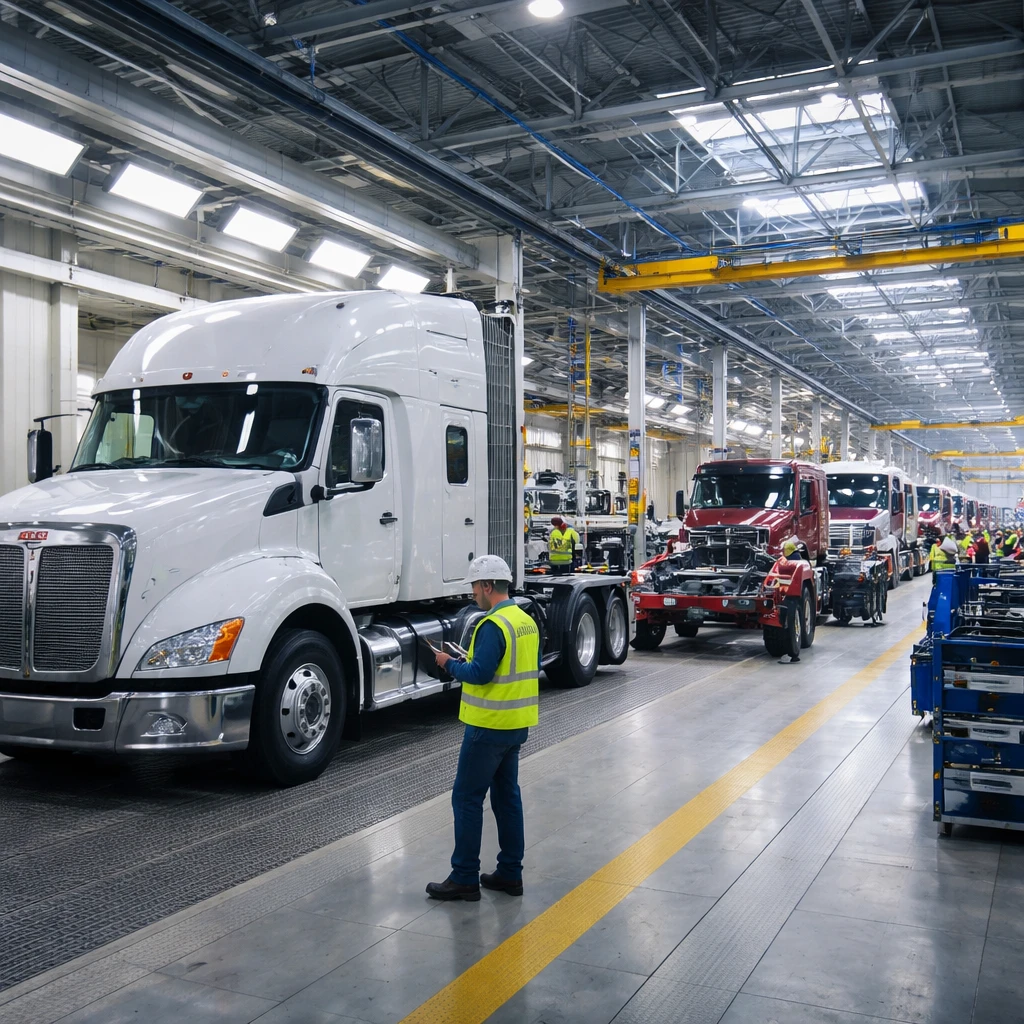
Paccar is a global truck maker that produces heavy, medium and light-duty diesel trucks under Kenworth, Peterbilt and DAF. It also operates a large Parts segment and a Financial Services business. These three businesses are complementary: truck manufacturing is cyclical, but the Parts and Financial Services units provide recurring revenue and cash flow that smooth results across the cycle. That mix matters now because truck volumes remain pressured, but parts demand and finance yields have been more resilient.
What the numbers say
Key metrics investors should keep front-of-mind:
- Market capitalization ~ $66.8 billion and enterprise value roughly $76.1 billion.
- Reported EPS around $4.52 with a price-to-earnings in the high 20s (~28x).
- Trailing free cash flow about $3.02 billion; cash on the balance sheet is meaningful and the company pays a quarterly dividend ($0.33 per share).
- 2025 full-year sales declined to $28.4 billion (-16% year-over-year) and reported EPS fell materially, but the Parts and Financial Services segments showed resilience during the downcycle.
Those numbers show a classic capital-heavy manufacturer that nevertheless throws off steady cash. The market is currently valuing Paccar at roughly 28x earnings and an EV/EBITDA near 16.6x. That multiple is not cheap on absolute terms, but when you account for the cash generation and strong aftermarket margins the valuation looks reconcilable if growth stabilizes and margins recover modestly.
Technical and positioning context
Momentum indicators support a tactical long: the 10- and 20-day moving averages are below the current price, the 9-day EMA is above the 21-day EMA, MACD is in bullish momentum and RSI sits around 61 — constructive, but not extended. Average daily volume is roughly 2.6 million shares, giving the stock adequate liquidity for an active trade. Short interest has been falling from prior highs; recent days-to-cover hover near 4 days — a moderate level that could amplify moves on an earnings surprise.
Valuation framing
Paccar’s market cap of about $66.8 billion against free cash flow of roughly $3.0 billion gives a free cash flow yield near 4.5% on trailing data. The stock trades at about 28x reported earnings and an EV/EBITDA of 16.6x. Those multiples reflect both the industry cyclicality and a still-healthy profitability profile: return on equity sits north of 12% and returns on assets are positive. If Paccar demonstrates stabilization in truck orders or margin improvement in Parts & Financial Services, the market is likely to re-rate multiples higher from a discount to a more normalized industrial multiple — the re-rating case underpins the trade.
Catalysts (2-5)
- Earnings release and management commentary that show smaller-than-expected declines in truck deliveries and better-than-modelled margins in Parts and Financial Services.
- Positive industry flow-through: infrastructure spending and continued demand in vocational/box truck categories supporting replacement cycles.
- Dealer or alliance announcements that increase service automation and reduce downtime, improving parts margins and aftersales retention.
- Macro directional tailwinds such as easing supply-chain constraints or improving freight demand that translate into improved order outlooks.
Trade plan (actionable)
Thesis: Expect a modest earnings beat and constructive management commentary to trigger a re-rating over the mid term as markets reward better cash conversion and structural parts resilience.
Entry: Buy at market around $126.98.
Stop loss: $120.00 - invalidates the near-term momentum setup and limits downside to roughly 5.6% from entry.
Target 1: $138.00 - near-term post-earnings re-rate objective capturing a move toward the recent 52-week high and multiple expansion.
Target 2: $155.00 - stretch target if results materially beat and guidance implies stabilization; captures a larger multiple re-rating backed by improved cash flow conversion.
Horizon: mid term (45 trading days). The window allows for the earnings announcement, initial market reaction and the follow-through re-rating period. If the company beats and commentary is constructive, sell or scale toward Target 1 within a couple of weeks post-announcement; hold to Target 2 only if the re-rating momentum is sustained and volume-backed.
Position sizing & risk management: Limit position size so the distance from entry to stop equals a pre-determined allocation of portfolio risk (e.g., 1-2% of portfolio). Re-evaluate on the earnings print and be prepared to tighten stops into strength.
Supporting data table
| Metric | Value |
|---|---|
| Market cap | $66.8B |
| EPS (trailing) | $4.52 |
| P/E | ~28x |
| Free cash flow (trailing) | $3.02B |
| EV/EBITDA | ~16.6x |
| 52-week range | $84.65 - $131.88 |
| Avg daily volume | ~2.6M |
Risks and counterarguments
Every trade has friction. Below are the primary risks that would invalidate or reduce the attractiveness of this long idea:
- Earnings miss or weak guidance. The clearest downside trigger is a quarterly beat that fails to materialize or an earnings print with weaker-than-expected guidance. Given the cyclicality of truck orders, management could conservatively guide, which would pressure the multiple.
- Macroeconomic slowdown. Freight volumes and capex plans are sensitive to macro conditions; a sudden slowdown in industrial activity or tighter credit conditions would depress truck orders and parts demand.
- Margin pressure in Parts/Financial Services. The bullish case leans on Parts and Finance to cushion manufacturing weakness. If those segments show margin compression or worsening credit losses, cash flow and valuation sustainment weaken.
- Policy or trade shocks. Tariffs or trade policy shocks that raise component costs or constrain exports could hurt profitability and offset any positive order trends.
- Counterargument: The market has already priced in stabilization; Paccar currently trades at a mid-to-high single-digit free cash flow yield and ~28x earnings. If investors view the cycle as structurally impaired rather than cyclical, even a one-quarter beat may not lead to a durable re-rating. In that scenario, upside could be muted, and the trade would underperform.
What would change my mind?
I will reconsider the bullish stance if the earnings release shows sustained declines in parts revenue or materially higher credit losses in Financial Services, or if management signals a step-change downward in truck order visibility. Conversely, stronger-than-expected guidance on orders or clear signs of improving aftermarket margins would reinforce the thesis and prompt adding to the position toward the $155 target.
Conclusion
Paccar is a pragmatic, cash-generative truck manufacturer with aftermarket and finance businesses that reduce headline cyclicality. The shares offer a defined, mid-term trading opportunity: buy at market around $126.98 with a $120 stop and staged targets at $138 and $155. The trade balances a reasonable upside if Paccar posts an earnings beat and management confirms stabilization, while keeping downside contained if momentum breaks. Risk is real — particularly around cyclical truck demand — but the company's cash flow and parts resiliency make a post-earnings re-rating a credible outcome.
Selected recent catalyst
Industry collaboration on service management was announced on 03/15/2026, which could incrementally improve aftermarket efficiency and parts margins over time.