
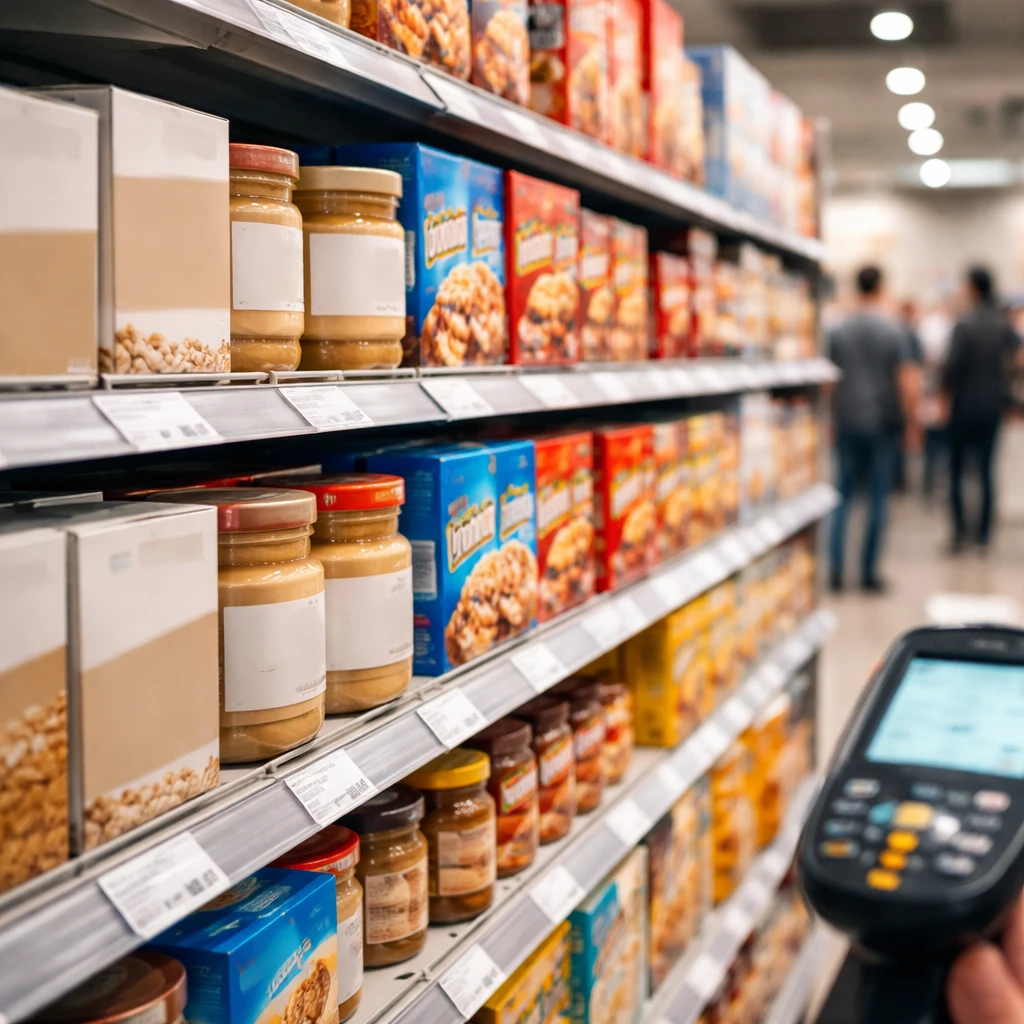
Bank of America published its quarterly private label tracker on Wednesday, presenting updated private label performance across packaged food subcategories and analyzing company exposure. The report incorporates an expanded set of channels from Nielsen, now including data from Costco, Amazon P1, and Pet Specialty stores. In addition, the tracker shifts its comparison baseline from pre-COVID levels to 2023 levels to better capture share movements after several years of inflation.
According to NielsenIQ data cited in the analysis, private label accounted for 29.1% of total food sales in the first quarter of 2026. That share was unchanged versus the fourth quarter of 2025 and was up 10 basis points compared with the first quarter of 2025. The report also notes that price gaps between total food and private label food narrowed by 5 basis points compared with the fourth quarter of 2025.
At the category level, refrigerated dough saw a notable sequential increase in private label share, rising 210 basis points. Bank of America observed that such an increase is typical in the first quarter following strong branded share improvement during the peak baking season in the fourth quarter. The analysis identifies General Mills (NYSE:GIS) as the principal branded competitor in refrigerated dough.
Private label share also advanced in peanut butter on both a sequential and year-over-year basis. The report references a disclosure from Hormel Foods (NYSE:HRL), which reported volume softness in its Skippy brand during its first quarter 2026 earnings call in January.
In snacking nuts and seeds, private label retained the largest share position, improving about 90 basis points sequentially to roughly 44% of the category. Bank of America notes that those private label gains came at the expense of smaller manufacturers and The Wonderful Co.
Shelf-stable soup diverged from those trends, with private label share declining 60 basis points sequentially, a change the report attributes to movement in ready-to-serve products. Still, Bank of America documents that Campbell Soup (NYSE:CPB) has ceded share to private label on a year-over-year basis since the fourth quarter of 2024, with private label capturing share on nearly a one-for-one basis. General Mills has also lost share to private label in shelf-stable soup since the second quarter of 2025.
In its company-level assessment, Bank of America judged that Hershey (NYSE:HSY), Mondelez (NASDAQ:MDLZ) and Conagra (NYSE:CAG) are relatively better positioned when accounting for weighted private label exposure, portfolio share positions and pricing gaps. By contrast, Campbell Soup, General Mills and Hormel Foods are identified as facing higher risk from private label exposure.
Key takeaways
- Private label made up 29.1% of total food sales in Q1 2026, unchanged from Q4 2025 and up 10 basis points year-over-year, per NielsenIQ.
- Nielsen channel coverage in the tracker was expanded to include Costco, Amazon P1 and Pet Specialty stores, and the baseline for comparison was moved to 2023 to better reflect post-inflation share shifts.
- Bank of America assessed relative company positioning versus private label exposure, identifying Hershey, Mondelez and Conagra as better positioned and Campbell Soup, General Mills and Hormel Foods as facing greater risk.
Risks and uncertainties
- Company exposure to private label share gains presents revenue and market-share pressure for certain consumer packaged goods firms, particularly Campbell Soup, General Mills and Hormel Foods - impacting packaged food and consumer staples sectors.
- Changes in Nielsen channel coverage and the shift in the comparison baseline to 2023 may affect comparability with earlier reports and analyses that used pre-COVID benchmarks - relevant to analysts tracking long-term trends in retail and food categories.
- Volume softness reported for branded products, such as Skippy in Hormel Foods' Q1 2026 commentary, introduces uncertainty for branded players in the peanut butter segment.
The report's expanded channel set and updated baseline aim to provide a clearer view of where private label has gained or lost ground after years of inflationary pressure. Bank of America's category-level observations and company exposure assessments offer a snapshot of current competitive dynamics between private label offerings and established branded manufacturers.