
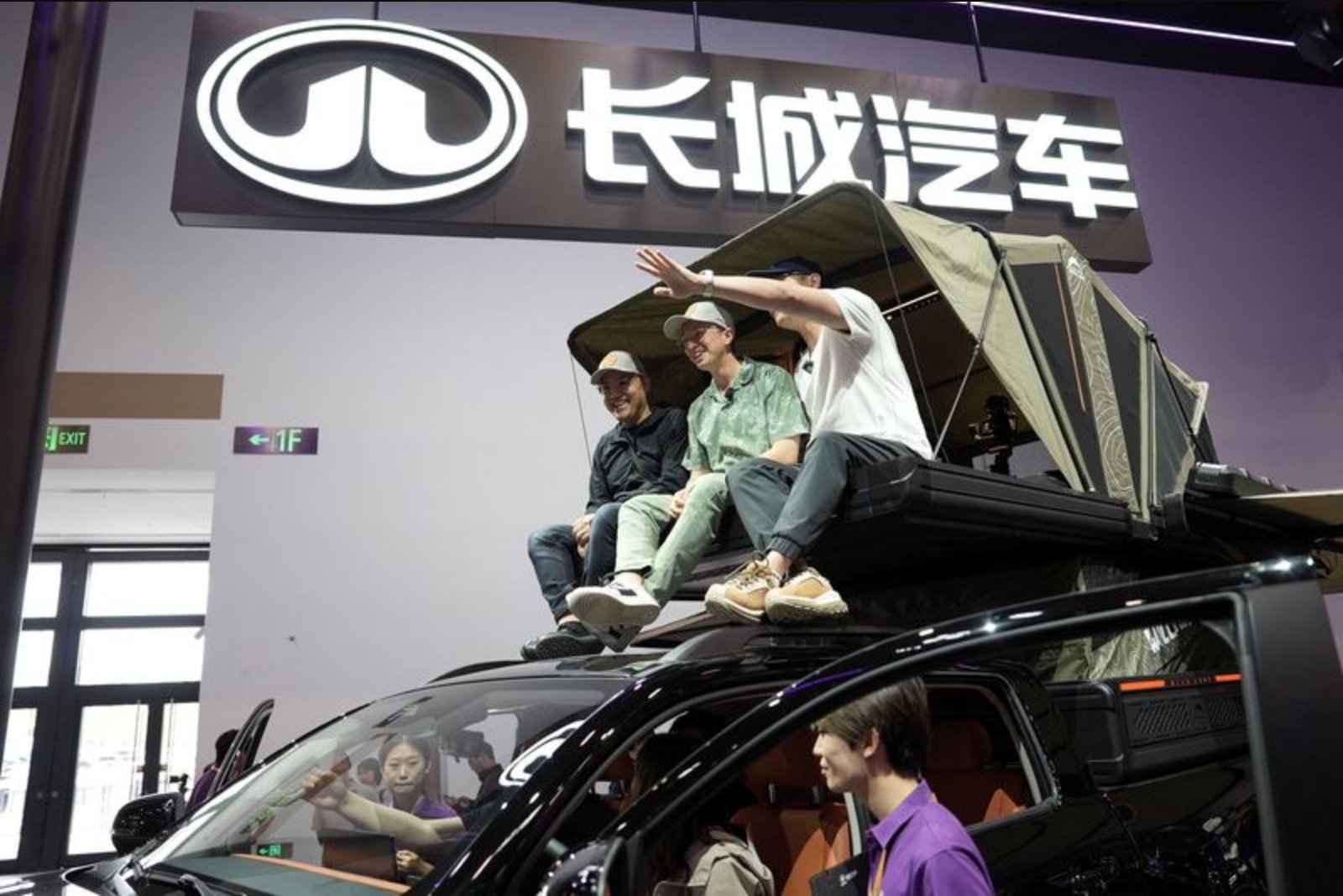
BEIJING, April 26 - An American YouTuber has been escorting foreign visitors through the sprawling displays at the Beijing Auto Show, giving them close-up access to Chinese electric and concept vehicles that many in the United States can currently only encounter on the internet.
Thirty-four-year-old Ethan Robertson led a group of more than a dozen people from countries including Australia, New Zealand and the United Arab Emirates through exhibition halls filled with electric SUVs, pickup trucks and futuristic concept cars. The tour aimed to provide English-speaking audiences a first-hand view of the vehicles driving attention toward China’s auto sector.
Robertson is co-founder of Wheelsboy, a YouTube channel focused on Chinese cars for English-language viewers. On the tour, attendees were shown a range of models that many found compelling for similar reasons: lower sticker prices, advanced onboard technology and a broad variety of designs.
At one display, Robertson highlighted a luxury electric SUV from Leapmotor, a brand backed by Stellantis. The vehicle features expansive screens and an atypical rear-seat amenity described as a fridge. "You’re looking at a car that’s maybe $30,000 and that car is fully equipped," he said. "Whereas $30,000 barely gets you into any electric vehicle or hybrid" in the United States.
The price differential translates into mixed reactions from Robertson’s largely American audience, who frequently respond with a combination of fascination and frustration. "Our comment section is full of people saying things like, ’I can’t believe the government won’t allow them to sell this car in my country,’" Robertson said.
Tour participants underscored the appeal of the vehicles on display. John Cordell, a 77-year-old retiree from New Zealand who previously worked in heating and ventilation, was drawn to a yellow Deepal S07 midsize crossover. Cordell said the car’s color initially caught his eye, but he also praised the interior layout, the heads-up display, the multiple screens and a surround-view camera system. He traveled with his brother-in-law and his son on a two-day tour that cost $399 per person.
Cordell already owns a Chinese-made electric vehicle in New Zealand, a BYD Atto 3, and said the level of engineering and technology influenced his purchase decisions. "Everything is very well engineered," he said.
Andrew Pertsoulis, a 62-year-old retired performance coach from Sydney, noted that the interior ambience and the tech-oriented cabins made the vehicles feel futuristic. "It’s what separates them," he said, adding that large screens and tech-rich interiors made him feel as if he had "stepped into a new generation of vehicle."
Robertson, who lives in China and has covered the country’s car industry for six years, said U.S. viewers’ impressions have shifted over that period. He described an evolution from viewing Chinese-made cars as low-quality imitations to recognizing that several brands are now advancing elements such as battery performance, software capabilities and charging speeds.
He also said that despite the positive coverage on his channel, which has 210,000 subscribers, some viewers sometimes accuse him of working for Chinese companies or the government. He denied those claims, saying he does not work for either.
Interest in Chinese automakers among Americans is growing, reflected in commentary from industry observers who follow developments more closely. Lei Xing, identified as the American co-host of the China EVs & More podcast, described China’s auto industry as very large and complex, noting that it includes more than 100 automakers. Lei said the scale of the market can be bewildering even to those who follow it.
Although Lei does not expect many Chinese brands to enter the U.S. market rapidly because of political hostility, he predicted that Chinese vehicles would ultimately make their way to American buyers. "It’s a matter of time," Lei said. "I know in my life I’m going to be able to buy a Chinese EV."
Context and takeaways
- The Beijing Auto Show serves as a venue for prospective buyers and enthusiasts to examine Chinese electric vehicles in person, rather than relying solely on online content.
- Visitors on guided tours highlighted affordability and integrated technology as key attractions, noting features and amenities that appear more fully specified than comparable-priced vehicles in the United States.
- Observers who follow the market say perceptions of Chinese-made cars have shifted from skepticism about quality to recognition of advancements in batteries, software and charging.
Notable details
- Robertson’s Wheelsboy channel focuses on Chinese automobiles for English-speaking viewers and has 210,000 subscribers.
- The tour featured models including a Leapmotor luxury electric SUV and a Deepal S07 midsize crossover; Roberton pointed to examples where technology content is significant at price points around $30,000.
- Tour cost cited for at least one two-day group was $399 per person.
This article summarizes on-site impressions from visitors to the Beijing Auto Show and comments from people who follow China’s electric vehicle industry. It reflects statements and observations made by attendees, the YouTuber leading tours and podcast hosts, without introducing additional claims beyond those provided by participants.