
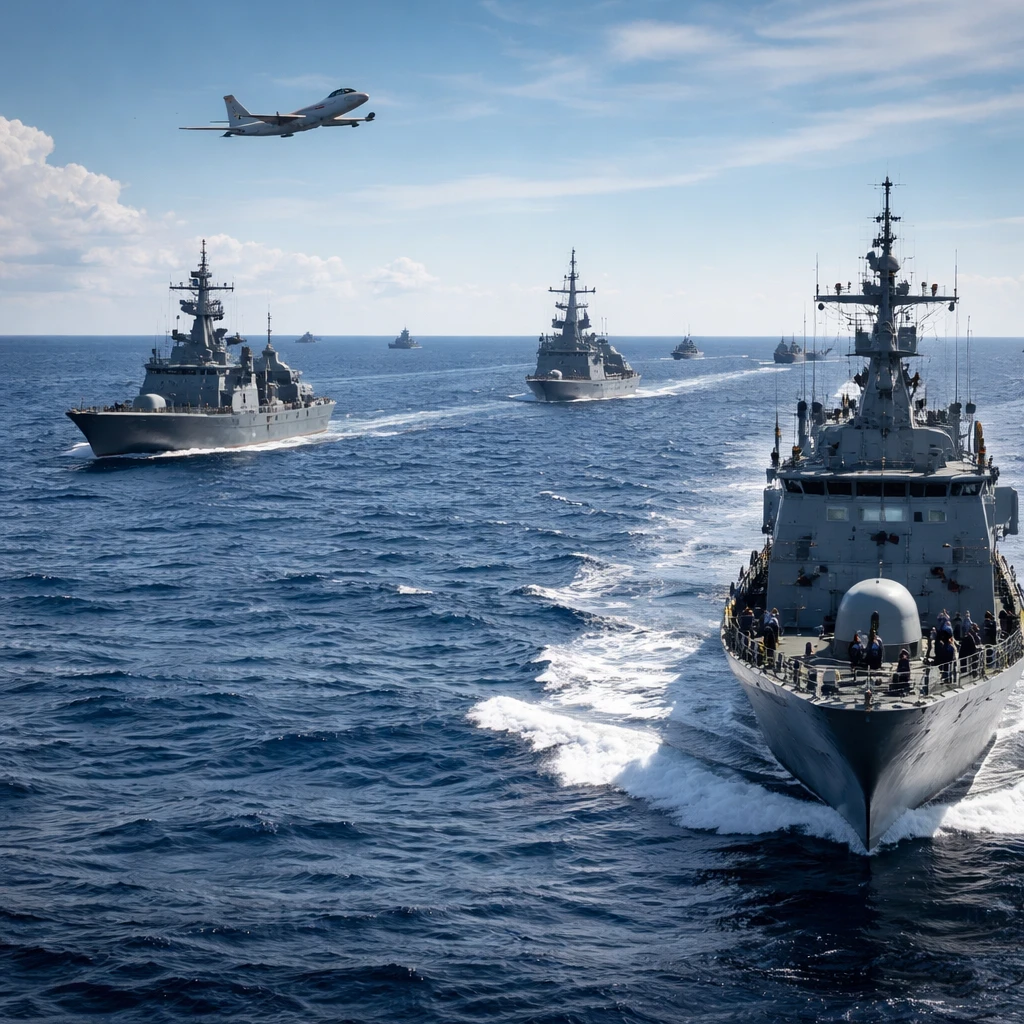
The United States and Japan joined the Philippines in five days of maritime exercises in the South China Sea, held from July 21 to July 25, as Manila and Beijing exchanged competing accounts of recent incidents in the contested waters.
According to the Philippine military, the drills brought together naval warships, coast guard vessels, surveillance aircraft and fighter jets from the three countries. Officials said the focus was on improving interoperability and strengthening coordination among the partners, but did not provide the precise location where the exercises took place.
Joint operations between the Philippines, the United States and Japan have grown both in scale and frequency in recent years as Manila deepens defence cooperation with both allies in response to competing territorial assertions. The latest round of exercises began one day after an encounter at Second Thomas Shoal that drew opposite versions from the parties involved.
Philippine authorities said Chinese Coast Guard personnel struck a Filipino sailor with a baton during the encounter. China disputed that account, saying Philippine vessels initiated the incident and rammed Chinese boats.
Tensions did not subside during the drills. The Philippine Coast Guard reported that Chinese vessels used water cannon against Philippine government ships operating near Scarborough Shoal on Thursday and Friday of the exercise period. Beijing responded by saying its coast guard took lawful measures after Philippine vessels entered waters claimed by China.
Separately, Philippine armed forces chief Antonio Nafarrete visited Thitu Island in the Spratly Islands on Saturday. The island is controlled by Manila and is located about 300 miles west of the Philippine province of Palawan. During his visit, Nafarrete told troops stationed there that they played a central role in defending the outpost and pledged additional support for their operational capabilities.
The South China Sea is a major conduit for global maritime trade and contains important fishing grounds as well as potential energy resources. Multiple governments - China, the Philippines, Vietnam, Malaysia, Brunei and Taiwan - have overlapping claims in the area. Beijing asserts sovereignty over nearly the entire waterway and continues to reject a 2016 international arbitration ruling that found no legal basis for China’s broad claims within its so-called nine-dash line.
Context and operational details
- The exercises ran from July 21 to July 25 and included sea and air assets from the Philippines, the United States and Japan.
- Manila characterized the operations as aimed at improving interoperability and coordination among the three partners, while withholding the drills' exact location.
- The drills took place amid reported confrontations - an encounter at Second Thomas Shoal and water-cannon incidents near Scarborough Shoal - which the Philippines and China have described very differently.
Strategic implications noted during the period
Officials on all sides have emphasized operational readiness and presence. Manila has been expanding ties with the United States and Japan as it contests extensive territorial claims by Beijing. The Philippine armed forces chief's visit to Thitu Island and his pledge of support to troops underscore ongoing efforts by Manila to reinforce outposts it controls in the Spratly Islands.