
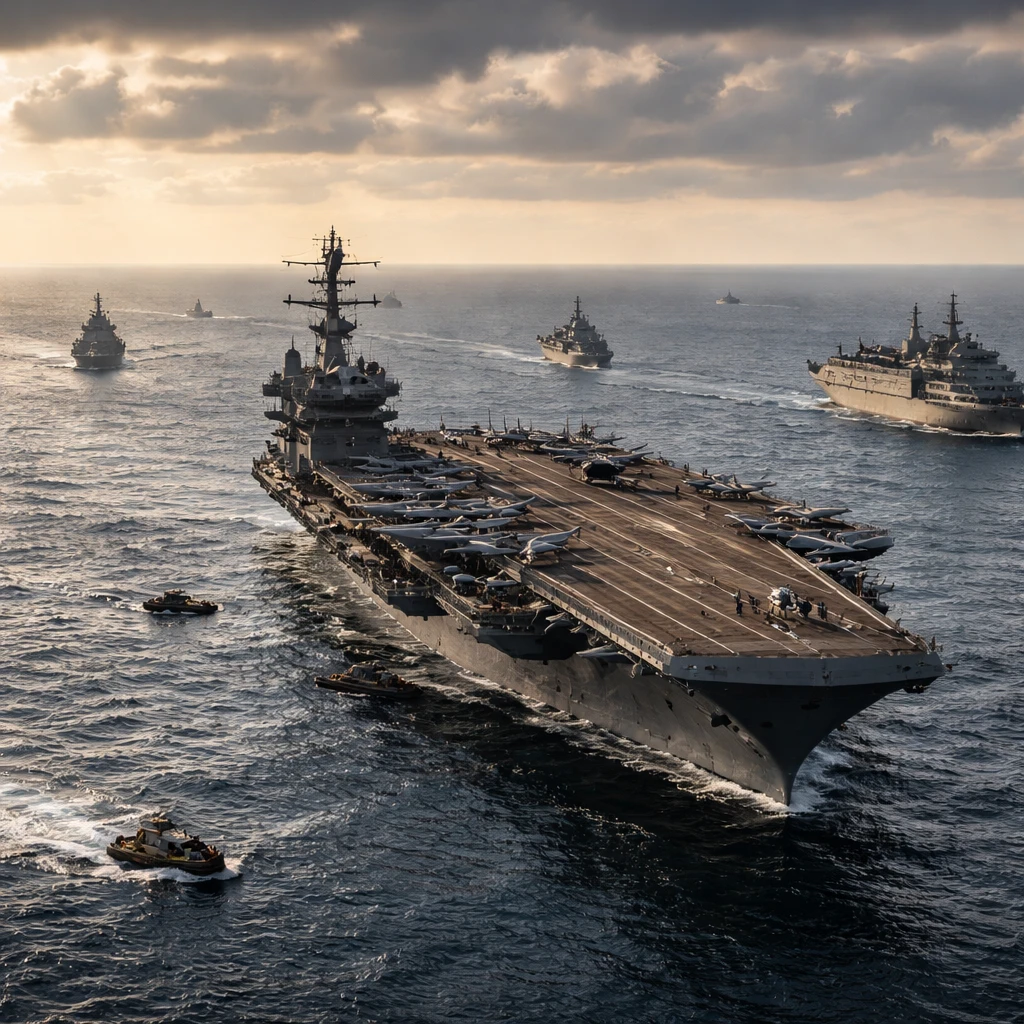
The Pentagon has ordered an additional U.S. military buildup in the Middle East totaling approximately 10,000 troops and significant naval forces as Washington intensifies pressure on Iran while attempting to preserve a fragile ceasefire and revive negotiations.
The deployment comprises about 6,000 personnel aboard the USS George H.W. Bush carrier strike group and roughly 4,200 personnel assigned to the Boxer Amphibious Ready Group and the 11th Marine Expeditionary Unit. These reinforcements will augment an already substantial U.S. presence in the region, which currently numbers about 50,000 service members.
The move comes as U.S. policymakers push Tehran to reopen the Strait of Hormuz and to return to talks on its nuclear program. The ceasefire in effect is scheduled to end in two weeks, expiring on April 22, making the days ahead critical for both diplomatic engagement and military planning.
President Donald Trump expressed optimism about the trajectory of the conflict in a taped interview with Fox Business, saying he sees the war as "very close" to being over and suggesting that Iran desires an agreement. He added that if the United States ended its pressure campaign now, Iran would take decades to rebuild, language that signals Washington's intent to retain leverage until broader concessions are secured.
Officials say the additional forces will provide U.S. commanders with expanded operational options if negotiations falter or if the ceasefire collapses. The reinforced naval presence is expected to increase the number of U.S. aircraft carriers in or near the region to three, significantly enhancing strike capacity and maritime enforcement capabilities.
Alongside the military buildup, U.S. forces have begun enforcing a maritime blockade aimed at traffic to and from Iranian ports. More than a dozen U.S. warships are positioned in the Gulf of Oman and the Arabian Sea to monitor vessels transiting the Strait of Hormuz.
In the first 24 hours of the operation, six merchant ships were intercepted and turned back to Iranian ports without incident, officials reported. The mission is described as an effort to tighten economic pressure on Tehran and to constrain its ability to export oil.
U.S. planners are also reviewing contingency options for potential ground operations should diplomacy fail. Those plans include missions designed to secure nuclear material, protect shipping routes, or target Iranian export infrastructure. Officials acknowledge such operations would carry substantial risks, including the possibility of broader regional escalation.
Summary
- Approximately 10,000 additional U.S. troops and major naval assets are being deployed to the Middle East to increase pressure on Iran while attempting to preserve a ceasefire and revive negotiations.
- The new deployment includes about 6,000 personnel on the USS George H.W. Bush carrier strike group and roughly 4,200 with the Boxer Amphibious Ready Group and the 11th Marine Expeditionary Unit, augmenting an existing force of about 50,000 in the region.
- U.S. forces have begun enforcing a blockade on maritime traffic to and from Iranian ports; six merchant ships were intercepted and returned in the first 24 hours without incident.
Key points
- Defense and security - The deployment raises U.S. strike and maritime enforcement capacity in the region by increasing carrier presence to three and adding amphibious capability.
- Energy and shipping - The blockade and interdictions aim to limit Iran's oil exports and tighten economic pressure, with implications for maritime traffic through the Strait of Hormuz.
- Markets and risk assessment - Heightened military posture and potential for contingency ground operations could influence market perceptions of regional risk, particularly in energy and shipping sectors.
Risks and uncertainties
- Ceasefire expiration - The current two-week ceasefire expires on April 22; its lapse would intensify diplomatic and military decision points.
- Escalation risk - Plans for potential ground operations to secure nuclear material or target export infrastructure carry the danger of a broader regional escalation.
- Economic choke points - Enforcement of a maritime blockade and interdiction of merchant ships increases uncertainty for energy and shipping industries reliant on passage through the Strait of Hormuz.