
Economy April 19, 2026 03:42 PM

Merz and Lula Push for Deeper EU-Brazil Economic Ties at Hanover Fair

Leaders hail imminent EU-Mercosur pact and highlight Brazil’s strategic mineral reserves as a focal point for industrial cooperation

By Nina Shah
Merz and Lula Push for Deeper EU-Brazil Economic Ties at Hanover Fair

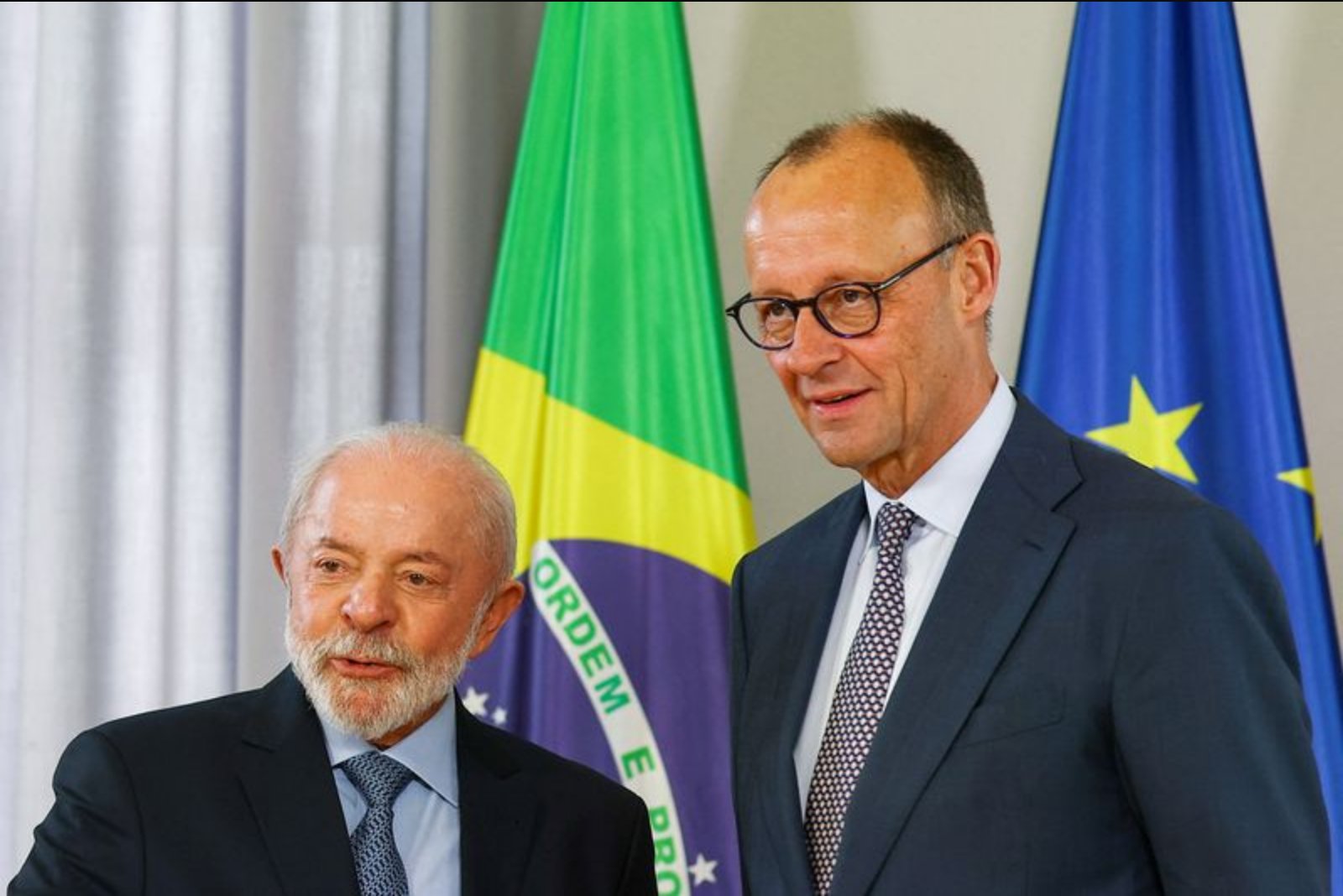
At the opening of the Hanover industrial fair, German Chancellor Friedrich Merz and Brazilian President Luiz Inacio Lula da Silva called for closer economic cooperation between the European Union and Brazil. Both leaders welcomed the EU-Mercosur free trade agreement coming into force on May 1 and emphasized collaboration on raw materials, technology transfer and industrial processing capacity. Lula underscored Brazil’s significant but still partially mapped mineral reserves and urged more domestic processing and technological partnership.

Key Points

  • EU-Mercosur free trade agreement comes into force on May 1, and leaders framed it as a commitment to a rules-based, multilateral economic order.
  • Brazil holds major reserves of critical minerals - largest niobium reserves, second-largest graphite and rare earths reserves, and third-largest nickel reserves - while only about 30% of its mineral potential has been mapped.
  • Planned cooperation includes technology transfer, expanded processing capacity in Brazil, and collaboration across AI, critical minerals and data centers, affecting mining, manufacturing and technology sectors.

On Sunday at the opening of the Hanover industrial fair, German Chancellor Friedrich Merz and Brazilian President Luiz Inacio Lula da Silva urged stronger ties between Europe and South America’s largest economy, framing closer cooperation as central to a rules-based global trading system.

Both leaders welcomed the EU-Mercosur free trade agreement, which is due to enter into force on May 1. Merz said the move underlines commitments to multilateralism and to an economic order governed by rules, adding that the aim is cooperation with as few tariffs as possible - ideally none at all.

Lula, whose country is this year’s partner nation at the world’s largest industrial trade fair in Hanover, framed Brazil as a dependable partner for Europe, particularly when it comes to supplying raw materials. He noted that only about 30% of Brazil’s mineral potential has been mapped, while highlighting the country’s existing resource strengths: the world’s largest reserves of niobium, the second-largest reserves of both graphite and rare earths, and the third-largest reserves of nickel.

"These raw materials must serve as a driver of economic and social development," Lula said, urging greater technology transfer and the expansion of processing capacity within Brazil.

Beyond mineral resources, Lula said he intended to cover the full spectrum of economic cooperation with Merz, explicitly including areas such as artificial intelligence, critical minerals and data centers. The two governments are scheduled to hold German-Brazilian consultations on Monday to advance those discussions.


Context and implications

Leaders presented the activation of the EU-Mercosur agreement as a tangible step toward lowering trade barriers and strengthening institutional ties. Lula’s emphasis on mapping and processing capacity points to a dual objective: to leverage Brazil’s raw-material advantages while boosting domestic industrialization through technology partnerships.

Discussions slated for government consultations could address practical measures across industrial and technology sectors, though the public remarks focused on broad goals rather than detailed implementation steps.


Summary takeaway

  • Merz and Lula called for closer EU-Brazil cooperation at Hanover, welcoming the EU-Mercosur deal effective May 1.
  • Lula highlighted Brazil’s substantial mineral reserves and the limited mapping to date, and he pushed for technology transfer and more in-country processing.
  • Planned German-Brazilian consultations on Monday are intended to take forward talks that include AI, critical minerals and data centers.

Risks

  • Only about 30% of Brazil’s mineral potential has been mapped, creating uncertainty for resource planning and investment in the mining sector.
  • Limited technology transfer and insufficient domestic processing capacity in Brazil could constrain the ability to convert raw material advantages into industrial and social development, affecting manufacturing and downstream industries.
  • Existing tariffs and trade barriers remain a factor to be addressed - leaders called for as few tariffs as possible - meaning trade frictions could impede the intended expansion of EU-Brazil commerce if not resolved.

More from Economy

BOJ Keeps Door Open to Near-Term Rate Increase Amid Middle East Uncertainty Apr 19, 2026 Left-Wing Summit in Barcelona Seeks Strategy to Counter Global Rightward Shift Apr 19, 2026 Trump Accuses Iran of Breaching Ceasefire After Strait of Hormuz Incidents; VP Vance to Head U.S. Delegation to Pakistan Apr 19, 2026 Global Finance Meetings Highlight Limits of Multilateral Response as Energy Shocks Persist Apr 19, 2026 Morgan Stanley: AI Is Expanding Software Output, Not Replacing Engineers Apr 19, 2026