
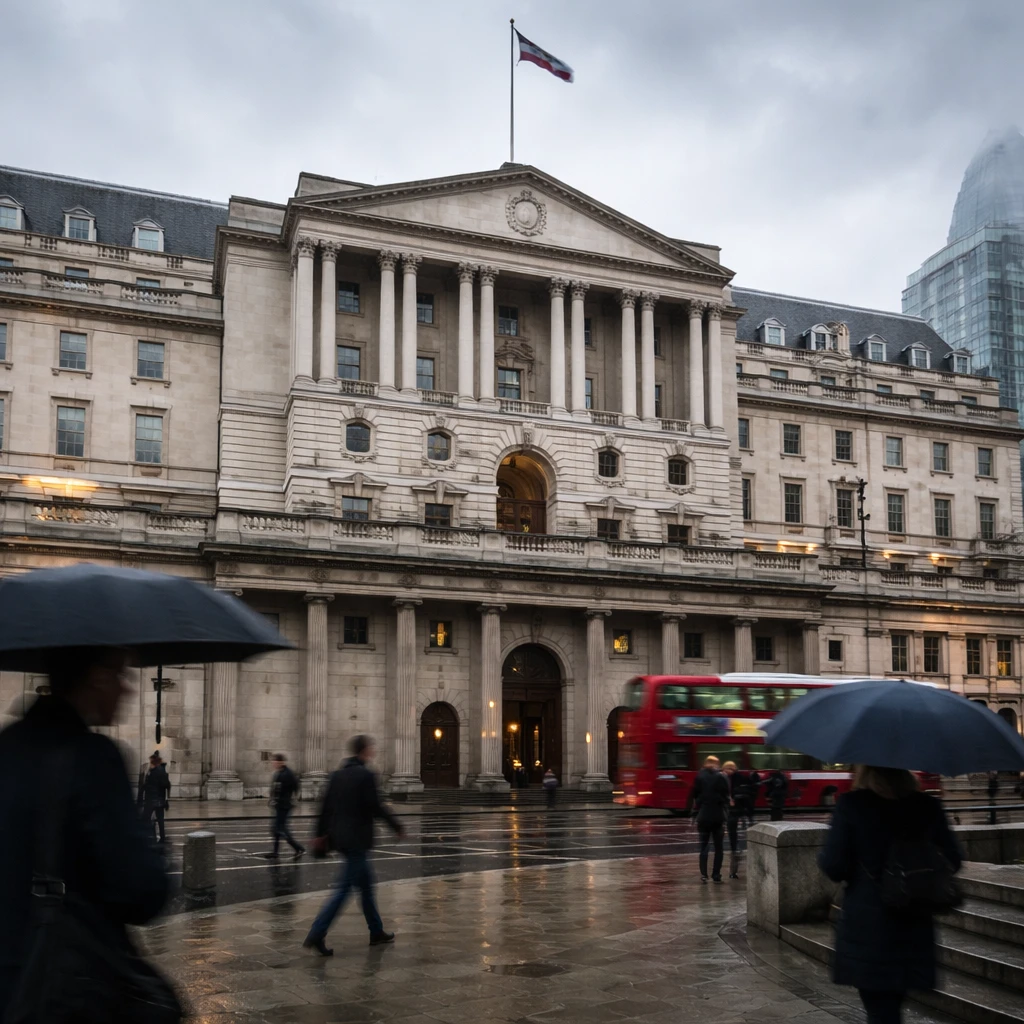
The Bank of England opted to leave its bank rate unchanged at 3.75% in a decision reached by a 7-2 majority on the Monetary Policy Committee. Policymakers said they were taking a cautious posture because global energy prices, while lower than at the previous meeting, remain above pre-conflict levels and continue to be volatile.
In a statement accompanying the decision, the BoE said: "Global energy prices have fallen since the previous meeting in response to events in the Middle East. But they remain higher than pre-conflict and have continued to be volatile. The impact of the energy shock on the U.K. economy remains uncertain." That uncertainty underpinned the committee's judgment that it was appropriate to maintain Bank Rate at this meeting.
The decision comes in the context of other major central banks making different near-term choices. The central bank's pause echoes a similar move by the U.S. Federal Reserve earlier in the week, while the European Central Bank moved to raise rates at its meeting last week. The BoE noted that central banks are contending with the economic consequences of a surge in energy costs tied to the Iran war.
Oil markets have shown some retreat from the highs reached after the joint U.S.-Israeli operation in late February. The BoE statement linked the easing in oil to the signing of an interim peace agreement between Washington and Tehran that would halt hostilities and reopen the Strait of Hormuz. Still, the bank acknowledged that some market participants expect crude to remain elevated for a period, since a supply shock tied to the strait's closure will take time to unwind, and others see a persistent geopolitical risk premium should Iran again disrupt the narrow maritime corridor.
Domestically, recent headline inflation data were cited by the BoE as a moderating influence. Consumer prices in the U.K. held at 2.8% in May, matching a 13-month low previously recorded in April. Nevertheless, the bank cautioned that inflation is expected to rise later in the year "as the effects of higher energy prices continue to pass through" into broader costs.
Crucially, the BoE warned of the potential for second-round effects in price and wage-setting if higher energy prices persist. The committee wrote that "the risk of material second-round effects in price and wage-setting, against which policy needs to lean, is greater the longer higher energy prices persist." At the same time, the bank pointed to a loosening labor market and signs of a weakening economy that may act to contain inflationary pressures.
On specific inflation projections, the BoE reported that energy and non-energy prices are lower and that CPI inflation is now expected to be "a little under 3%" in the third quarter, picking up to just over 3.25% in the fourth quarter. Those projections are below the path set out in an earlier report from April, reflecting a slightly less aggressive near-term outlook for price growth.
Commentators framed the hold as a deliberate preservation of policy options rather than inaction. Nick Saunders, CEO of online investment platform Webull UK, said the decision should not be read as indifference and argued that by holding rates the BoE "preserves firepower for next year’s battles." Saunders added that the MPC is effectively betting that second-round effects can be endured for now and that the bank will retain scope to raise rates later should inflation spike even if the economy is sputtering.
BoE Governor Andrew Bailey has previously suggested the central bank had "already tightened policy considerably" by abandoning plans for a possible rate cut this year. He has maintained that the BoE has room to wait and assess the macroeconomic impact of the Middle East conflict. Other policymakers, however, have flagged the possibility that businesses could still push up prices, which could in turn influence household perceptions of the central bank's ability to cap inflation.
Weighing the balance of risks, the MPC's vote reflects a central-bank posture that prioritizes optionality. With energy prices trending down from recent peaks but remaining elevated relative to pre-conflict levels, the BoE has signaled that it will monitor incoming data closely and stand ready to act if pressures re-emerge. For now, the committee judged that maintaining Bank Rate is the prudent course, given the mix of persistent external inflationary risks and emerging domestic signs of weakening demand and looser labor market conditions.
Summary
The Bank of England held Bank Rate at 3.75% in a 7-2 vote, citing falling but still elevated energy prices and uncertainty about their pass-through to the U.K. economy. While recent CPI data and labor-market softening may help contain inflation, the BoE warned of heightened risk that prolonged energy-price pressure could feed into wages and broader prices, and kept policy on hold to retain flexibility.
Key points
- The Monetary Policy Committee voted 7-2 to keep Bank Rate at 3.75%.
- Global energy prices have declined since the previous meeting but remain above pre-conflict levels and volatile - a factor lifting inflationary risk.
- Recent U.K. CPI held at 2.8% in May, matching a 13-month low, but the BoE expects inflation to rise later this year as energy cost pass-through continues; CPI is projected a little under 3% in Q3 and just over 3.25% in Q4.
Risks and uncertainties
- Persistent higher energy prices could generate second-round effects in prices and wages, increasing inflationary pressure - relevant to consumer-facing sectors and wage-sensitive industries.
- Geopolitical developments around the Strait of Hormuz carry the risk that oil prices could re-elevate if the corridor is disrupted again, affecting energy-intensive sectors and broader market sentiment.
- Businesses may still raise prices despite central-bank vigilance, which could erode household confidence in the BoE's ability to control inflation and influence consumption patterns.