
European Central Bank Chief Economist Philip Lane spoke Thursday in Hertfordshire, UK, offering a concise assessment of the current economic environment and the policy stance that the bank has adopted. He characterized the disruption facing Europe as a "medium shock," explicitly contrasting it with the larger shock experienced in 2022. Lane said the European economy is "doing ok" under the present conditions.
On the topic of monetary policy, Lane defended the ECB's choice to increase interest rates. He argued that the sequence of rate hikes was sensible even when assuming a milder disturbance - in his words, the tightening "made sense" under such a scenario. He framed the rate increases as measures intended to contain price shocks rather than as responses to a uniformly strong inflationary impulse.
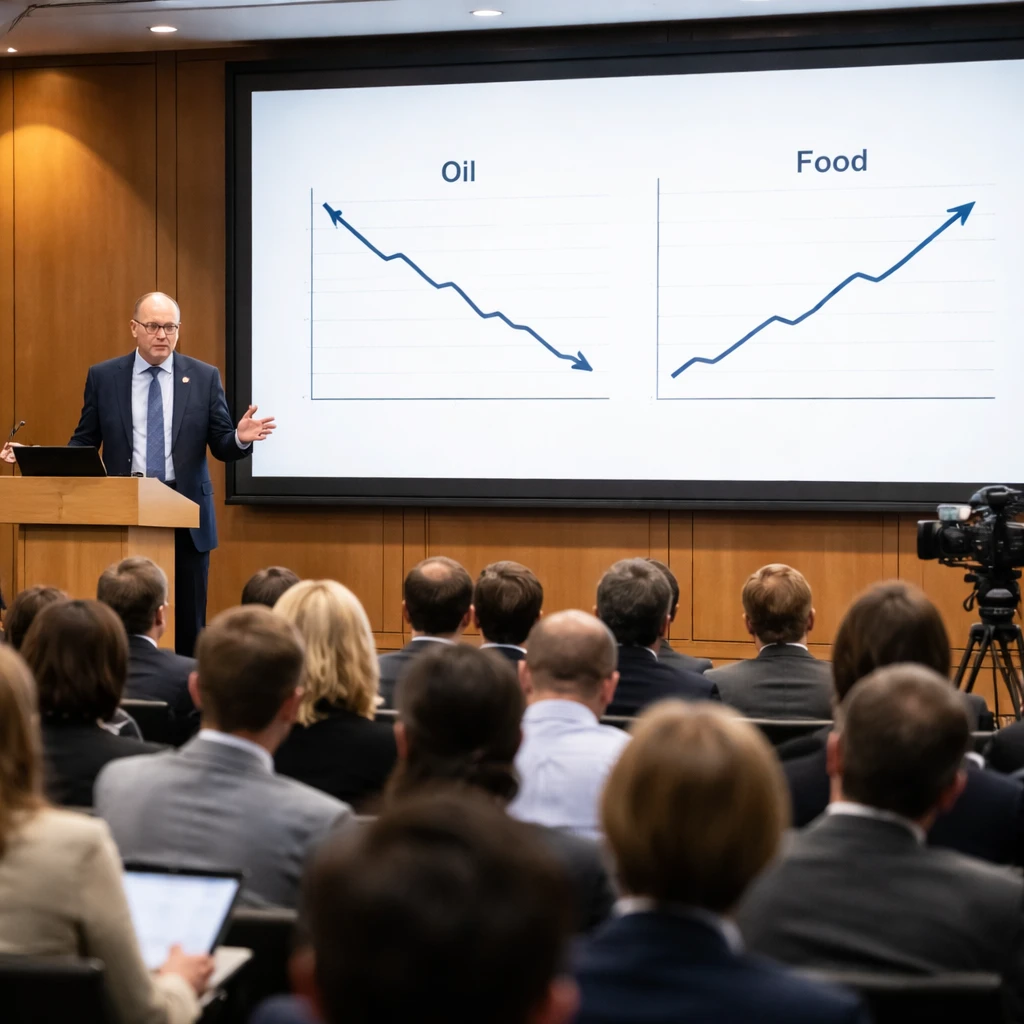
Lane also discussed commodity price behavior, drawing attention to uneven dynamics across different goods. He noted that movements in oil prices do not necessarily move in lockstep with food prices. Specifically, he observed that even when oil prices fall, food prices can rise. That distinction, he implied, is relevant to understanding the nature of the current price shocks and the channels through which they affect the economy.
The comments delivered in Hertfordshire provided a succinct overview of the ECB's assessment of current risks and of its justification for past policy moves. Lane's emphasis on the relative size of the shock - medium rather than large - and on the role of rate hikes to contain price shocks underscores the central bank's reasoning without advancing new policy commitments or forecasts in his remarks.
Key points
- Lane labeled the present disturbance to the European economy a "medium shock," smaller than the 2022 shock.
- He defended the ECB's decision to raise interest rates, saying the hikes were appropriate even under milder conditions and were aimed at containing price shocks.
- Lane highlighted divergent commodity trends, noting that oil and food prices can move in opposite directions - oil may fall while food prices rise.
Risks and uncertainties
- Persistence of commodity price divergence - differing moves in oil and food prices could sustain price shocks in certain sectors, notably energy and food production.
- Uncertainty over how long the current "medium shock" will last and what further implications it may have for prices and economic activity.