
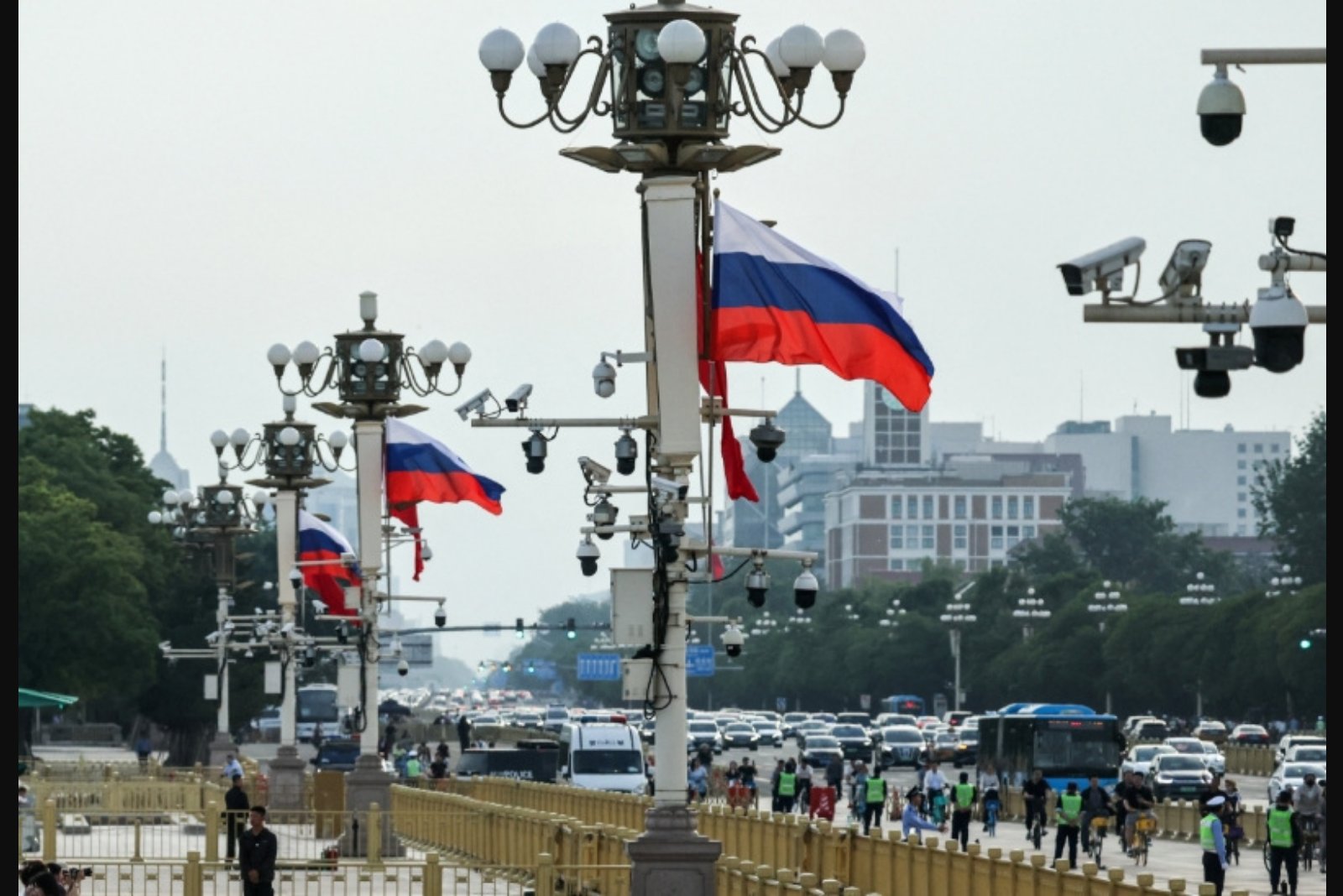
China and Russia’s top leaders are due to hold a summit in Beijing on Wednesday that will cover both bilateral ties and broader international issues, culminating in a private tete-a-tete over tea. The meeting comes immediately after a visit to Beijing by U.S. President Donald Trump and will be watched closely for both its substance and its optics.
Xi is known for receiving visiting leaders over tea, and observers say the setting and manner of such encounters carry symbolic weight about how the Chinese leader views his guest. When Xi previously hosted Putin in May 2024, the two leaders removed their ties and spoke over tea outdoors in Zhongnanhai, the former imperial garden that now houses the offices of the ruling Communist Party and the government. By contrast, Trump’s recent stroll through a secret garden and tea with Xi in the same compound, followed by a tour of the Temple of Heaven last week, presented a more choreographed sequence of events.
"Beijing is loving the optics of this. They’re loving being the centre of world attention, and they will be playing it for their domestic audience for all that it’s worth," said Graeme Smith, a senior fellow at the Australian National University’s Pacific Affairs department. "In some ways, Xi is benefiting from the emotional instability of both those world leaders," he added, referencing Trump’s penchant for pomp and Putin’s long-time show of camaraderie with Xi.
Chinese state media have presented the consecutive visits by the leaders of two major, and politically distinct, powers as validation of China’s global standing amid an increasingly fragmented world order. Putin’s arrival on Tuesday evening was marked by a formal welcome on the tarmac where China’s Foreign Minister Wang Yi greeted him. An honour guard and Chinese youths waving both China and Russia’s national flags were present at the ceremony.
Putin, whom Xi has called a "dear friend" and who has been described by the Chinese leader as an "old friend," visits at a moment when bilateral trade has begun to recover after a downturn last year. Official figures show two-way trade rose 16.1% in the first four months of this year over the same period in 2025 in value terms. Total trade between the two countries was worth 1.63 trillion yuan ($240 billion) in 2025, a decline of 6.5% from a record in 2024 and the first fall in five years.
Putin has publicly acknowledged the need to reverse that downtrend, a recognition that underscores China’s importance as an economic lifeline for Moscow as sanctions and the war in Ukraine weigh on the Russian economy. He is travelling with a large delegation that includes deputy prime ministers, ministers and heads of state corporations and major banks.
The Kremlin has said it has set "serious expectations" for the visit. The program reportedly includes formal talks, a signing ceremony, and a banquet, with the concluding tea intended to provide a more informal venue for discussions of major international matters. About 40 documents are expected to be signed, and the Kremlin said it will issue a 47-page joint statement laying out the strengthening partnership between the two countries.
Officials indicated that Putin and Xi are expected to agree on a joint declaration endorsing the establishment of a multipolar world order and promoting a "new type of international relations," according to a Kremlin aide. Industry experts cited that negotiations on the Power of Siberia 2 gas pipeline - a project designed to link Russia to northern China - are also likely to be part of the agenda.
The so-called "no limits" partnership between China and Russia has tightened since Western sanctions were imposed in response to the war in Ukraine. Those sanctions and broader geopolitical shifts have made energy and trade cooperation an important bilateral focus.
Energy market dynamics are part of the calculus for both sides. The article notes that energy supply shortages connected to conflict in Iran could strengthen Russia’s case for the Power of Siberia 2 pipeline as a long-term gas source for China, while at the same time Beijing may prefer to adhere to a supply diversification strategy. The meeting and any agreements reached may therefore carry implications for energy trade and commodity flows between the two countries.
Financial terms referenced in relation to trade use the exchange rate of ($1 = 6.8012 Chinese yuan renminbi).
Contextual note: The summit combines ceremonial optics with concrete deliverables - a signing ceremony, a substantial joint statement, and discussions of large-scale energy infrastructure - and will be evaluated both for its immediate agreements and for what the public presentation of the meetings signals about the bilateral relationship.