
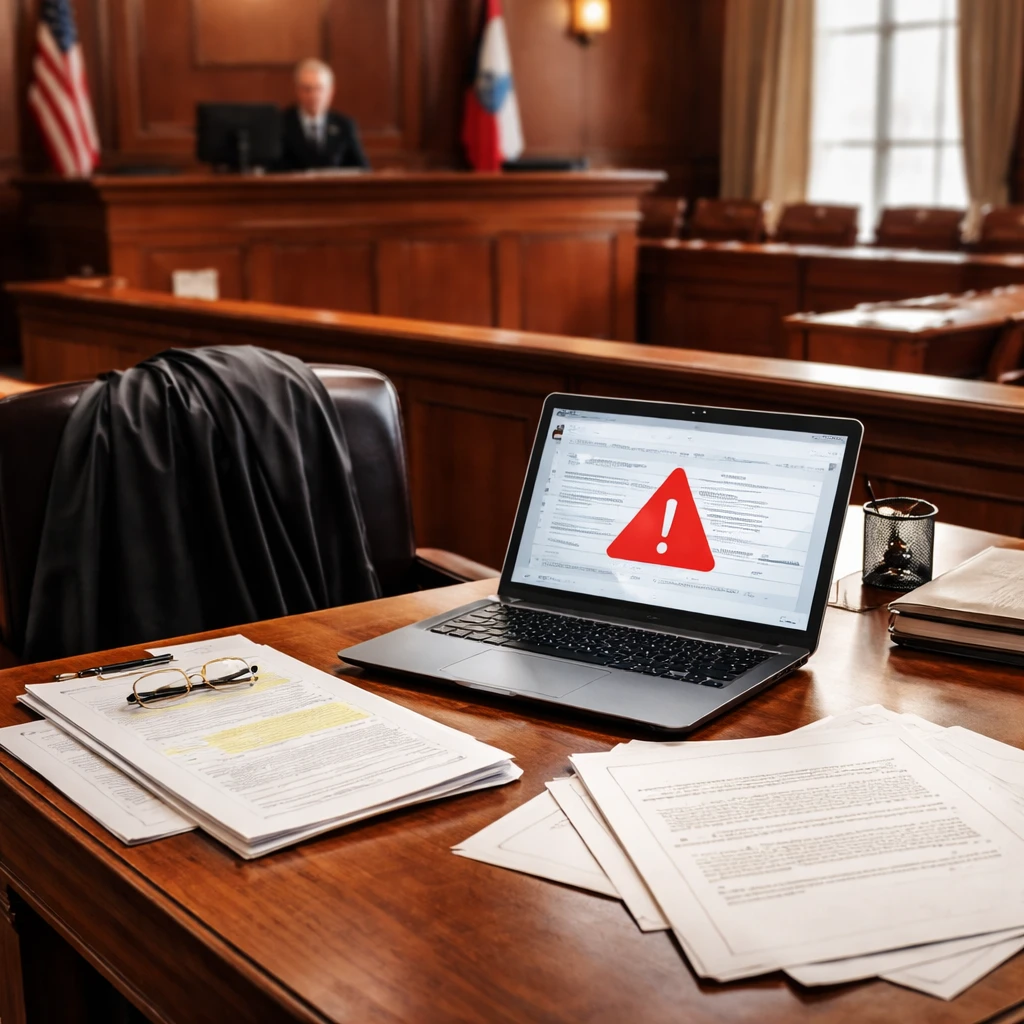
The Georgia Supreme Court on Tuesday imposed sanctions on a Clayton County assistant district attorney after finding that her use of artificial intelligence tools produced false and misattributed legal citations that were incorporated into a trial court's ruling in a homicide case.
In its decision, the state's highest court barred Deborah Leslie from appearing before the justices for six months and ordered her to complete further legal education focused on ethics, brief writing and the appropriate use of AI in legal work. The court found "numerous fictitious or misattributed case citations" in a 2025 trial court order that denied a motion for a new trial.
Justice Benjamin Land underscored the gravity of the misconduct in the opinion, writing that, "Citing cases that do not exist or do not support the proposition for which they are cited is a violation of this Court's rules and falls far beneath the conduct we expect from Georgia lawyers."
The sanction arose during the appeal of Hannah Payne, who is serving a sentence of life in prison plus 13 years following convictions for murder and false imprisonment in the death of Kenneth Herring. According to the Georgia Supreme Court, Leslie prepared a proposed order urging the trial judge to deny Payne's request for a new trial; that proposed order included AI-generated citations that were later determined to be fabricated. The trial judge adopted much of Leslie's proposed order, including the false citations, when denying the motion.
As a result of the findings, the justices vacated the earlier ruling and remanded the matter to the trial judge with instructions to issue a new order that does not include fictitious citations. The court also issued guidance to trial judges to examine proposed orders with an awareness that artificial intelligence software - "with all of its potential risks and benefits" - may have been used in their preparation.
Leslie and the Clayton County District Attorney's Office did not immediately respond to requests for comment. Leslie had apologized in an earlier court filing for failing to independently verify the AI-generated citations.
The Georgia case highlights a broader trend in which state and federal courts nationwide have disciplined attorneys for relying on generative AI tools for legal research and drafting without adequately vetting the outputs. The decision stands out because it involves a prosecutor and because the AI-originated errors were replicated in a court opinion rather than remaining confined to an attorney's draft.
Payne's attorney, Andrew Fleischman, criticized the outcome's effect on his client's appeal, saying, "Hannah Payne has strong issues for appeal. It is a shame that the State's misconduct is now delaying her opportunity to have those issues be decided." The high court's action both disciplines the prosecutor and seeks to restore the integrity of the appellate record by removing fictitious citations from the lower court's order.
Context and next steps
- The case has been returned to the trial court for issuance of a new order absent the fabricated citations.
- The prosecutor will be prohibited from appearing before the Georgia Supreme Court for six months and must complete specified continuing legal education.
- The ruling signals that judges should scrutinize proposed orders for possible AI-generated inaccuracies.