
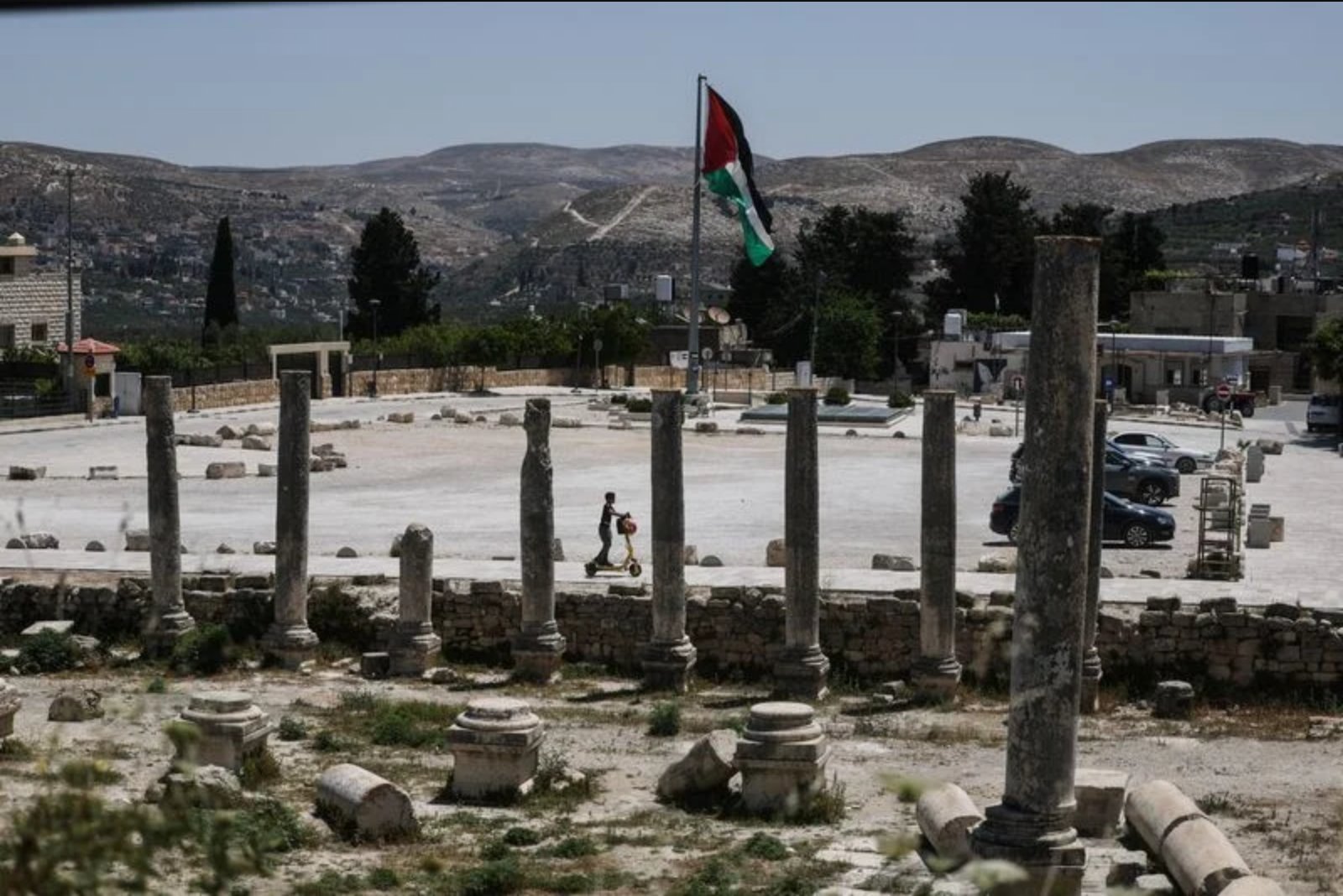
An Israeli bill that would move civil authority over ancient sites in parts of the West Bank to an Israeli ministry has provoked fierce objections from Palestinians and several Israeli organizations, who say the measure effectively amounts to annexation and will accelerate settlement expansion.
The proposal, titled the "Heritage Authority in Judea and Samaria" bill, cleared one of three parliamentary votes in May. It remains uncertain whether the final vote will take place before Israel’s parliament disperses ahead of an election expected on October 27.
Under the text of the bill, oversight of Roman, Byzantine and Crusader-era locations would be placed under the Israeli Ministry of Heritage. The measure would also permit related "expropriation and purchase of real estate" in the West Bank - a territory that Israel refers to by its Hebrew biblical name, "Judea and Samaria."
Critics say that shift would remove management of some antiquities from the Palestinian Authority, which under the 1990s Oslo peace accords has exercised limited self-rule in parts of the West Bank, captured by Israel in 1967. The PA’s tourism minister, Hani Al-Hayek, said the move is intended to "expand control and expand settlements in these areas, deep inside Palestinian territories." Israel counters that the bill’s intention is to protect ancient sites.
One prominent Israeli settlements watchdog, Peace Now, described the draft law as "constitut[ing] an annexationist measure in every respect" and warned it would open the door to broad-scale confiscation of Palestinian land. Peace Now said that while archaeology has sometimes been used to justify settlement activity, the latest measures would extend the practice on an unprecedented scale.
Locally, villagers near the archaeological site of Sebastia in the northern West Bank say they face immediate practical consequences. The ancient Sebastia site contains layers of remains that archaeologists attribute to the 9th-century B.C. Israelite kingdom, as well as Roman, Byzantine, Crusader and Ottoman periods. It appears on a tentative list for possible inclusion as a UNESCO World Heritage Site.
In late 2025, Israeli authorities announced a plan to seize about 1,800 dunams (445 acres) in the area around the Sebastia ruins, a move described by officials as aimed at developing the site. Village representatives say the plan would affect around 5,000 olive trees in groves belonging to local residents.
"They are incorporating areas containing water resources, roads and antiquities, leaving us as residents without any resources. It is part of settlement expansion," said Sebastia Deputy Mayor Nizar Kayed.
Local business owners say the economic picture has already deteriorated. Tourism has declined since late 2023 as a result of war in the region, and enterprises that rely on visitors have seen revenue fall. "It seems that the Israeli plan (is) to isolate the archaeological site from the people," said Nahed Sakha, who runs a restaurant in Sebastia located on land listed for confiscation.
On the parliamentary front, legislator Zvi Sukkot, a driving force behind the bill, frames the initiative as a safeguard for relics tied to ancient and biblical heritage. Sukkot told reporters that "There’s nothing here that changes the legal status of Judea and Samaria." He added: "There are many people who are bothered by our desire to prove the ties between the people of Israel and this land," and "All the stories of the Bible, all our history, the people (of Israel) were born in Judea and Samaria." Sukkot is a member of the pro-settler Religious Zionism party.
Members of Prime Minister Benjamin Netanyahu’s coalition who back similar positions generally oppose the establishment of a Palestinian state and favor annexationist policies for the West Bank. International bodies and most countries regard Israeli settlements in the West Bank as illegal under international law, citing the Fourth Geneva Convention provision that bars transfer of a civilian population into occupied territory; Israel rejects that interpretation and instead regards the West Bank as disputed territory, citing security needs and historical and biblical ties.
The draft bill has also drawn concern from within Israel’s legal and scientific communities. In an open letter to Prime Minister Netanyahu and to Sukkot, the Israel Academy of Sciences and Humanities urged the legislation be abandoned. The academy warned: "This will undoubtedly lead to an immediate deterioration in Israel’s international relations in the field of archaeology, and it will also have an impact on other areas of science and research."
Legal officials in Israel’s defence establishment and Israeli scientists have reportedly expressed unease about the measure, noting potential implications beyond archaeology, including diplomatic fallout and impacts on academic cooperation.
For residents of affected villages, the debate over heritage administration intersects directly with livelihoods. Those who depend on olive groves and visitors to archaeological attractions say they face both economic uncertainty and the prospect of losing access to land and resources. The bill’s fate in parliament will determine whether the proposed legal transfer of authority, and the accompanying powers to expropriate or purchase land, proceed before the legislature pauses ahead of the scheduled election.
As the measure moves through the parliamentary process, advocates on opposing sides continue to frame the issue in starkly different terms - protection of antiquities versus expansion of control - leaving both local populations and international observers to weigh the bill’s potential consequences for heritage, land rights and regional relations.