
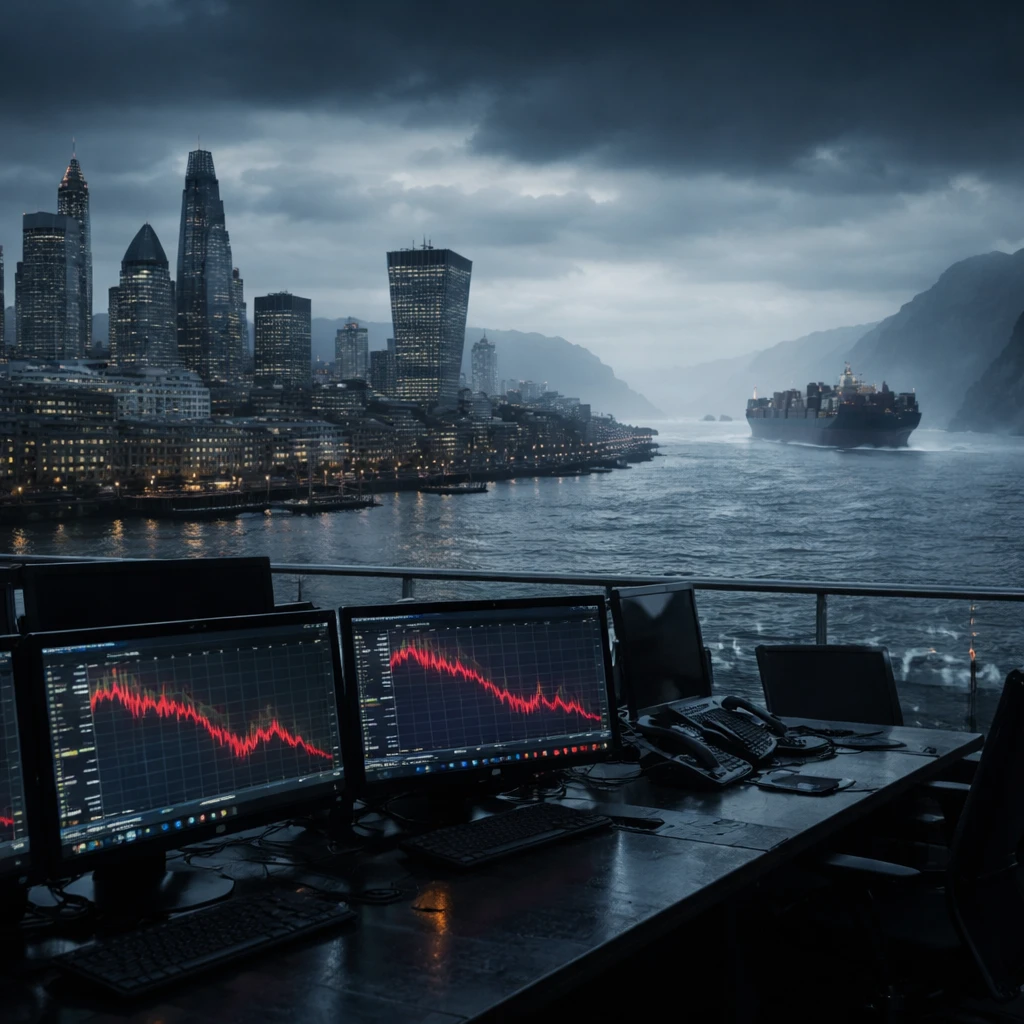
British stock markets declined on Friday as a fresh security incident in the Strait of Hormuz and a widespread drop in Asian technology shares combined to sap investor sentiment across Europe.
By 03:20 ET (07:20 GMT) the FTSE 100 had fallen 0.37%. Germany's DAX was down 0.69% and France's CAC 40 slipped 0.22%. The pound held close to $1.3197.
Apple (NASDAQ:AAPL) contributed to the negative tone after announcing price increases on iPad and MacBook models, citing higher costs for memory and storage chips. While the FTSE 100 does not have direct exposure to that specific tech story, the index moved lower in step with a broader deterioration in risk appetite.
Maritime incident and policy responses
Iran's Revolutionary Guard Corps struck a Singapore-flagged cargo vessel in the Strait of Hormuz on Thursday, hitting the ship's bridge but causing no injuries, according to the UK Maritime Trade Operations Centre. The incident prompted the International Maritime Organization (IMO) to pause its escort operation through the strait.
IMO Secretary General Arsenio Dominguez said seafarer safety was "paramount" and that an evacuation plan would remain suspended "until further clarity." Separately, Iran's Persian Gulf Strait Authority warned that ships transiting outside its designated framework would not be covered by guarantees of safe passage and would bear full liability for any resulting consequences.
The question of whether transit fees will be introduced remains unresolved. U.S. Secretary of State Marco Rubio, concluding a Gulf tour that included a meeting with the Gulf Cooperation Council in Bahrain, again rejected any system of charges. He said international waterways "do not belong to any nation state" and warned that permitting fees would spread "throughout the world like a contagion." Oman’s foreign minister said future arrangements "will not involve imposing any transit fees," while Iran said it would work with Oman "to define future administration and maritime services in Strait of Hormuz."
Commodities reaction
Energy markets moved lower on the session. Brent crude fell 2.11% to around $73.91 a barrel, while U.S. WTI eased 2.25% to $70.30. Precious metals were relatively steady: gold futures were little changed at $4,044.85, with spot gold up marginally at $4,0229.31.
UK corporate and sector impact
On the corporate front, Heathrow Airport projected a £147 million decline in adjusted core profit for 2026 compared with 2025. The airport cited weaker passenger traffic expectations tied to travel uncertainty related to the Middle East situation and also pointed to higher employment costs.
Taken together, the market movements and corporate guidance reflect risks to travel and shipping sectors from geopolitical strains in the Gulf, and they highlight sensitivity in broader equity markets to shifts in technology sector sentiment.
What to watch next
Investors will be monitoring any clarification from the IMO or regional authorities on escort operations and liability rules for transiting vessels, as well as further corporate responses to rising component costs in technology supply chains. Oil and gold price moves will also be observed for indications of how commodity markets are pricing the impact of the incident and related policy positions.
For now, markets remain cautious as participants weigh the immediate operational impact on shipping routes and the secondary effects on airlines, ports and broader global trade flows.