
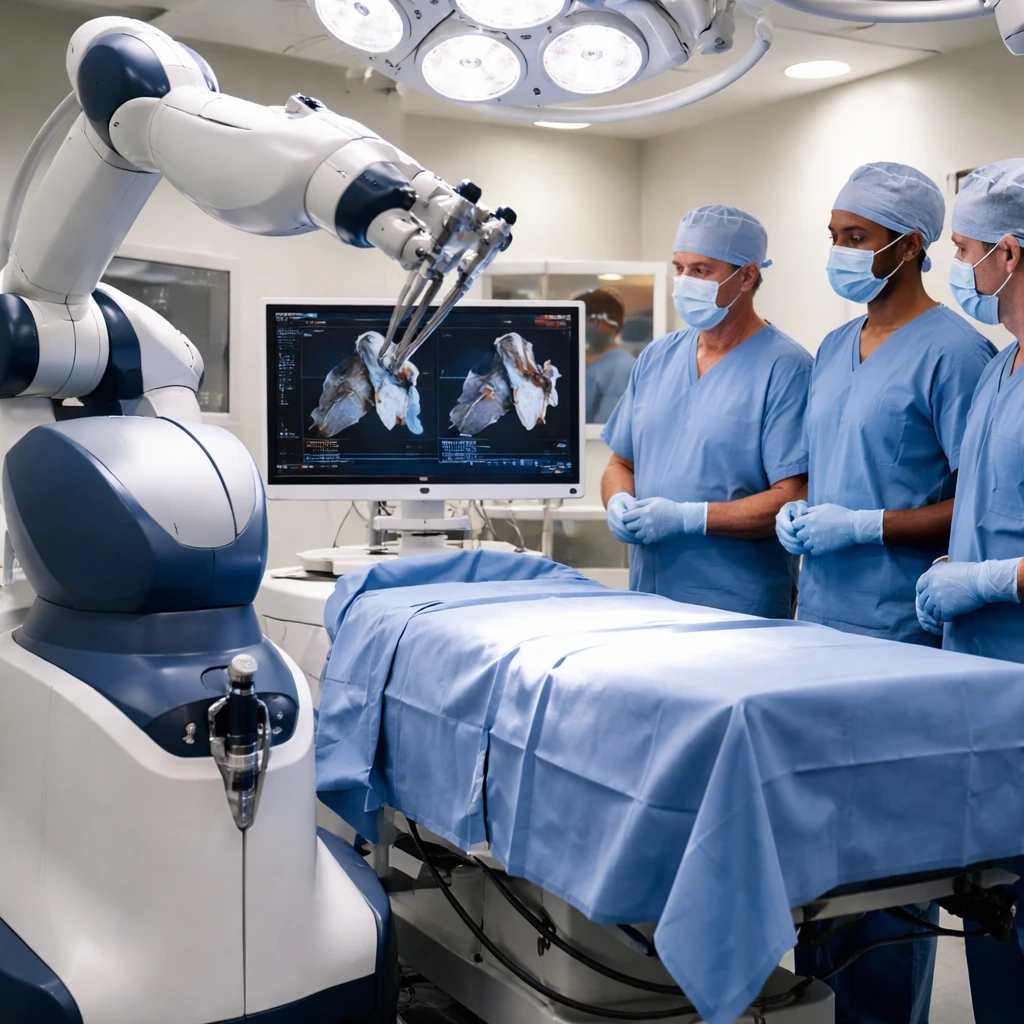
Following discussions at the Becker’s Healthcare Spine, Orthopedic, and Pain Management-Driven ASC conference in Chicago, BTIG said Stryker’s Mako robotic system has positioned itself as a leading robotics choice for ambulatory surgery centers (ASCs) as the market’s view of robotics has shifted from discretionary adoption to a perceived necessity.
BTIG analyst Ryan Zimmerman kept a Buy rating and a $379 price target on Stryker (NYSE:SYK), pointing to Mako’s ability to serve multiple service lines as a distinguishing advantage. The firm also reiterated Buy ratings for Medtronic (NYSE:MDT) with a $90 target, Boston Scientific (NYSE:BSX) at $65, and Solventum (NYSE:SOLV) at $89. Zimmer Biomet (NYSE:ZBH) and Globus Medical (NASDAQ:GMED) remained Neutral in BTIG’s view.
Panelists at the conference emphasized that newer surgeons increasingly view access to robotic platforms as a baseline requirement for practice, and that patients are actively seeking robotic-assisted procedures. These dynamics are pushing ASCs to treat robotics not only as a clinical tool but also as a competitive differentiator and marketing asset.
One practical change aiding adoption has been the emergence of more flexible commercial arrangements. Vendors including Stryker have offered contract terms that can include volume-based pricing and walk-away clauses, reducing financial exposure for ASC operators and making capital-intensive robotics systems easier to evaluate.
"The reimbursement environment represents the most challenging period in 25 years,"
said a spine surgeon who spoke at the conference, describing how reimbursement pressures are squeezing margins. The panel noted that insurers increasingly outsource claims adjudication to third-party contractors, a shift that has contributed to margin compression and boosted demand for AI-driven coding and billing tools.
Changes to Medicare coverage also influenced provider strategy. Cuts to nerve block reimbursement in certain procedures have encouraged providers to diversify into neuromodulation, creating potential demand across spinal-cord stimulation, peripheral nerve stimulation, deep-brain stimulation, sleep apnea, and pelvic health devices.
When considering enabling technologies for spine and orthopedic ASCs, augmented reality was highlighted as a cost-effective solution. Panelists contrasted this with robotics, which faces economic headwinds given high acquisition and operating costs and limited incremental reimbursement tied specifically to robotic assistance.
Conference speakers identified several innovation catalysts that could reshape ASC technology choices over time: improvements in augmented reality that reduce reliance on pre-operative imaging, the expiration of BMP/Infuse patents that could open the biologics market, and increasing momentum behind total disc replacement.
Sectors impacted: medical devices, ambulatory surgery centers, hospital outpatient services, healthcare technology and billing.