
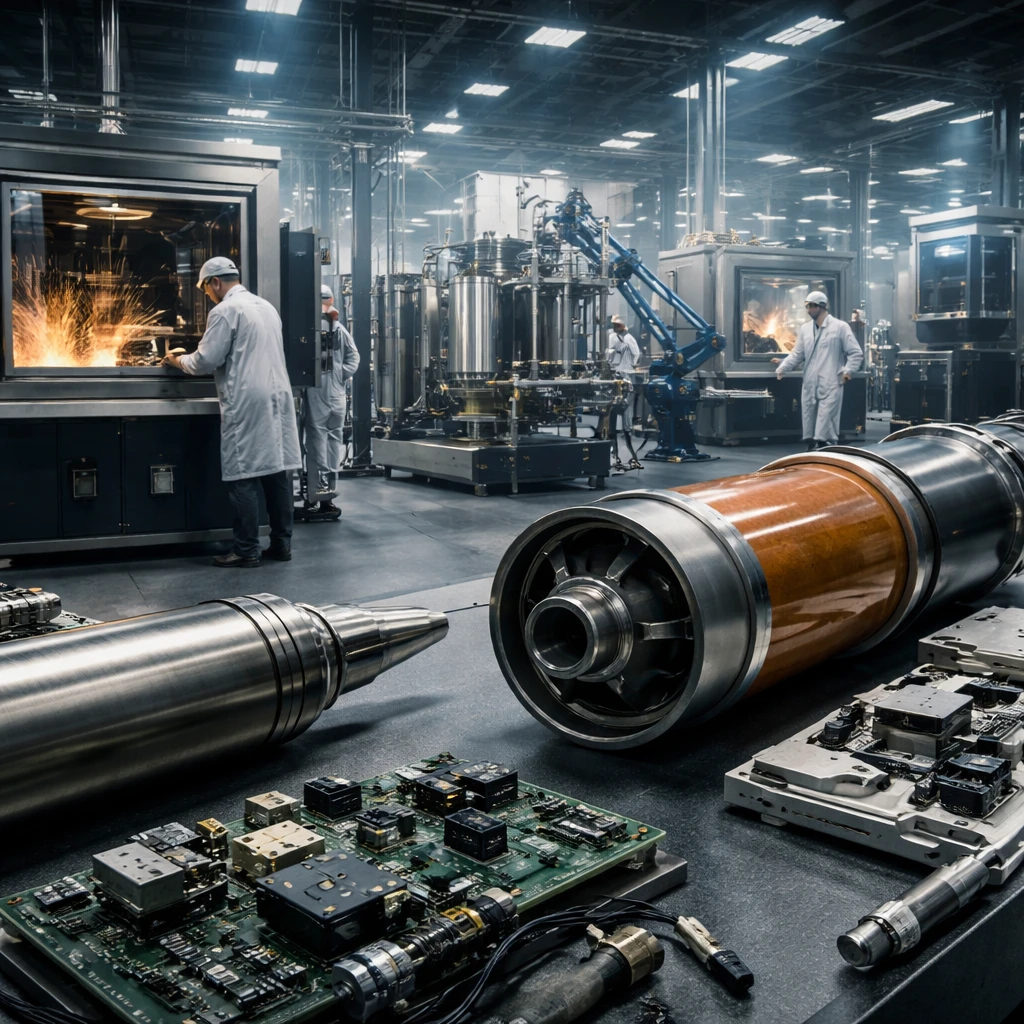
Startups entering the defense market are increasingly turning to components and manufacturing techniques from unrelated commercial industries to ramp up production of rocket motors and other weapons more quickly and cheaply. Companies are sourcing automotive processors, fracking-grade metal tubes and pharmaceutical-style mixing systems while adopting 3D printing to shorten lead times and increase throughput, according to industry participants and publicly reported company details.
Quick summary
Faced with large-scale demand for missile motors, a new cohort of defense-focused startups is drawing on parts and know-how from the auto, oil and gas, and pharmaceutical sectors. The U.S. military has used more than 50,000 rockets, missiles and other projectiles propelled by rocket motors since 2022, and Washington has allocated $53 billion and eased procurement rules to boost production. Startups including Castelion, Anduril, X-Bow Systems and Firehawk Aerospace claim faster, lower-cost manufacturing by using nontraditional suppliers and technologies, but obstacles such as multi-step solid rocket motor manufacturing processes, curing and X-ray inspection bottlenecks, and unpredictable procurement cycles remain.
Demand surge and government response
U.S. Pentagon data shows the military has expended over fifty thousand rockets, missiles and other projectiles powered by rocket motors since the Russian invasion of Ukraine in 2022 through the U.S. strike on Iran. In response to that surge, the U.S. government is setting aside $53 billion and simplifying procurement rules to expand critical missile and rocket production. The potential rewards for suppliers are substantial: contracts with an agency that operates with an annual budget in excess of one trillion dollars and the cachet that comes with being cleared as a Pentagon contractor.
Executives from large defense primes including Lockheed, Boeing and Raytheon parent RTX have publicly warned that shortages of solid rocket motors are constraining missile output. That shortage has opened space for younger firms to challenge established suppliers by emphasizing speed, volume and cost reduction.
Repurposing automotive electronics and fracking hardware
One California-based firm, Castelion, which manufactures solid rocket motors and hypersonic weapons, is sourcing electronic components originally developed for the automotive industry. Chief Operating Officer Sean Pitt said Castelion uses Field-Programmable Gate Arrays - processors common in advanced driver assistance systems and electric vehicles - because they can be purchased at roughly one-tenth the cost and obtained about six times faster than aerospace-specific equivalents. Castelion has also tapped parts from the oil and gas sector: rather than ordering high-pressure metal tubes from aerospace vendors that often have extended lead times, the company is buying high-temperature, stress-rated precision machined tubes used in hydraulic fracturing operations. Pitt said these tubes are engineered to tolerate heat and pressure comparable to rocket motor demands, and they are available from many more vendors at lower prices than their aerospace counterparts. Castelion, which is reported to have a valuation near $3 billion, has secured major Pentagon contracts to produce more than 500 hypersonic weapons.
Adopting pharmaceutical mixing techniques
Another notable example is Anduril, a recent entrant that has secured several billion dollars of defense contracts and is valued at $61 billion. Anduril has purchased bladeless mixers from Colorado-based FlackTek that are capable of processing multi-hundred-kilogram propellant batches in minutes rather than hours. According to company accounts, these bladeless centrifugal mixers yield more than a tenfold increase in production throughput compared with Anduril’s prior mixing systems and produce over 24 times the output of conventional industrial mixers, which use paddle-style mechanisms and require lengthy cleaning cycles. The same bladeless centrifugal technology is also used in pharmaceutical manufacturing for precision compounds such as liposome-based cancer treatments, industries where batch consistency and contamination control are similarly exacting.
3D printing and tooling to shrink development timelines
Three-dimensional printing has become another lever for accelerating capability. A 2024 case study from a traditional rocket manufacturer, Northrop Grumman, estimated that replacing conventionally machined metal tooling with 3D-printed polymer tools reduces the time to create a production line from roughly a year to about six weeks. That reduction allows a new rocket motor to move from design to production much faster.
New Mexico-based X-Bow Systems specializes in lower-cost solid rocket motor production by 3D printing propellants and motors. The company says this approach can dramatically lower both the time and expense of SRM production and has claimed it can shorten the timeline to establish a new production line for 3D-printed motors from a three-to-six-year span down to about twelve months. X-Bow has already been awarded a $191 million Pentagon contract for hundreds of solid rocket motors.
Texas-based Firehawk Aerospace, founded in 2020, also leverages 3D printing to produce SRMs, saying its process reduces rocket fuel production time from as long as 60 days to around 7 hours and at roughly one-tenth the traditional cost. Firehawk reports that its manufacturing method can enable custom-designed missiles to be test-ready within months. Firehawk has received venture backing from 1789 Capital, a fund in which President Donald Trump’s son is a partner.
Bottlenecks and the limits of new entrants
Despite the efficiency gains reported by startups, multiple industry analysts and officials stress that important manufacturing constraints persist. Tom Karako, director of the Missile Defense Project at the Center for Strategic and International Studies, pointed to the exacting, multi-step nature of solid-fuel rocket motor production - casting, curing, baking, X-raying and sanding - followed by intensive inspection. Karako noted that curing ovens and X-ray equipment remain bottlenecks for the industry.
Moreover, while a number of new companies are producing rocket motors for existing missile systems and some are building complete missiles, none have yet scaled manufacturing sufficiently to replace legacy contractors. Established players such as Northrop Grumman and L3Harris report they are investing in research and development to integrate new technologies, including expanded use of 3D printing and revised propellant mixing approaches, to keep pace with evolving competition.
Procurement cycles and business planning
Government purchasing patterns present an additional constraint. The Pentagon’s traditional model of buying rockets and missiles in annual quantities produces demand that can vary significantly from year to year. That volatility complicates long-term planning for companies seeking to achieve the cost efficiencies that come from stable, predictable production runs. Lukas Czinger, CEO of Divergent Technologies, which supplies missile parts, highlighted the need for multi-year procurement agreements that do not expire with shifts in administration as a prerequisite for high-volume, low-cost performance.
What this means for industry segments
The moves by startups to adopt automotive electronics, fracking-grade tubing and pharmaceutical-grade mixing reflect a broader reorientation of supply chains that blurs traditional boundaries between sectors. The defense sector is drawing on commercial-scale suppliers in automotive and oil and gas to address lead-time and cost concerns, while manufacturing techniques from pharmaceuticals and additive manufacturing are being used to improve consistency and reduce setup time.
At the same time, legacy defense manufacturers are both warning of material shortages and incorporating some of these novel methods themselves, producing a hybrid landscape where incumbents and new entrants pursue similar technical solutions at different scales.
Conclusion
Startups that repurpose commercial components and processes offer potential shortcuts to higher throughput and lower cost in rocket motor production. Their strategies range from buying automotive processors and fracking tubes to deploying bladeless pharmaceutical mixers and 3D printing production lines. However, technical bottlenecks inherent in solid rocket motor manufacture and the unpredictable nature of government procurement mean these firms must still demonstrate sustained, scalable production to supplant established contractors.