
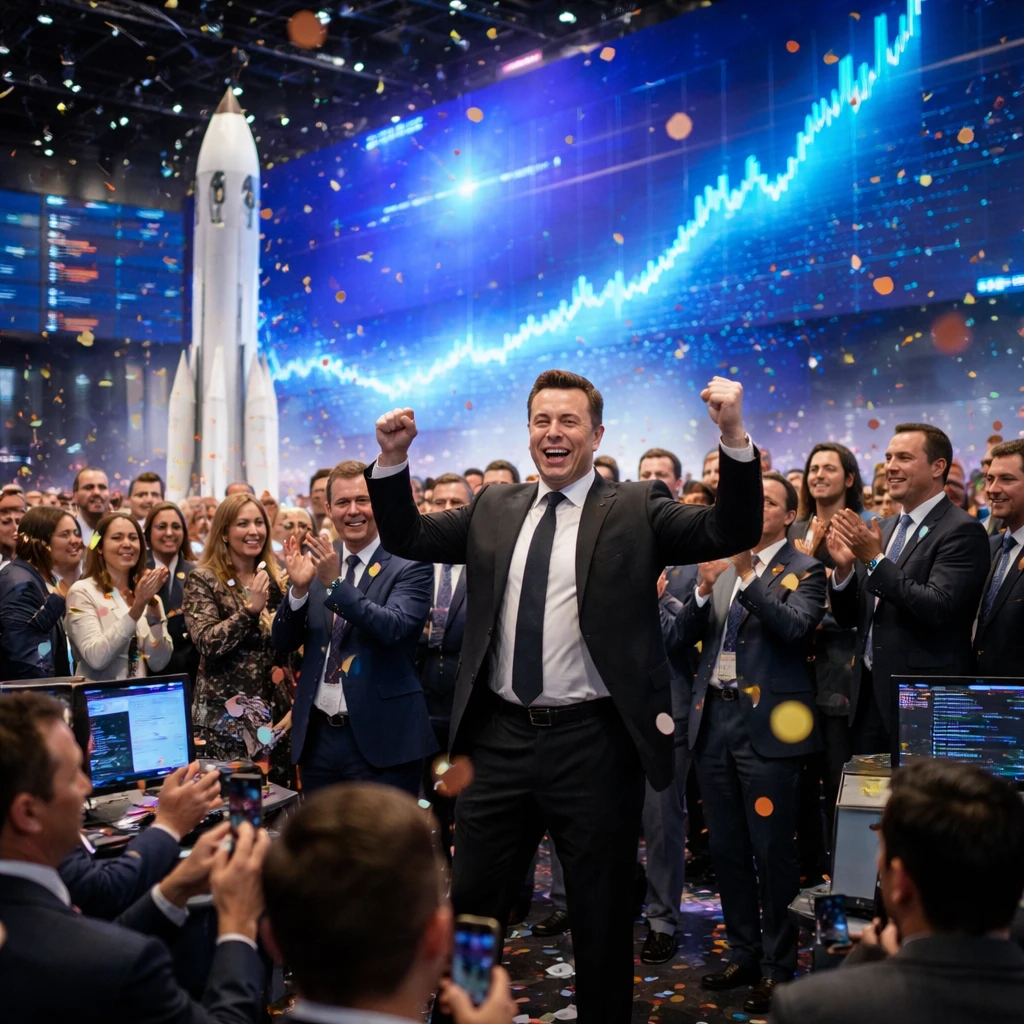
SpaceX made a thunderous entry into public markets on Friday, with shares advancing 19% in their first day of trading on the Nasdaq to close at $160.95 and give the company a market value of about $2.1 trillion. The debut followed a record-setting $75 billion initial public offering and produced heavy turnover as investors sought exposure to the company’s mix of rocket manufacturing, satellite operations and artificial intelligence interests.
Trading volume was substantial: more than 510 million shares exchanged hands, representing roughly $84 billion in turnover. The uptake came despite SpaceX operating as an unprofitable company and generating revenue that is a fraction of the income produced by other technology giants at comparable valuations.
The pop in the stock’s first session moved SpaceX past Broadcom in market capitalization and left it behind Amazon, which the market valued at about $2.6 trillion at the close. The strong debut was described by market participants as smoother than anticipated, with trading starting late on Friday morning without the technical problems that have plagued some prior high-profile listings.
Valuation and financial metrics
At the closing price, SpaceX’s implied market value pushed past the $2 trillion threshold. The company reported $18.7 billion in revenue, a figure that yields a price-to-revenue ratio near 112 at the IPO price and underscores the premium investors are paying for future growth expectations rather than present profitability.
Analysts and investors flagged the high valuation and limited free float as drivers of potential volatility. With a relatively small portion of total shares available for trading, even modest shifts in sentiment could produce outsized price moves early in the stock’s public life.
Investor mix and market reception
Retail investors received about 20% of the IPO allocation, a considerably larger allotment than is typical for initial public offerings. The allocation strategy drew notable retail participation, with some individual investors celebrating allocations as small as a single share.
Institutional demand was also evident. The listing attracted a wide spectrum of buyers, from large asset managers to retail fans of the company’s founder. Market observers noted that the debut brought into focus a kind of "Elon Musk premium" that some investors are willing to pay for his track record and the scope of his ambitions across space and technology.
"For many investors, SpaceX is the closest thing to investing in the railroads during the Industrial Revolution and they are willing to pay the Elon Musk premium for that opportunity," said Seth Hickle, chief investment officer at Mindset Wealth Management in Indianapolis.
Market mechanics and index inclusion
Although SpaceX is not profitable and therefore ineligible for the S&P 500, its rapid inclusion in the Nasdaq 100 is expected to make the company a significant holding for passive funds and ETFs that track that index. Under Nasdaq’s new fast-entry rules, the company could be added to the Nasdaq 100 in about a month, rather than waiting the typical up-to-year period, creating an additional, predictable source of demand for the shares.
Underwriters also retain the option to sell additional shares, a step that could lift the company’s valuation further if executed. That decision is typically made within thirty days of the offering.
Reactions, celebrations and employee impact
SpaceX executives marked the listing at the Nasdaq market site in Times Square, ringing the opening bell and celebrating on the trading floor. Separately, company founder Elon Musk hosted a gathering for employees in Texas. The IPO is expected to create substantial wealth for current and former employees: an estimated 4,000 staffers or former staffers will become millionaires based on the value of their SpaceX holdings, according to Hill.com.
Tom Mueller, a founding SpaceX employee and now CEO of the spacecraft startup Impulse Space, reflected on the company’s growth: "Seeing the company that I joined when it was just some sketches on paper become this valuable is almost surreal." Mueller spent 18 years at SpaceX and remains a shareholder.
Analyst commentary and market positioning
Investor views were mixed. Some prominent investors and backers highlighted the company’s transformational potential. Shaun Maguire, a partner at Sequoia Capital, said the founder merits an "extreme premium" for his track record; Sequoia led a $2 billion investment and that stake was said to be worth over $20 billion at the IPO price, according to a person familiar with the matter.
Other analysts offered more cautious valuations. Morningstar valued the company more conservatively at around $780 billion, and CFRA initiated coverage on Friday with a sell rating. Nancy Tengler, CEO and CIO of Laffer Tengler Investments, drew an analogy to Amazon in describing the company’s potential to change lives and said the stock is not being purchased on fundamentals alone.
Todd Schoenberger, chief investment officer at Crosscheck Management, stressed the uncertainty that lies ahead: "The question remains is, what happens in a couple of weeks from now. Right now, people want to bid the stock higher because it’s a winner at this point. Whether it stays that way, that remains to be seen." Analysts and portfolio managers urged investors to prepare for volatility, given the limited float and lofty valuation.
Sector and market ripple effects
The debut influenced related equities. Shares of other space and satellite-focused companies moved lower on Friday, with Planet Labs down roughly 9% and EchoStar off about 11%. Market commentators noted the potential for portfolio reshuffling as funds tilt allocations to include SpaceX once it becomes part of major indexes - a dynamic that could create selling pressure elsewhere in the technology sector as managers rebalance holdings.
SpaceX itself has highlighted the scope of its market opportunity. The company stated that its addressable market totals $28.5 trillion, calling it the largest market opportunity in human history. The firm also noted its leading operational role in recent launch activity, saying it accounted for more than four-fifths of the mass launched into orbit over the past three years, and pointed to Starlink-generated revenue as part of its foundation.
Context on the IPO size and precedent
At $75 billion, SpaceX’s IPO proceeds exceeded those of Saudi Aramco’s 2019 offering by more than double. The scale of the transaction reworked Wall Street’s IPO playbook in several ways, most notably by delivering a larger retail allocation than typical and by drawing intense public interest in a company with limited near-term profitability.
While multiple megacap AI-linked listings remain anticipated from other firms, including planned offerings by well-known AI companies, Friday’s event underscored the appetite for transformational technology names despite recent softness in the broader technology sector.
Closing observations
The Nasdaq debut delivered a high-profile validation of investor appetite for SpaceX’s combination of space systems, satellite services and AI ambitions. At the same time, the listing highlighted immediate questions about valuation, potential volatility, and the short-term market effects on related equities and index-tracking funds. As the company transitions into public markets, observers will be watching whether demand for the shares remains steady or gives way to price swings in coming weeks.