
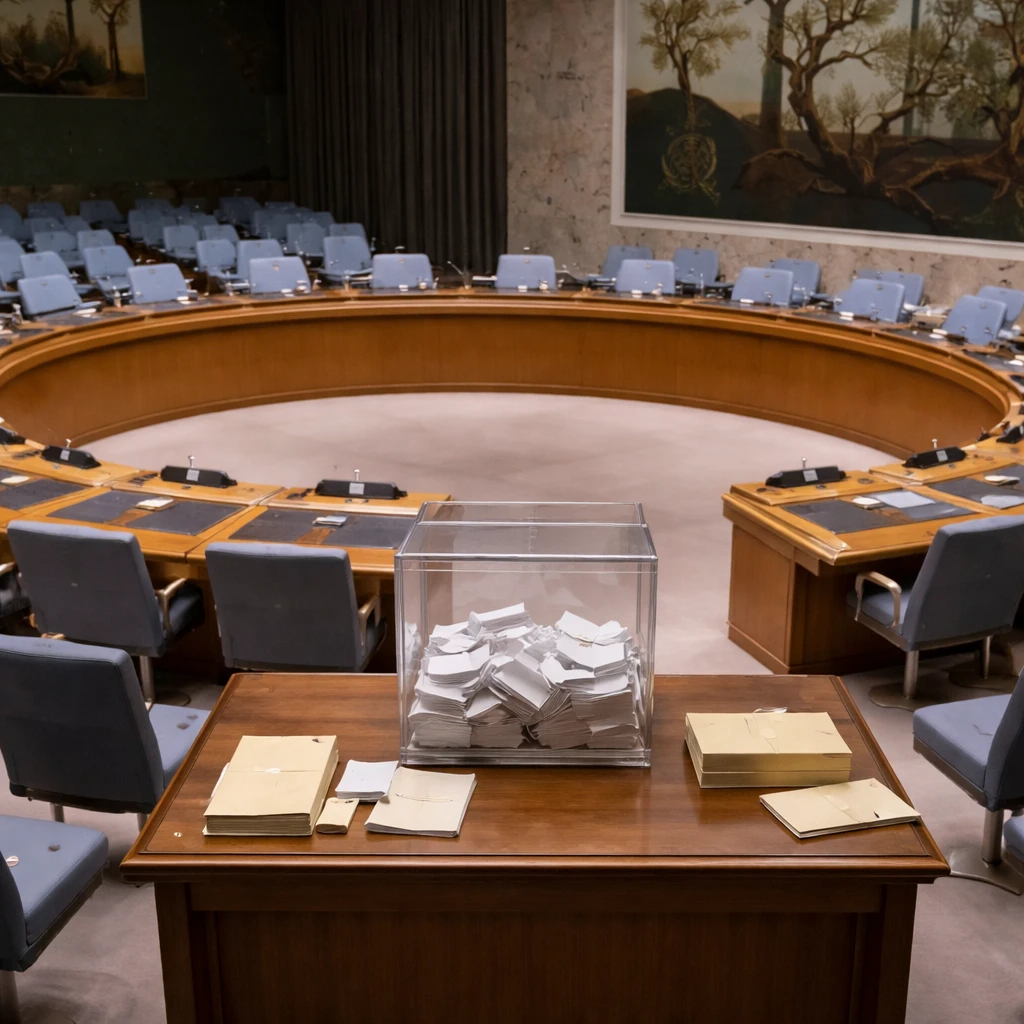
July 28 - The U.N. Security Council will conduct its first informal closed-door "straw poll" ballots on Thursday as an early test of support for seven candidates competing to become the next secretary-general of the United Nations.
The field currently includes candidates from seven countries: Argentina, Chile, Costa Rica, Ecuador, Guyana, Senegal and Uganda. They are contending to replace Antonio Guterres of Portugal, who will leave office at the end of this year after serving two five-year terms.
Members of the Security Council will cast secret, non-binding ballots that ask whether they "encourage," "discourage" or have "no opinion" on each aspirant. Only the council's 15 members attend the exercise and the votes themselves are confidential. Early rounds use identical ballots for all members so that delegates can see aggregate levels of support and opposition without knowing whether any particular negative vote came from one of the five permanent members who hold veto power - China, France, Russia, the United Kingdom and the United States.
At a subsequent stage in the process, the five permanent members will use a different-colored ballot from elected members. That color differentiation reveals whether a candidate has received a "discourage" vote specifically from one of the permanent members.
There is no clear front-runner at present. Historical practice indicates the council may run several rounds of straw polling through the summer, and the contest could extend into late September or early October. If the body cannot coalesce around a consensus candidate, the process could last even longer.
The seven individuals currently in the running are:
- Rafael Grossi of Argentina, head of the U.N. nuclear watchdog;
- Michelle Bachelet of Chile, the former Chilean president;
- Rebeca Grynspan of Costa Rica, former vice president of Costa Rica;
- Maria Fernanda Espinosa of Ecuador, a former Ecuadorian foreign minister;
- Carolyn Rodrigues-Birkett of Guyana, a former Guyanese foreign minister;
- Macky Sall of Senegal, a former Senegalese president; and
- Olara Otunnu of Uganda, a diplomat who entered the race last week.
Other candidates may still decide to join the contest.
After the Security Council reaches a recommendation, it adopts a resolution - typically behind closed doors - proposing an appointment to the 193-member U.N. General Assembly. That recommendation requires at least nine votes in favor and no veto from any permanent member. Subsequent approval by the General Assembly has long been viewed as largely formal, often described as a rubber stamp following the council's recommendation.
The current president of the Security Council is the Democratic Republic of the Congo. Its U.N. ambassador, Zenon Mukongo Ngay, confirmed to reporters on Tuesday that the initial round of straw polls would occur on Thursday morning. He also said that Olara Otunnu would be included among those on the ballot, despite the fact that Otunnu has not yet participated in the informal hearings that other candidates have completed.
Otunnu's curriculum vitae states that he invented the system of straw polls to select a new secretary-general when he served as Security Council president in 1981.
The incoming secretary-general will inherit an institution described in the contest as facing a crisis of confidence and diminished standing, with mounting calls to streamline a large and expensive bureaucracy and to cut duplication across many U.N. agencies. Those themes are central to expectations for any successor and form part of the broader discussion council members will consider as they weigh candidates in the straw polls.
Process notes: Straw polls are informal and non-binding. They are intended to give council members a confidential way to register levels of encouragement or concern about each candidate. If a candidate attracts a "discourage" vote from any permanent member in the colored-ballot phase, it signals a likely veto should the matter reach a formal resolution.