
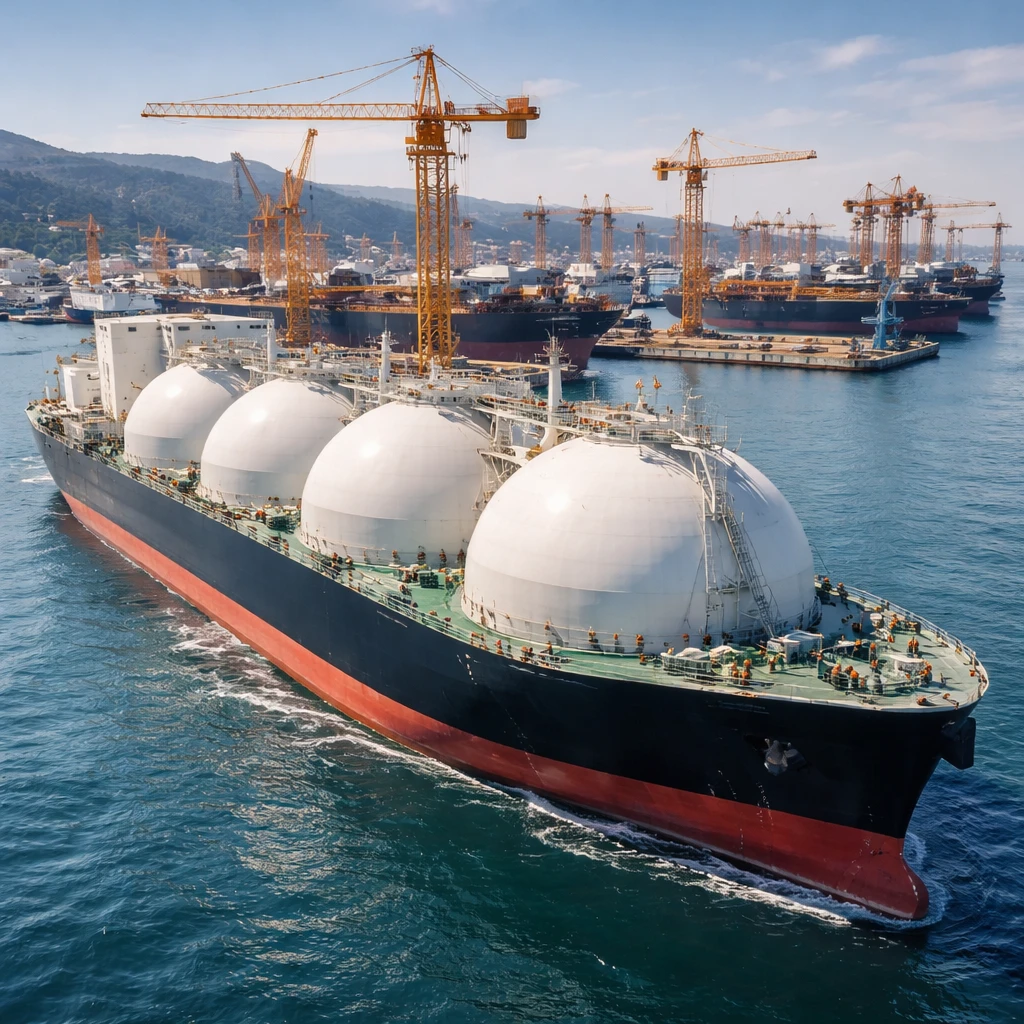
Two sell-side firms have moved to more positive stances on Gaztransport et Technigaz as analysts point to an unusually deep orderbook and an expanding pipeline of LNG carrier requirements tied to energy security and a faster replacement cycle for older tonnage.
Barclays opened coverage of the French containment-systems licensor with an "overweight" rating and a price target of c275 per share. At the same time, Berenberg upgraded its view on the stock to "buy" from "hold," raising its price target to c245 from c190.
The company reported a backlog of c1.9 billion at the end of June 2026, comprising 306 orders in total: 272 LNG carriers, 22 very large or ultra-large ethane carriers, three floating storage and regasification units (FSRUs), four floating LNG units (FLNGs) and five onshore storage projects.
Barclays cited company guidance that the backlog should translate into roughly c300 million of revenue in the second half of 2026, c655 million in 2027 and c603 million in 2028. The bank emphasised GTTs strong market position, noting it equips about 85% of the global LNG carrier fleet with its membrane technology and has taken all new LNG carrier containment-system orders since 2016. Barclays also highlighted the groups portfolio of more than 3,600 patents and its commercial links with South Korean and Chinese shipyards.
On longer-term volumes, Barclays projected that GTT could secure 500 to 600 LNG carrier orders by 2035, a figure the bank described as at least 25% higher than the companys own guidance. Barclays argued that roughly 120 million tonnes per annum of liquefaction capacity sanctioned in 2025 and in the first half of 2026 had only partially converted into committed vessel orders. That tally included 84 million tonnes per annum sanctioned in 2025 and 37 million tonnes per annum in the first half of 2026. Barclays further referenced a forecast for LNG demand to rise by 335 million tonnes per annum between 2025 and 2040 to reach 760 million tonnes per annum.
Berenberg offered a still more aggressive build for vessel demand, modelling about 650 LNG carrier orders over the next decade versus managements updated guidance of around 550. Its scenario broke demand down into roughly 300 vessels for projects already under construction, about 150 orders related to potential new project sanctions and approximately 200 replacement orders as existing vessels age beyond economic viability.
Both brokerages pointed to the fleet replacement dynamic as an important driver. Barclays calculated that more than 250 carriers will be over 20 years old by 2030, increasing to more than 500 by 2040. Berenberg identified 198 vessels it considers at near-term scrapping risk, noting that tightening environmental regulations and fuel-cost differentials are rendering older steam-turbine ships economically uncompetitive. The brokers highlighted that modern vessels consume almost 50% less fuel than carriers built in the early 2000s.
On financial metrics, Barclays expects revenue to grow at an 8.8% compound annual rate from 2025 through 2028, with adjusted EBITDA margins remaining at approximately 66% to 67% over that span. The bank forecast return on average capital employed above 100% in 2027 and return on equity of around 62%, supported by free cash flow of c459 million in 2027 rising to c579 million in 2028.
Barclays underscored the cash conversion characteristics of GTTs asset-light licensing model, which it said converts 80% to 85% of EBITDA into free cash flow. Management has committed to distribute at least 80% of net income as dividends, a policy that Barclays says implies a 2026 dividend yield of roughly 4.3%.
In its estimates, Barclays set 2028 EBIT at c658 million, about 16% above a consensus level of c566 million, and projected 2028 revenue at c1.03 billion, roughly 19% above consensus. Berenberg put its 2028 revenue estimate at c910 million, around 2.4% above a c889 million consensus.
Both brokers also flagged the strategic contribution from GTT Marine, the companies digital shipping division formed by combining Ascenz Marorka, Vessel Performance Solutions and the Danelec business acquired for c194 million in 2025. The division accounted for about 8% of first-half 2026 sales and was identified as a growing source of recurring revenue. Berenberg modelled a 10% revenue compound annual growth rate for GTT Marine through 2030, with EBITDA margins expanding to nearly 26%.
What this means
- Analysts see a clear pipeline of vessel demand that supports near-term revenue visibility and the potential for faster-than-expected order conversion as recent liquefaction investment decisions are realised.
- GTTs asset-light licensing model and strong margin profile underpin forecasts for robust free cash flow and dividend capacity.
- GTT Marine is highlighted by brokers as an incremental recurring-revenue stream that can diversify the groups earnings mix.
Data and projections cited in this piece are taken from broker research and company guidance as described above.