
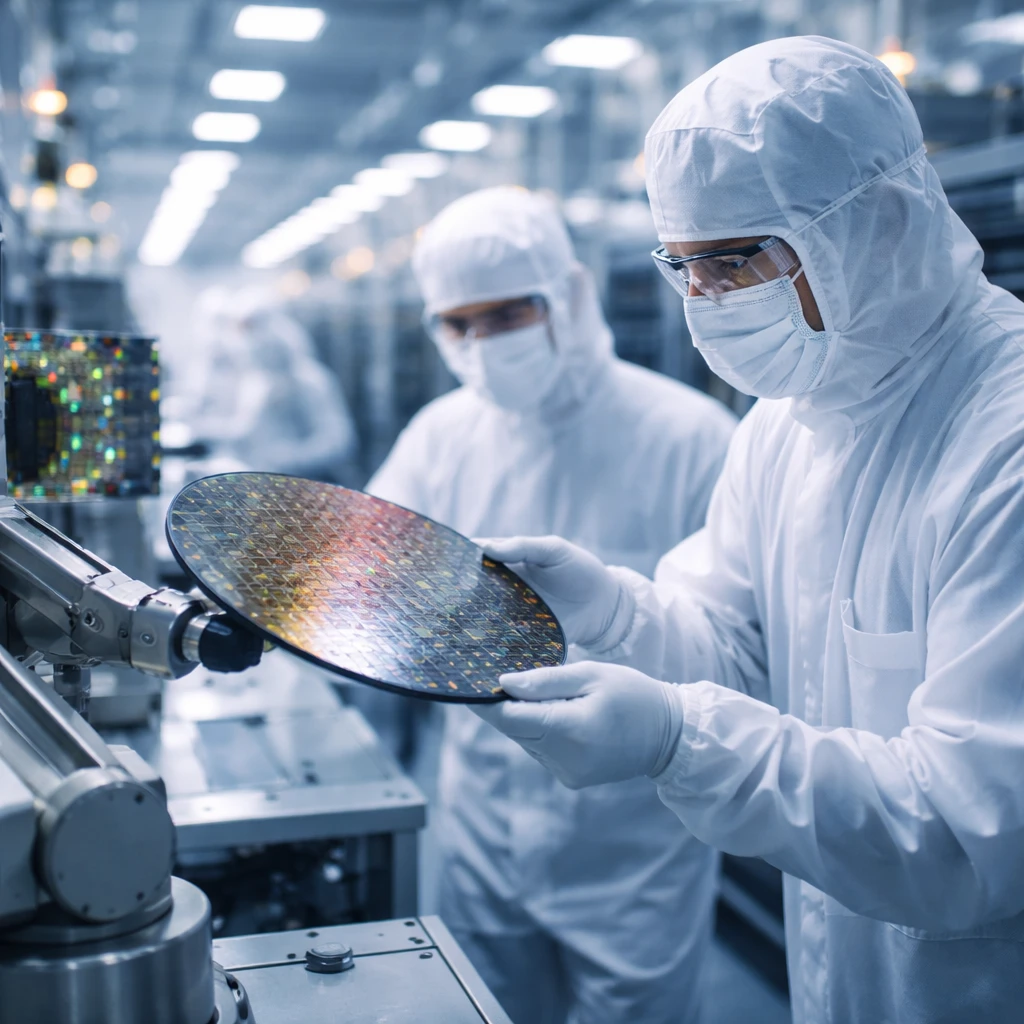
Bank of America analysts say artificial intelligence will compress decades of semiconductor growth into a much shorter period, identifying five principal themes they expect to underpin the industry’s next $1 trillion in sales.
In a note led by Vivek Arya, the team contrasted the long arc of the chip industry to date with what they foresee ahead: "The chip industry took ~50 years to generate its first $1Tn in sales," and "We expect AI to help add another $1Tn in just the next five years."
The five themes
- AI data center systems - BofA projects the total addressable market for AI data center systems will expand to roughly $1.7 trillion by 2030 from $273 billion in 2025.
- Memory strength and durability - The bank highlights memory as a sustained growth area backed by long-term supply agreements.
- Semiconductor capital equipment and reshoring - Rising chip complexity and reshoring trends are expected to lift demand for wafer fab equipment and related capital spending.
- Analog chips - Increased AI power requirements are cited as a driver for analog semiconductor demand.
- Agentic CPU demand - BofA estimates an agentic CPU opportunity of about $170 billion across x86 and ARM server architectures.
Revised industry and equipment outlooks
Following the thematic update, BofA raised its semiconductor industry revenue forecast to $2.7 trillion by 2030, implying a 28% compound annual growth rate from 2025. That is an upward revision from its previous $2.3 trillion projection. Within that outlook, the analysts identify memory as the dominant segment and project nearly 300% year-on-year growth for memory in 2026 alone.
The bank also increased its wafer fab equipment (WFE) spending projections. BofA now expects WFE spending to reach $250 billion by 2028, up from a prior estimate of $203 billion, and sees potential for spending to hit $292 billion by 2030.
Stock-level adjustments
BofA translated the sector-level upgrades into a series of upward price-target revisions across equipment suppliers, memory, connectivity and CPU plays. Notable moves include:
- Micron - target raised to $1,500 from $950, citing robust high-bandwidth memory demand and structurally constrained supply through 2028.
- Applied Materials - target raised to $720 from $540, reflecting higher WFE forecasts.
- Lam Research - target raised to $480 from $330.
- KLA Corporation - target raised to $317 from $210.
- Marvell - target raised to $365 from $240 on strength in AI connectivity demand.
- Intel - target raised to $160 from $135 on expanding server CPU and foundry opportunities.
- Credo Technology - target raised to $340 from $252.
One notable exception to the broadly bullish revisions was Axcelis Technologies. Although BofA raised its price target on Axcelis to $156 from $130, the firm retained an Underperform rating, stating that the stock already appears fully valued even after accounting for the potential earnings uplift tied to its pending merger with Veeco.
Market implications and perspective
From a supply-chain and capital expenditure standpoint, the report signals stronger near-term demand for memory, expanded spending on wafer fabrication equipment, and growing requirements for components that support higher AI power and agentic CPU workloads. The combination of sustained memory demand and higher WFE investment informs both equipment suppliers and chipmakers as they plan capacity and contract negotiations.
These forecast shifts and price-target changes map directly to publicly traded names central to fabrication, memory and AI infrastructure. The analysts’ revisions reflect an expectation that AI-driven workloads will lift revenue across multiple semiconductor subsectors and associated capital spending.
Summary
Bank of America expects AI to drive the next $1 trillion in semiconductor sales within five years through a set of five themes focused on AI data centers, memory, capital equipment and reshoring, analog chips, and agentic CPUs. The bank raised its industry revenue and WFE spending forecasts and adjusted price targets across several semiconductor-related stocks, while keeping an Underperform on Axcelis despite a higher target.