
Overview
Shares of one major GPU designer retreated in early trading after its chief executive disclosed an extramarital affair and the company announced an independent board review to determine whether the executive was targeted by a foreign intelligence operation. The company said that proprietary data and national security were not compromised. That probe comes at a sensitive time for the business - days before quarterly results and while lawmakers are requesting formal briefings on export-control compliance - but it also underscores a larger market dynamic: the AI-driven expansion of physical compute capacity is widening beyond any single supplier.
Why the AI infrastructure opportunity is diversifying
Major headlines that center on one or two dominant technology names increase exposure to corporate-level governance and geopolitical risk. Meanwhile, capital is reallocating into a broader set of infrastructure elements required to run next-generation AI workloads. That reallocation includes investment in domestic semiconductor manufacturing, proprietary accelerators developed by hyperscale cloud providers, systems integrators that assemble and deploy hardware regardless of component brand, and the electric supply systems capable of powering multi-megawatt racks and, in the largest cases, gigawatt-scale campuses.
Quantitative portfolio models designed to detect shifts in market leadership show growing allocations to a diversified roster of companies that convert compute demand into revenue. Across active strategies named Tech Titans and Beat the S&P 500, those models maintain exposure to profitable infrastructure enablers rather than concentrating on single-vendor hardware names.
Custom silicon and domestic manufacturing
The evolution begins at the chip level, where cloud providers and industrial equipment firms are moving away from reliance on one dominant GPU supplier. Microsoft is a prominent example of this trend. The company, which the portfolio models selected and which has gained 38.3% since selection, is both continuing to buy third-party hardware and deploying in-house Maia accelerators and Cobalt central processors. These custom designs aim to lower cloud unit costs and reduce dependence on external suppliers.
Crucially, Microsoft monetizes AI directly through Azure and Copilot. The article's source data indicates that commercial AI solutions on those platforms exceed a $37 billion annualized run-rate and sit alongside corporate operating margins near 47%. That structure converts AI adoption into recurring, high-margin software cash flow that is less exposed to hardware supply-chain disruption.
On the analog side, Texas Instruments provides chips that manage power and signal chains for racks, industrial automation and electric vehicles. Texas Instruments, which has risen 32.7% since being included in the model portfolio, operates domestic 300mm fabrication in Texas and Utah. With its multi-year U.S. manufacturing expansion nearing completion, the company expects capital spending to ease and free cash flow to shift toward dividends and buybacks.
Systems integration and enterprise application layers
As racks and accelerator networks are assembled, enterprises require vendor-agnostic systems engineering and software layers to convert compute into usable workflows. Kyndryl Holdings, spun out of a legacy enterprise services firm and up 32.1% since selection, supplies the technical architecture to move legacy databases into hybrid cloud environments. The company trades at a valuation discount relative to semiconductor peers while signing multi-year modernization agreements with major cloud providers.
Insight Enterprises plays a similar role as a primary systems integrator and hardware reseller for large corporations. Insight, also up 32.1% since inclusion, aggregates and deploys hardware and software solutions whether customers select Nvidia, AMD, or custom hyperscaler silicon, allowing the company to expand margins from enterprise IT refresh cycles without single-vendor exposure.
Above the infrastructure stack, enterprise software firms convert deployed compute into subscription revenue. Salesforce, which rose 31.1% since selection, is monetizing AI through offerings such as Agentforce, a platform that embeds autonomous workflow agents into customer service and sales databases. That approach turns AI adoption into high-margin subscription cash flow while avoiding direct ownership of data center assets and their depreciation.
Power capacity - the limiting resource
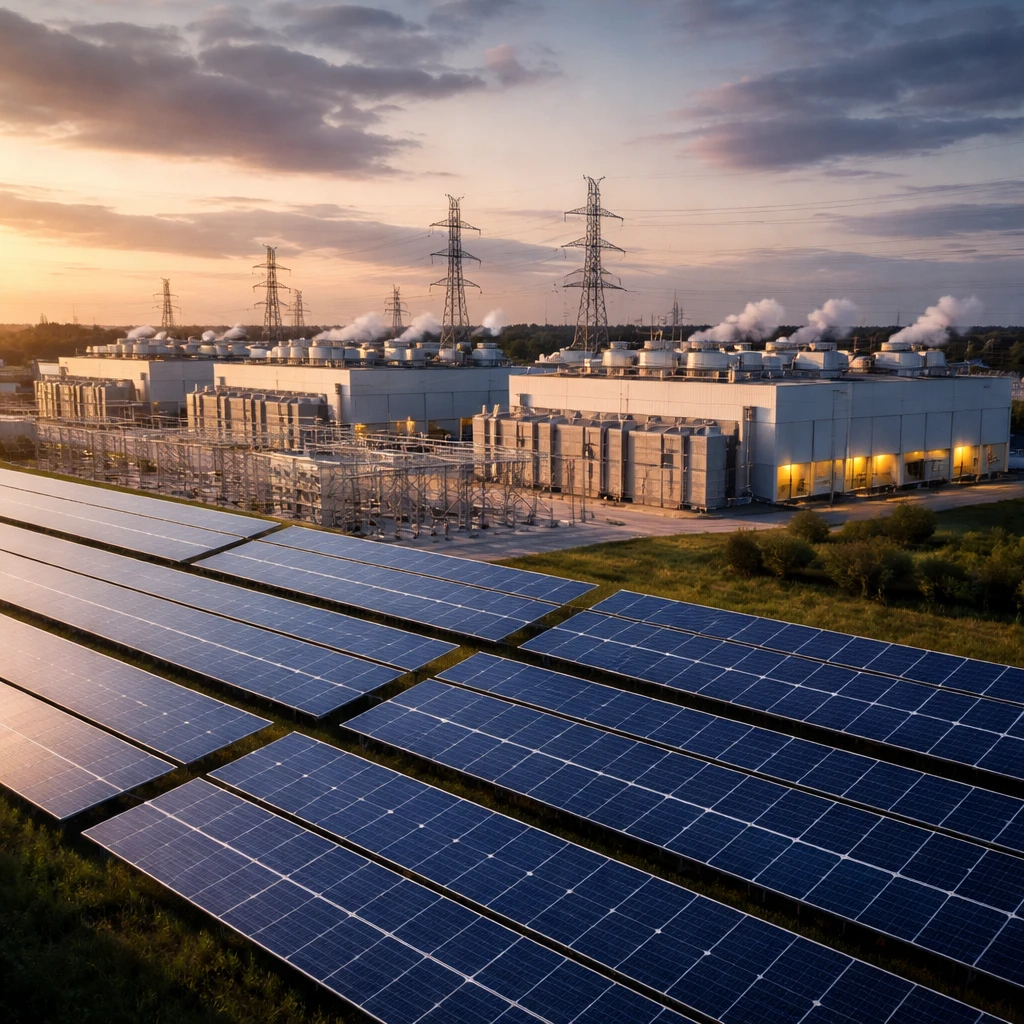
As AI workloads grow, the operational constraint is increasingly electric power rather than chip supply. Modern data centers require dedicated multi-megawatt feeds and, for the largest deployments, gigawatt-scale generation before compute clusters can be fully activated.
First Solar addresses that constraint by supplying utility-scale photovoltaic generation to long-term power purchase agreements with cloud operators. The company, which has gained 15.3% in November, is the largest U.S.-based solar manufacturer. Its domestic supply chain mitigates exposure to overseas tariffs and semiconductor trade restrictions, making it a direct supplier for cloud operators securing reliable clean power for new facilities.
What this means for investors and capital allocation
The recent governance scrutiny of a single high-multiple hardware designer highlights the vulnerability of concentrated exposure to any one vendor. While headline volatility affects favorites in the market, the durable economics of the AI compute buildout rest on a broad ecosystem that includes utility power, domestic silicon fabrication, systems integration and enterprise software.
Investment strategies that prioritize companies capable of converting structural industry growth into documented balance-sheet cash flow have outperformed in this approach. According to the models referenced, the Tech Titans strategy has delivered a 152.06% return since its November 2023 launch, outperforming the benchmark S&P 500 by nearly 78%.
For active investors seeking exposure to these themes, a full set of model-driven strategies is available for a monthly fee of $9.
Conclusion
Market attention to corporate governance and export-control scrutiny at one large chip designer has elevated short-term risk for concentrated positions. Yet the physical infrastructure required to scale AI is broader and more distributed - spanning custom hyperscaler accelerators, domestic analog and fabrication capacity, integrators that assemble vendor-neutral systems, enterprise software that captures recurring revenue, and utility-scale clean power providers. Each of these layers presents potential revenue pathways as compute demand expands.