
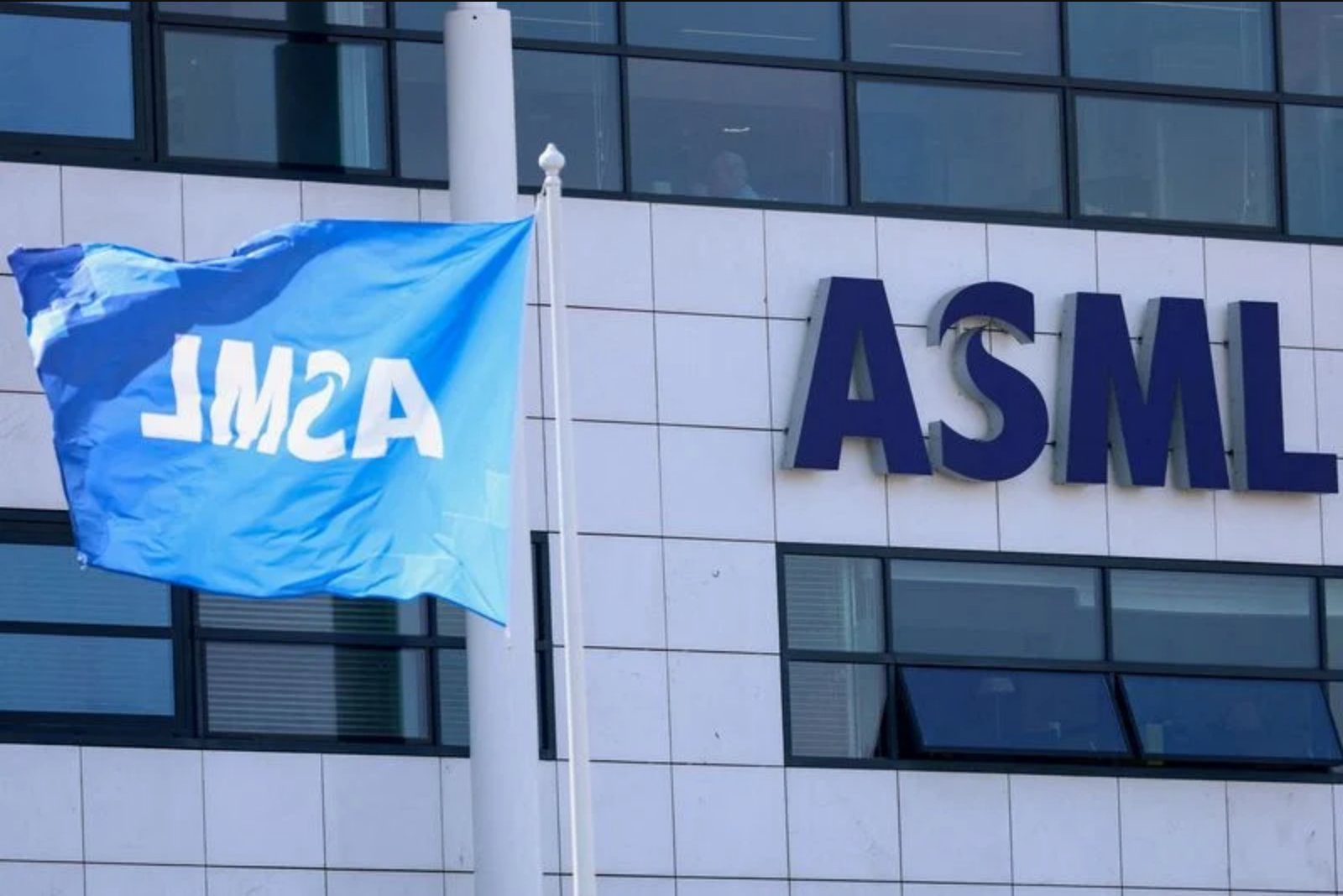
AMSTERDAM, July 14 - ASML, the Netherlands-based manufacturer of lithography equipment widely used in producing advanced semiconductors, is due to report quarterly earnings on Wednesday as markets weigh whether the company can justify a high valuation and navigate rising trade controls aimed at China.
The company has become Europe’s most valuable listed firm, with a market capitalisation of €610 billion ($696 billion). Its stock has climbed nearly 70% so far this year, fuelled by a spending surge among memory and logic chip manufacturers seeking to add capacity. Customers such as SK Hynix, Samsung and Micron are expanding their production footprints, while foundry leaders and other potential sources of demand - including ongoing investments by TSMC and Intel’s recovery - add to pressure on ASML to supply more equipment. Elon Musk’s TeraFab plans were also cited by market participants as a factor that could further stretch demand.
Regulatory developments in the United States cloud the outlook. Proposed U.S. legislation would press allies to align with U.S. export controls designed to limit China’s ability to produce advanced chips, and ASML is explicitly referenced in that draft law. The company has stated it has not sold its most advanced extreme ultraviolet (EUV) systems to China. Analysts note, however, that China could represent as much as 20% of ASML’s sales this year through lawful purchases of less-advanced deep ultraviolet (DUV) tools used for automotive, industrial and consumer electronics chips.
Analysts polled by LSEG expect ASML to report second-quarter net profit of €2.61 billion, up 8.8% year-on-year, and revenue of about €8.8 billion, up 14%. Market watchers are also focused on whether ASML will raise its full-year revenue outlook, currently set in a band between €36 billion and €40 billion.
Mehdi Hosseini, an analyst at broker Susquehanna, said he expects a "beat-and-raise" outcome and suggested that ASML’s production capacity through the end of 2027 might already be fully booked. Morningstar’s Javier Correonero questioned the conservatism of ASML’s long-term guidance, noting the company’s 2030 sales target of at least €44 billion "now looks overly conservative," and added he forecasts €60 billion in 2030 sales.
ASML is the sole supplier of EUV lithography systems - the large, roughly $300 million machines required to print the smallest features on leading-edge chips. Each EUV system takes about a year to assemble, a factor that constrains how quickly end customers can scale AI infrastructure and other advanced production. Chief Executive Christophe Fouquet told investors in April that the company is taking steps to avoid becoming a bottleneck similar to what the industry experienced during the COVID-19 pandemic.
The company has set targets to ship 60 EUV tools this year and 80 next year. ASML has also indicated it could theoretically ship up to 90 units without expanding physical production capacity. In addition to that figure, JPMorgan analysts have suggested a potential output as high as 110 units. ASML told Reuters it is exploring "creative ways to help customers" beyond the 90-unit estimate, citing measures such as upgrades to older machines, faster assembly and swifter installation to accelerate throughput.
Securing long-lead components has been a stated priority. ASML noted additional supplies of parts that typically require lengthy production cycles, such as precision optics from Zeiss and high-power lasers from German firm Trumpf. Trumpf’s spokesperson Manuel Thoma said the company is "fully prepared to meet ASML’s EUV demand over the next three years." Zeiss declined to comment on capacity plans but has been expanding its optics operations for both DUV and EUV systems.
Market participants remain divided on valuation and upside potential. The stock trades at roughly 49 times estimated 2027 earnings, a multiple some analysts regard as elevated. KBC analyst Thomas Couvreur said much of the expected upside appears priced in and maintained a "hold" recommendation on that basis. Conversely, ING analyst Marc Hesselink noted ASML has lagged the Philadelphia Semiconductor Index so far this year and argued that strong results coupled with additional capacity expansion could support a recovery in relative performance.
Investors will watch the upcoming quarterly print for signs that ASML’s backlog, delivery cadence and any commentary on export controls can sustain current forecasts and justify the premium valuation, particularly given the interplay between customer demand, supply-chain constraints and shifting trade policy.
Data points from estimates and company guidance cited in this article:
- Market capitalisation: €610 billion ($696 billion)
- Share price increase year-to-date: nearly 70%
- China's potential share of ASML sales this year (through legal DUV purchases): up to 20%
- Second-quarter net profit estimate: €2.61 billion (up 8.8%)
- Second-quarter revenue estimate: €8.8 billion (up 14%)
- Current full-year revenue guidance: €36 billion to €40 billion
- ASML EUV shipment targets: 60 this year, 80 next year; theoretical capacity up to 90 without physical expansion
- Long-term sales target cited by ASML: at least €44 billion by 2030; one analyst forecast: €60 billion
- Valuation measure: roughly 49 times estimated 2027 earnings