
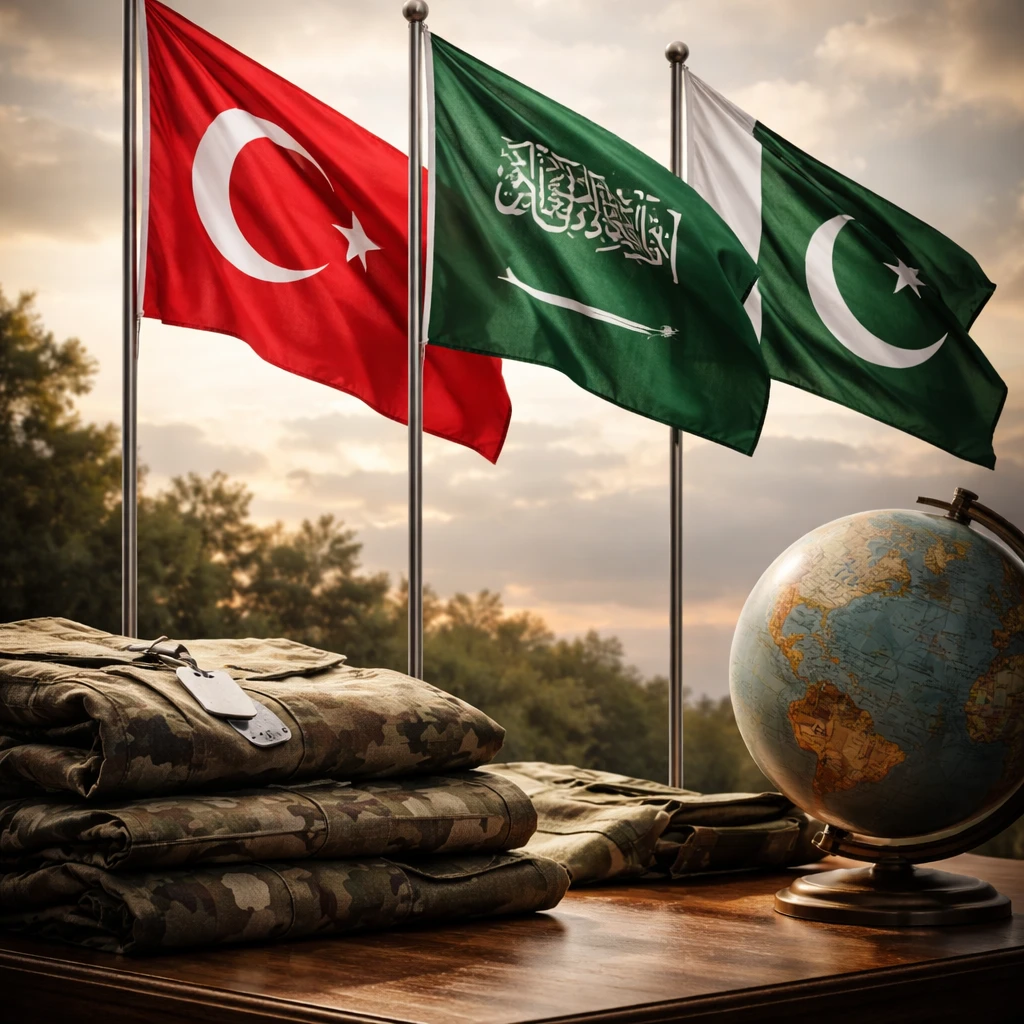
Turkish President Tayyip Erdogan has formalised Turkey's participation in the Mecca Joint Defence Agreement with Pakistan and Saudi Arabia by signing the pact into law, the country's Official Gazette said on Friday. The presidential signature completes a ratification process that followed parliamentary approval on November 5.
The three countries initially concluded the agreement in Mecca in August. The signing took place amid rising concerns tied to a U.S.-Israeli military campaign against Iran, a context noted at the time of the pact's inception.
Under the terms of the Mecca agreement, an attack directed at any one member state is to be considered an attack on all three signatories. The clause establishes mutual-defence obligations among Turkey, Pakistan, and Saudi Arabia.
The pact also removes legal obstacles that had existed for Turkey to offer military assistance to Saudi Arabia. Saudi Arabia has been subject to attacks from Yemen's Iran-backed Houthi militants, and the agreement provides a framework under which Turkey could extend support.
A lawmaker from Turkey's ruling party stated last month that the government planned to submit a separate parliamentary mandate to authorise deployment of Turkish military personnel to Saudi Arabia under the terms of the agreement. That planned submission remains a parliamentary process and has not been concluded in the text of the agreement itself.
Officials from the three countries are scheduled to meet in Islamabad on Friday and Saturday to discuss next steps and implementation details. The meeting presents the immediate forum for member states to coordinate on operational and political aspects of the pact.
Some of the signatories' characteristics were highlighted in public statements around the deal: Turkey maintains NATO's second-largest military force; Saudi Arabia is home to Islam's holiest sites and ranks among the world's top oil exporters; Pakistan is identified as the only Muslim-majority country possessing nuclear weapons. Those features underline the strategic weight each party brings to the agreement.
At this stage, the ratification by Turkey completes one national step in a multilateral process. Further actions, including any parliamentary mandate for troop deployments and outcomes from the Islamabad meeting, will determine how the agreement is implemented going forward.
Summary
The Turkish presidency signed the Mecca Joint Defence Agreement into law after parliament's approval on November 5. The pact, first signed in August, obliges the three members to treat an attack on one as an attack on all and clears the legal path for Turkey to provide military support to Saudi Arabia. A separate parliamentary mandate would be needed to deploy Turkish troops. Officials from Turkey, Pakistan, and Saudi Arabia are set to meet in Islamabad on Friday and Saturday to coordinate implementation.
Key points
- The Mecca Joint Defence Agreement has been ratified in Turkey following presidential signature and prior parliamentary approval on November 5.
- The pact establishes collective-defence obligations among Turkey, Pakistan, and Saudi Arabia, and enables Turkey to support Saudi Arabia militarily, where appropriate.
- Sector impacts to monitor include defence (deployments and military cooperation) and energy (Saudi Arabia's status as a top oil exporter), given the security dynamics noted in the agreement.
Risks and uncertainties
- The requirement for a separate parliamentary mandate to deploy Turkish military personnel to Saudi Arabia introduces a procedural uncertainty for actual troop deployment under the agreement; this affects defence-sector planning.
- The mutual-defence clause means that an attack on any signatory could draw the other parties into collective responses, creating potential for escalation that could influence regional stability and energy markets.
- The outcome of the scheduled Islamabad meeting on Friday and Saturday is uncertain and will shape how the pact is operationalised across political and military channels.