
Summary
Republican-controlled legislatures in multiple states have advanced or enacted congressional redistricting plans in recent months, a wave intensified by two judicial rulings that altered the legal protections for some majority-Black districts and invalidated a Democratic-drawn referendum in Virginia. Those rulings, together with state-level maneuvers, have positioned Republicans to increase their advantage in a number of competitive seats nationwide as the November midterm elections approach. Democrats remain within reach of a House majority if they can flip a small number of Republican seats, making each contested district potentially decisive.
The national context
The latest chapter in a year-long national battle over congressional maps has unfolded as both parties sought to redraw districts to their advantage. The fight began last summer when President Donald Trump urged Republicans in Texas to adopt a map targeting five Democratic-held seats. California Democrats answered with their own map aiming at five Republican incumbents, and other states moved to reshape districts in response. Through much of this spring, control over new lines had been roughly balanced between the parties.
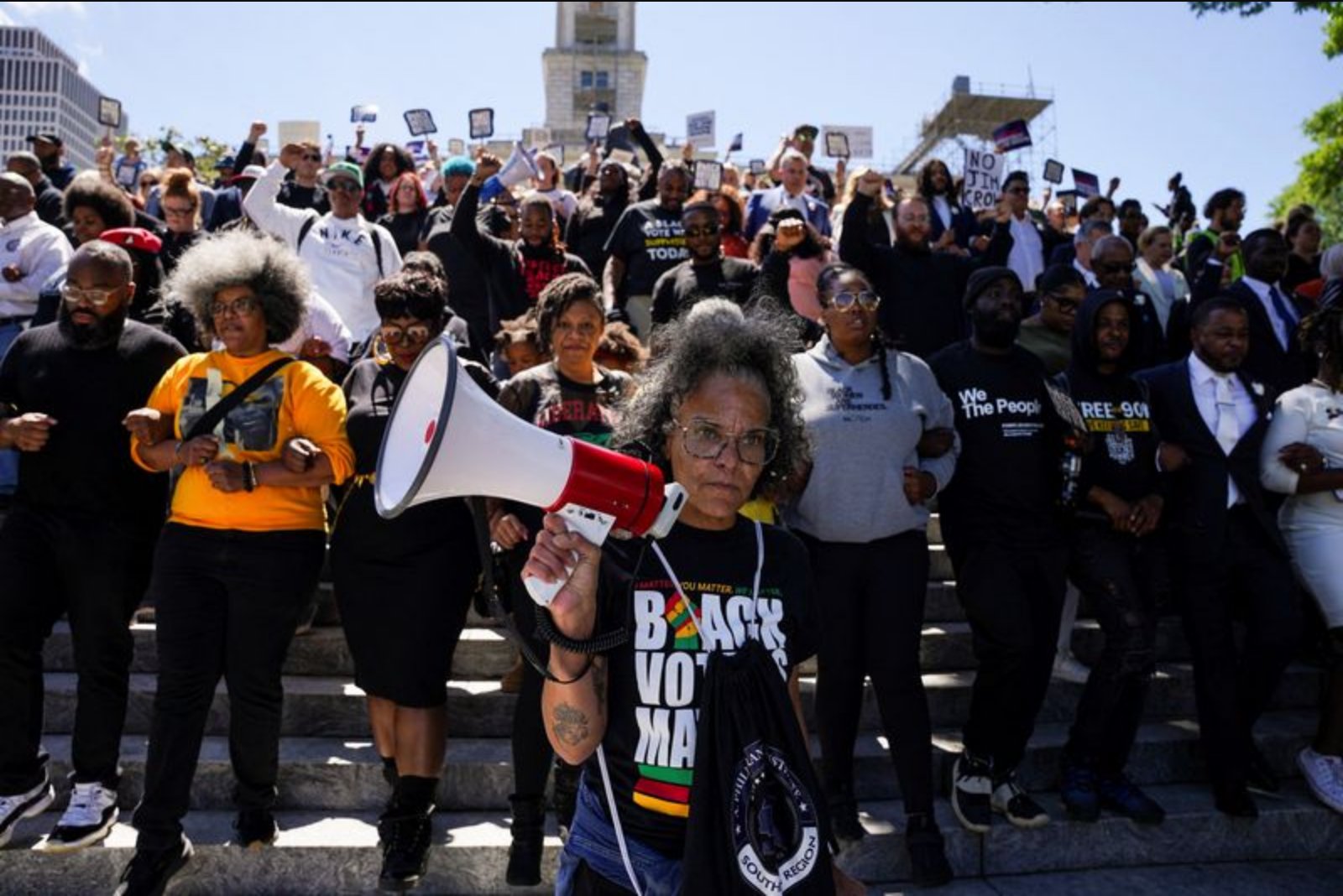
That equilibrium shifted after two court decisions. A U.S. Supreme Court ruling reduced protections for majority-Black districts, removing a prior legal barrier to redrawing certain districts. Separately, the Virginia Supreme Court invalidated a Democratic-backed referendum that would have enacted a new map in that state. Taken together, these decisions have enabled Republican lawmakers to pursue more aggressive redistricting in several states, and observers now see Republicans as likely to finish this cycle having increased their edge in nearly a dozen U.S. House districts.
Democrats need to flip three Republican-held seats from the 2024 baseline to reclaim a House majority, which means each district where maps have changed could prove pivotal.
State-by-state developments
Tennessee - One seat
Tennessee Republican legislators on May 7 approved a new congressional map that dismantles a majority-Black district centered on Memphis. The action is explicitly tied to the U.S. Supreme Court decision that reduced the legal protections that had preserved such districts under the Voting Rights Act. The revised lines are expected to threaten the seat held by the state's lone Democratic U.S. representative, Steve Cohen, and, if enacted as planned, would leave Republicans representing all nine congressional districts in Tennessee.
South Carolina - Possibly one seat
In South Carolina, Republicans are weighing a map that would target the district of long-serving Democratic U.S. Representative Jim Clyburn. It remains unclear whether the plan will secure sufficient support to become law. Implementing the new map may require postponing the state's June primary nominating election. Republicans already control six of South Carolina's seven U.S. House districts.
Alabama - Possibly one seat
The U.S. Supreme Court recently cleared the way for Republican lawmakers in Alabama to pursue a new map that would focus on one of the state's two majority-Black districts, both currently held by Democrats. Anticipating the court's move, Republican legislators had passed a law permitting them to cancel the scheduled May 19 U.S. House primary elections and set a new date. Previously, a court order had required the state's current map to remain in place until 2030, but the Supreme Court granted a Republican request to lift that injunction. The outcome could permit a return to an older map with only a single Democratic-leaning district. Republicans already represent the state's other five House seats.
Texas - Up to five seats
In early December, the U.S. Supreme Court allowed a Republican-backed Texas map to stand, overturning a lower court finding that the map likely discriminated against minority voters. That decision cleared the way for a map targeting five Democratic-held seats. Governor Greg Abbott signed the plan into law in August. Weeks earlier, more than 50 Democratic state lawmakers fled the state in a bid to prevent a vote on the map, temporarily stalling the process before they ultimately returned. Under a Republican-drawn map from 2021, Republicans already control 25 of Texas' 38 congressional seats.
Florida - Up to four seats
Florida's Republican Governor Ron DeSantis enacted a new congressional map intended to flip up to four Democratic-held seats and called a special legislative session in late April. The Republican majority in the legislature passed the map into law during that session. Democrats have pledged legal challenges, arguing that the state constitution forbids drawing districts solely for partisan advantage. Prior to this change, Republicans held 20 of Florida's 28 congressional seats after a 2022 map adopted by the governor and legislature flipped four Democratic districts.
Missouri - One seat
Governor Mike Kehoe signed a map in September that dismantled a Democratic-held seat based in Kansas City, improving the Republican position in seven of the state's eight districts. Opponents are pursuing a voter referendum to reverse the map and several organizations have filed lawsuits challenging its legality.
Ohio - Up to two seats
Ohio's redistricting process was affected by a quirk of state law that required a new map for 2026 because the previous plan had been approved with no Democratic votes. The state's redistricting commission, composed of five Republicans and two Democrats, unanimously approved a compromise map in October that increases Republican prospects of flipping two Democratic-held seats while stopping short of the more extreme changes Democrats had feared. Republicans currently hold 10 of Ohio's 15 congressional seats.
North Carolina - One seat
North Carolina's Republican-majority legislature approved a map in October intended to flip a Democratic-held district. If successful, the change would give Republicans control of 11 of the state's 14 U.S. House seats. Under state law, the Democratic governor, Josh Stein, had no power to block the legislature's plan.
Louisiana - Up to two seats
Following a U.S. Supreme Court finding that the state's map was an unconstitutional racial gerrymander, Governor Jeff Landry postponed the state's May 16 primary election for the U.S. House. The delay allows the Republican-controlled legislature to consider replacement maps, including proposals that could dismantle both of Louisiana's majority-Black, Democratic-held districts. Republicans presently hold four of the state's six U.S. House seats.
Indiana - Effort failed
In Indiana, a proposed Republican map aimed at targeting the state's only two Democratic U.S. House seats was rejected by the state senate, representing a notable rebuke to President Trump from members of his own party. Republicans continue to hold seven of Indiana's nine congressional seats.
Kansas - Effort failed
Kansas Republicans abandoned a Trump-endorsed effort to redraw the state's congressional map after State House Speaker Dan Hawkins said in January that he lacked sufficient support to overcome a veto threat from Democratic Governor Laura Kelly. Republicans already hold three of Kansas' four U.S. House seats.
Democratic moves, pushback and blocks
California - Up to five seats (Democratic gains)
California voters approved a Democratic-backed map promoted by Governor Gavin Newsom and state lawmakers in large numbers. That map was explicitly designed to flip as many as five Republican-held seats in direct response to the Texas effort. Democrats currently hold 43 of California's 52 congressional districts.
Virginia - Effort blocked by court
Virginia voters approved a Democratic-drawn congressional map in a special election on April 21 that could have flipped four Republican-held seats. However, the Virginia Supreme Court on May 8 threw out the referendum results, ruling that Democratic lawmakers did not follow required procedures when passing the referendum for the ballot. The decision prevents the map from taking effect.
Utah - One seat
In Utah, a state judge ruled that a Republican-drawn map was illegally partisan and implemented an alternative map. That judicially imposed map is likely to flip one of Utah's four Republican-held seats to Democratic control.
Maryland - Effort stalled
Maryland Democrats in the state House advanced a new map in February targeting the state's only Republican congressman, a move supported by Democratic Governor Wes Moore and national party leaders. While Democrats control seven of the state's eight seats, the effort was undermined when state Senate President Bill Ferguson, a fellow Democrat, opposed the bill, likely dooming the proposal.
New York - Effort blocked by court
A New York judge ordered the state's independent redistricting commission to redraw a Republican-held congressional district centered on Staten Island, which could have given Democrats a chance to flip the seat in November. The U.S. Supreme Court's conservative majority placed that decision on hold on March 2 after the incumbent Republican, Nicole Malliotakis, sought relief. Governor Kathy Hochul has indicated she would pursue a new map in response to the Texas-driven changes, but state law prevents a statewide redistricting effort before 2027.
Implications and closing assessment
The aggregate effect of state legislative activity and judicial rulings has moved the redistricting cycle in a direction favorable to Republican lawmakers in multiple states. The U.S. Supreme Court's decision that undercut protections for majority-Black districts, along with state-court rulings such as the one in Virginia that vacated a Democratic referendum, have materially altered the legal terrain. As a result, Republican legislatures have greater latitude to redraw lines in a way that could weaken some Democratic incumbents and increase Republican chances in competitive districts.
At the same time, Democrats have advanced or won new maps in several states, notably California, and court interventions in places like Utah and New York have blocked or altered Republican-drawn plans. Several proposed changes remain subject to litigation or political maneuvering, and in some states internal divisions within the parties have constrained redistricting efforts.
With Democrats needing to flip three seats to secure a House majority, the outcome in each contested district will be closely watched by investors and political observers alike because control of the House affects legislative priorities and oversight. The redistricting battle is therefore not merely a regional political conflict but a national determinant of the congressional balance of power heading into the midterm elections.
Key points
- Recent court rulings have eased restrictions on changing majority-Black districts and invalidated a Democratic referendum in Virginia, giving Republicans a legal opening to redraw maps in multiple states - impact: High for political governance and electoral outcomes.
- Republican-controlled legislatures have enacted or proposed maps that could flip a number of Democratic-held seats in states including Tennessee, Texas, Florida, Missouri, Ohio, North Carolina and Louisiana - impact: Medium to high for political risk and election-related sectors.
- Democrats have had successes and setbacks: California approved a Democratic-backed map, while courts in Virginia, Utah and New York have blocked or altered proposed maps - impact: Medium on campaign strategies and legal services markets.
Risks and uncertainties
- Ongoing litigation - Many enacted or proposed maps are subject to lawsuits that could alter outcomes before the November elections. This creates legal risk for states and uncertainty for political stakeholders, with potential implications for legal services and compliance-related expenditures.
- Political maneuvering and scheduling - Actions such as postponing primary elections in Alabama and Louisiana or the need to move primary dates in South Carolina inject procedural uncertainty that could affect campaign planning and fundraising cycles, influencing political advertising and related media markets.
- Internal political opposition - In states like Indiana, Kansas and Maryland, intra-party divisions limited redistricting efforts, showing that legislative dynamics can prevent map changes even where one party controls a chamber. This uncertainty affects how broadly new maps will be adopted and the electoral stakes in affected districts.
Disclosure
Tags
redistricting, gerrymandering, elections, law, politics