
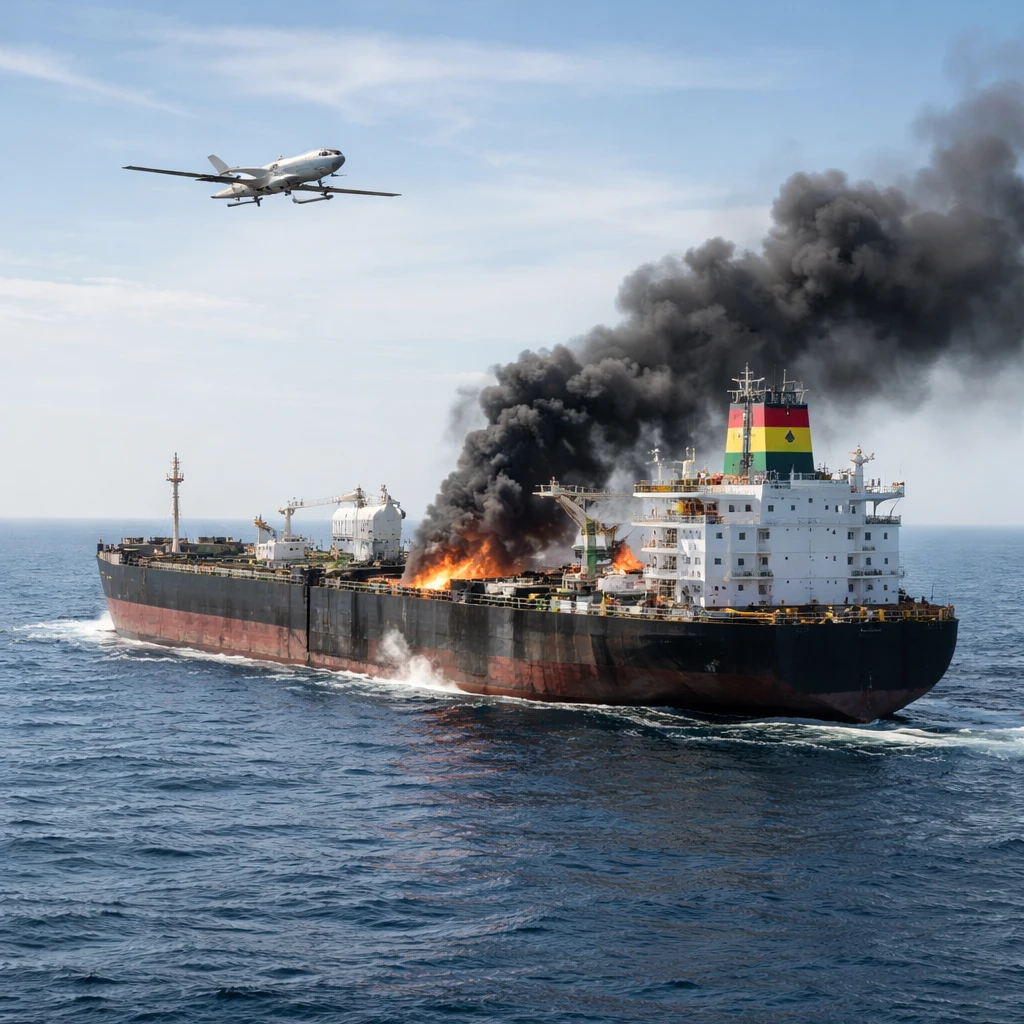
U.S. Central Command said a U.S. aircraft fired two Hellfire missiles into the engine room of the Guinea-Bissau-flagged tanker M/T Jalveer in the Gulf of Oman after the vessel's crew repeatedly failed to comply with directions from U.S. forces.
In a statement, CENTCOM said the Jalveer was attempting to transport oil from Iran through the Gulf of Oman and that U.S. forces acted against the tanker when the crew did not follow orders. "A U.S. aircraft fired two Hellfire missiles into the ship's engine room after the crew repeatedly failed to comply with directions from U.S. forces," the statement said.
The incident represents the third commercial vessel disabled by U.S. forces in the same week, according to the military's announcement. CENTCOM identified the ship as Guinea-Bissau flagged and indicated the vessel was carrying Iranian oil when it encountered the American blockade in the Gulf of Oman.
Officials described the engagement as a response to the crew's failure to adhere to instructions from U.S. personnel. Beyond the account provided by Central Command, no additional operational details or statements from the ship's operators or crew were included in the announcement.
Summary of events and official account:
- The vessel involved was the M/T Jalveer, flying the flag of Guinea-Bissau.
- CENTCOM said the ship was attempting to transport Iranian oil through a U.S. blockade in the Gulf of Oman.
- After the crew repeatedly failed to follow directions, a U.S. aircraft struck the ship's engine room with two Hellfire missiles.
- This was described by the U.S. military as the third commercial ship disabled by U.S. forces during the week.
The military's statement provided the core facts of the engagement but did not expand on the condition of the vessel, the status of the crew, or subsequent steps taken after the strikes. The announcement confined itself to describing the tactical action taken and the reason given by U.S. forces for that action.
Key sectors touched by the episode include maritime shipping and oil transport, both of which are directly referenced by the nature of the vessel and its cargo. The account is limited to the information released by Central Command and does not include corroborating details from other parties.
Key points
- U.S. forces disabled the Guinea-Bissau-flagged M/T Jalveer in the Gulf of Oman after the crew failed to comply with directions.
- Central Command said the vessel was attempting to move Iranian oil through an American blockade and that a U.S. aircraft fired two Hellfire missiles into the engine room.
- This is the third commercial ship disabled by U.S. forces in the area during the week, per the CENTCOM statement.
Risks and uncertainties
- Limited official detail: CENTCOM's statement provides the decisive action and rationale but omits further operational details, leaving questions about the vessel's condition and crew status.
- Pattern of incidents: The fact that this is the third commercial ship disabled by U.S. forces in a single week indicates an ongoing series of actions in the area, creating uncertainty for maritime operators and oil transporters.