
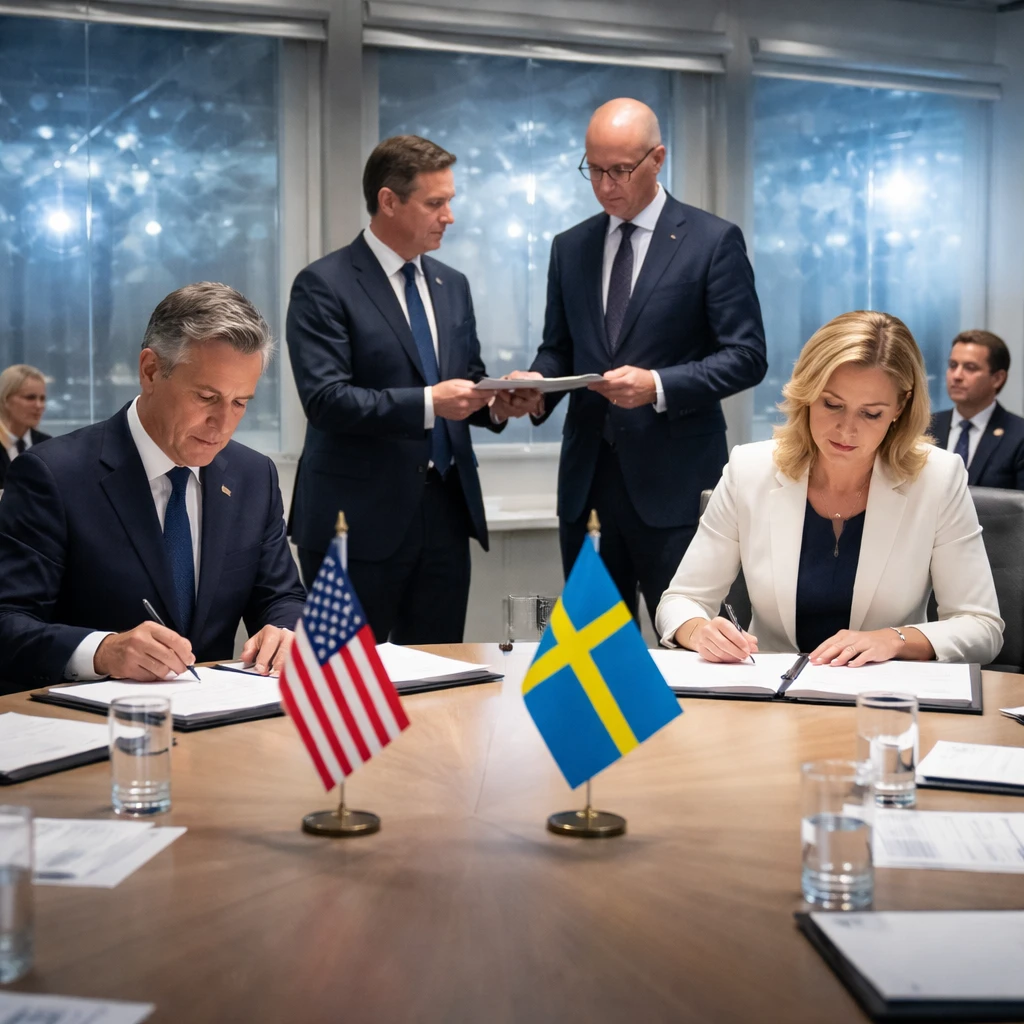
The United States and Sweden announced on Friday that they have entered into a Technology Prosperity Deal designed to deepen bilateral cooperation in multiple high-technology domains.
The memorandum of understanding expands on the 2006 Agreement on Science and Technology Cooperation and sets out a framework to advance next-generation artificial intelligence and network technologies, to promote trusted technology stacks, and to coordinate positions on international telecommunications standards.
Under the agreement, participants will engage with multilateral forums to shape telecommunications principles, including working through the International Telecommunication Union, the Global Coalition on Telecommunications, and the 2027 World Radiocommunication Conference.
The scope of cooperation encompasses a wide set of scientific and industrial areas. Those listed in the memorandum include advanced manufacturing, biomedical research, energy, space, and quantum computing, alongside defense innovation. Energy-related collaboration specifically highlights civil nuclear energy, small modular reactors, and fusion technologies, as well as joint work on technologies tied to critical minerals for energy systems.
The memorandum also seeks to broaden nuclear lifecycle innovation by enabling scientific exchanges focused on repository engineering and geologic modeling.
On defense, the agreement establishes a dialogue addressing technology cooperation and regulatory issues that affect technology transfer, with the stated aim of supporting transatlantic defense industrial collaboration. It also identifies measures to strengthen research security through intellectual property safeguards, investment screening, and talent integrity measures that concern entities of shared security interest.
Procedurally, the memorandum becomes operative on the date of the last signature. Either participant may discontinue the arrangement by providing 180 days written notice. Implementation is to be carried out through a Joint Committee Meeting mechanism; the composition and procedures for that body will be set by mutual agreement.
This agreement frames a coordinated approach across telecommunications, energy, and defense technology policy, with implementation details to be determined through joint governance and further exchange.