
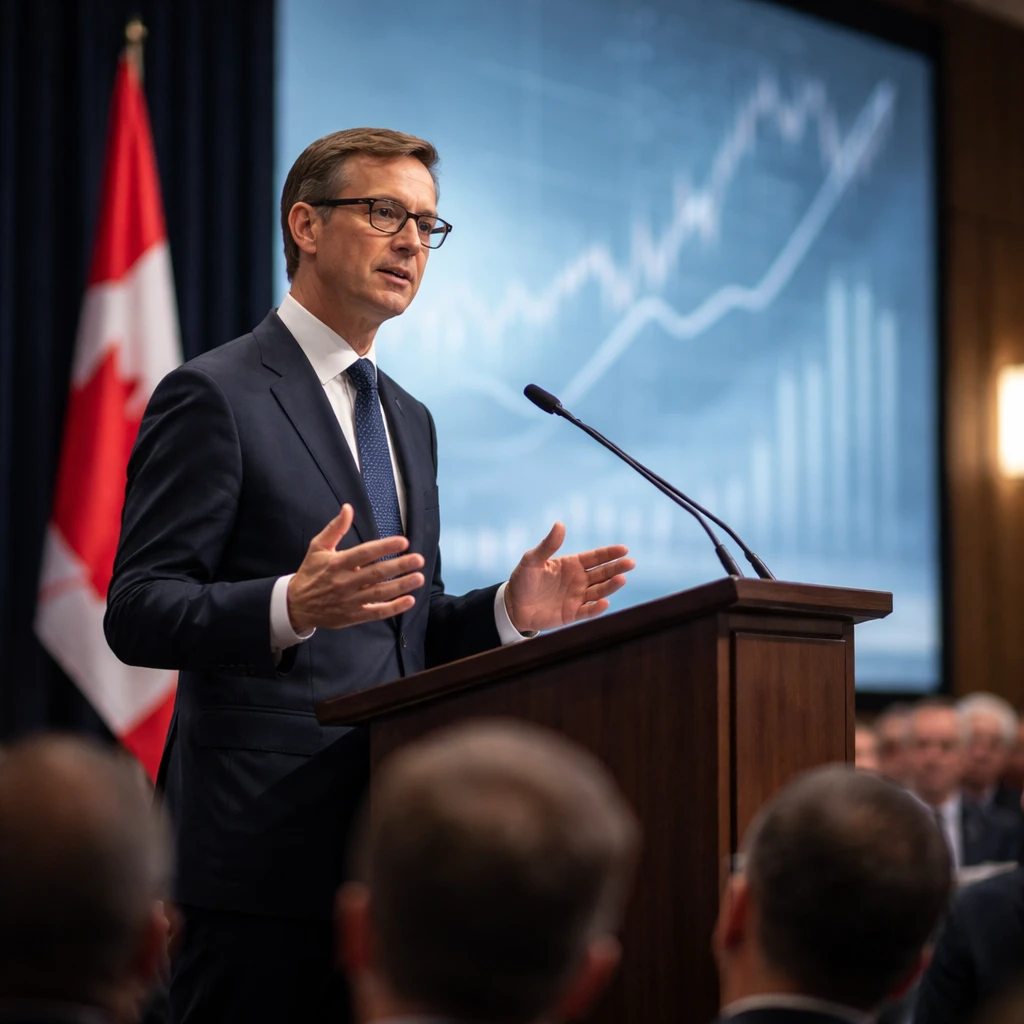
Bank of Canada Governor Tiff Macklem said Tuesday that Canadian inflation could finish the year below earlier projections, citing retreating crude oil prices and refinery margins, but he warned that lingering energy costs remain poised to spill over into broader consumer prices next year.
In remarks to the Economic Club of Canada in Toronto, Macklem noted that headline inflation has hovered near 3% since April and was previously projected in October to reach roughly 3.5% by year-end. While recent moderation in energy markets suggests that peak may be softer than anticipated, businesses that have largely absorbed elevated production and transport expenses since the spring are expected to pass those costs onto consumers over the coming year.
That risk of second-round price persistence, paired with firmer-than-expected domestic economic resilience, underpinned the central bank's decision last month to raise its benchmark interest rate by 25 basis points to 2.5%.
“Monetary policy can’t lower global energy prices. But it can limit how much they spill over,” Macklem said, underscoring the central bank's goal of preventing Middle East war-driven fuel shocks and U.S. trade tariffs from becoming entrenched across goods and services.
Against that backdrop, Macklem unveiled the central bank's five-year monetary policy framework renewal, reaffirming its 2% consumer price index target within a 1% to 3% control range. To navigate an environment increasingly defined by frequent supply shocks, the bank is sharpening its communications to emphasize total CPI while launching a new online inflation dashboard anchored by two primary core gauges: CPI-trim and CPIX.
Macklem acknowledged that policymakers were slow to recognize the breadth of post-pandemic price pressures in 2021, a surge that eventually drove Canadian inflation to a four-decade high of 8.1% in June 2022 and forced 475 basis points of rate increases. While the bank's credibility helped bring inflation down without triggering a recession, officials face renewed tension as U.S. tariffs weigh on growth at the same time supply disruptions push prices higher, creating what Macklem described as “the fundamental trade-off inflationary supply shocks create for monetary policy.”
Investors will look to the Bank of Canada's next policy decision in early December for further clarity on whether another rate increase is warranted. Meanwhile, the central bank's board of directors has initiated a search for Macklem's successor after the governor announced last week that he will step down when his seven-year term expires on June 2, 2027.