
Economy June 17, 2026 10:24 AM

EU chief says bloc will sign trade pact with India by year-end

Von der Leyen confirms formal signature to follow after G7 meeting with Modi; deal aims to cut tariffs across most goods and could take effect in 2027

By Avery Klein
Share
Twitter Reddit Facebook LinkedIn

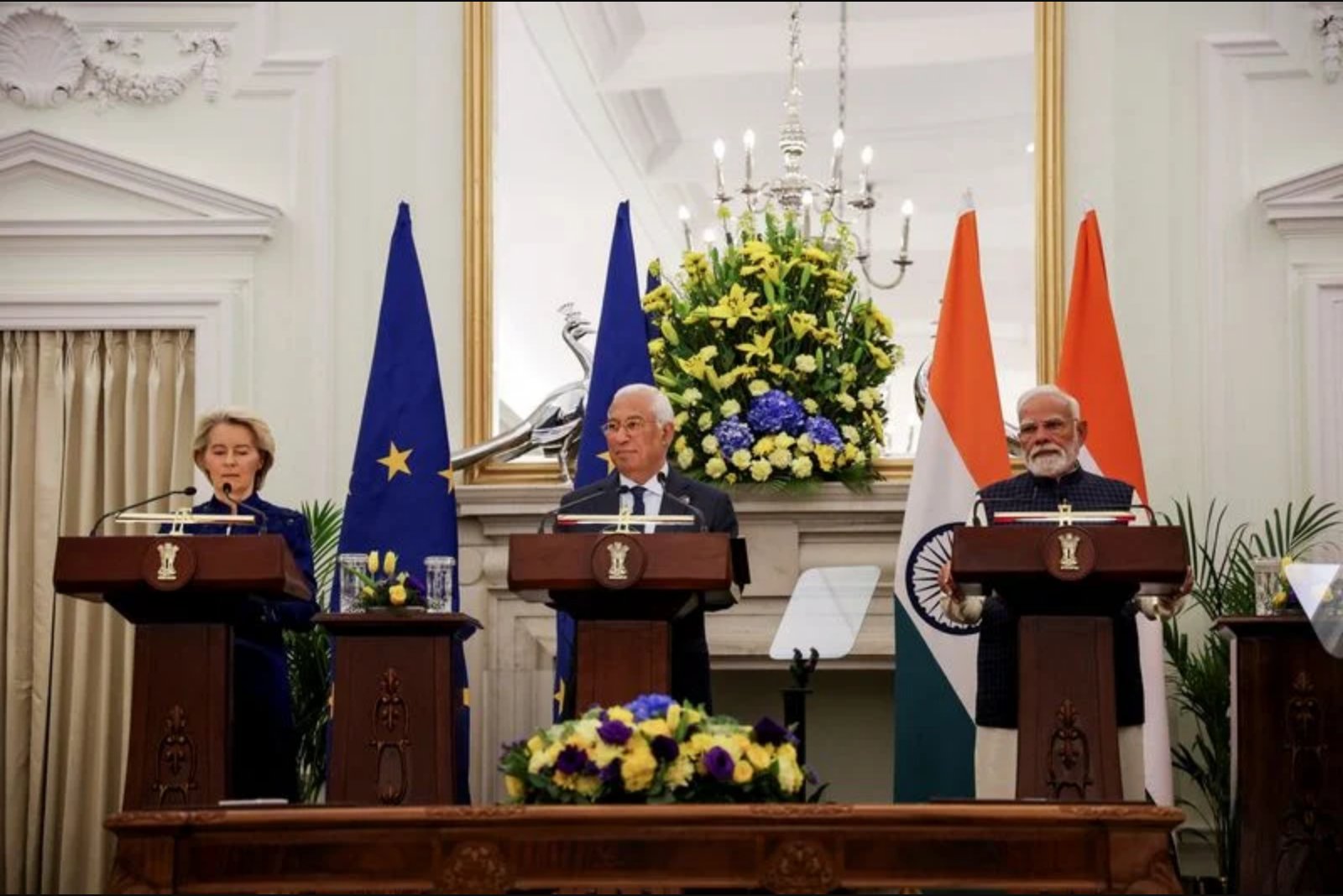
European Commission President Ursula von der Leyen said the European Union will formally sign its long‑awaited free trade agreement with India by the end of the year, following talks with Indian Prime Minister Narendra Modi at the G7 summit in France. The pact, struck in January, is designed to eliminate or reduce tariffs on the vast majority of traded goods and is forecast to double EU exports to India by 2032. Signing by year-end could allow the agreement to enter into force in 2027.

EU chief says bloc will sign trade pact with India by year-end
Summarize with
ChatGPT Perplexity Claude Grok Gemini

Key Points

  • EU President Ursula von der Leyen said the EU will sign the free trade agreement with India by the end of the year following a meeting with Prime Minister Narendra Modi at the G7 summit.
  • The January agreement would cut or remove tariffs on 96.6% of traded goods by value and is forecast to double EU exports to India by 2032, with estimated duty savings of 4 billion for European companies.
  • Signing the deal by year-end could enable it to enter into force in 2027; the pact is intended to boost two-way trade and reduce reliance on the U.S amid growing global trade tensions.

European Commission President Ursula von der Leyen said on Wednesday that the European Union intends to formally sign its landmark free trade agreement with India by the end of the year. The announcement came after von der Leyen met Indian Prime Minister Narendra Modi at the G7 summit in France.

Von der Leyen posted an update on X, noting that after the parties had "concluded the mother of all trade deals," they had been "moving fast to deliver on our commitments. We will sign the Free Trade Agreement by the end of the year."

The agreement, which negotiators reached in January after protracted talks, aims to cut tariffs on most goods traded between the EU and India. According to figures cited by the EU, the deal will eliminate or reduce tariffs on 96.6% of traded goods by value, and is forecast to double EU exports to India by 2032.

The EU has also estimated that the tariff changes will translate into duty savings of 4 billion for European companies, with an exchange rate reference noted as $1 = 0.8624 euros. Officials say that signing the pact by the end of the year could allow the agreement to enter into force in 2027.

Observers have described the deal as long-delayed and intended in part to boost two-way trade and reduce reliance on the U.S. amid rising global trade tensions. The statement from von der Leyen followed her bilateral discussions with Prime Minister Modi at the France summit.

Key procedural milestones remain implied by the timeline: a formal signature by year-end and, contingent on subsequent steps referenced by EU officials, a possible entry into force in 2027. The EUs figures on tariff coverage, export forecasts and projected duty savings were reiterated alongside von der Leyens confirmation of the year-end signing target.

As the parties move toward formalizing the deal, the stated objectives are to broaden market access through tariff reductions and to increase trade flows between the two economies over the coming decade.

Risks

  • Timing uncertainty - the announcement sets a target for a year-end signature, and officials indicate that further steps would be required for the deal to enter into force in 2027, leaving the final implementation date contingent on subsequent procedures.
  • Forecast risk - projected outcomes such as the doubling of EU exports to India by 2032 and the 4 billion in duty savings are forecasts cited by the EU and may depend on full implementation and other variables not detailed in the statement.
  • Political and procedural hurdles - the agreement was described as long-delayed, implying that future procedural or political steps could affect the timetable or the path to entry into force.

More from Economy

Banxico Deputy Governor Urges Keeping Policy Rate at 6.50% Amid Mixed Inflation Signals Jun 17, 2026 EU Opens Initial Diplomatic Channels with Kremlin, Official Says Jun 17, 2026 U.S. Total Crude Stocks Fall to Lowest Point Since March 1985 Jun 17, 2026 Trump Says U.S. and India Near Interim Trade Accord After G7 Talks; Calls Modi 'Very Tough' Jun 17, 2026 G7 forges coordinated plan to curb reliance on single suppliers for critical minerals Jun 17, 2026